
Charles Sumner: his complete works, volume 20 (of 20)
Charles Sumner
THE CLASSIC COLLECTION · 1874
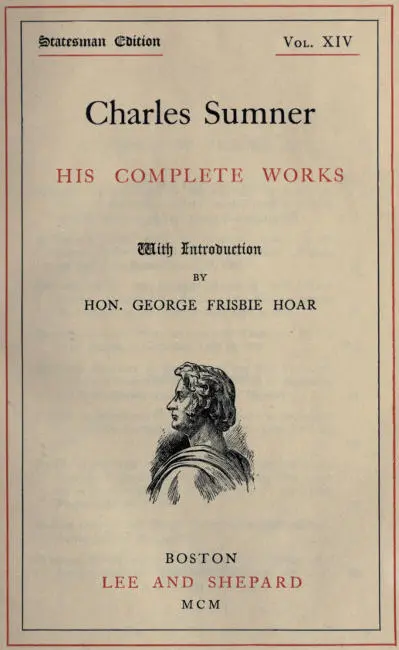
"Charles Sumner: His Complete Works, Volume 14 (of 20)" by Charles Sumner is a historical compilation written in the late 19th century. This volume contains a collection of speeches and writings of Charles Sumner, a prominent American politician and abolitionist, focusing on notable topics concerning justice, civil rights, and legislative practices during his time in the Senate. The topics highlight the pressing political issues and moral questions faced by the United States during the Reconstruction Era following the Civil War. The opening of this volume presents the context of Sumner's speeches in the Senate, beginning with a discussion on the contested election of Hon. John P. Stockton from New Jersey. Sumner argues against the legitimacy of a plurality vote in this election, emphasizing the importance of majority rule and drawing parallels to historical precedents from English parliamentary law. He asserts that the Constitution mandates senators be elected by a majority of votes, thus setting up his subsequent discussions on the principles of democracy and justice. Through a detailed analysis of the debate, Sumner showcases his commitment to lawful representation and the need for consistent application of democratic principles in governance.
Introduction adapted from the source catalogue; source summaries may be automatically generated.
Free to read · English · 96,771 words · No account needed
MAKE TIME FOR A GOOD BOOK
On by default. Untick to stop anonymous reading totals. Each page counts after 10 seconds in view. How this works.
Anonymous counting is on unless you have switched it off.
MR. SUMNER. Now it is proposed, for the first time, that the National Government shall intervene with its powerful aid. Are you ready to embark in that great undertaking? I do not say that you should not, for I am one who has never hesitated, and I do not mean hereafter to hesitate, in an appropriation for the good of any part of the country, if I can see that it is constitutional; and on the question of constitutionality I do not mean to be nice. I mean always to be generous in interpretation of the Constitution, and in appropriations for any such object; but I submit that Congress shall not in any respect pledge itself to this undertaking, involving such a lavish expenditure, except on the fundamental condition that the States where the money is to be invested shall be truly loyal and republican in form; and I insist that not one of those States can be such, except on the conditions stated in my amendment.
No vote was reached, and the joint resolution was never
considered again.
[1] Commentaries on American Law (4th edit.), Vol. I. p. 226.
[2] Stansbury, Report of the Trial of Judge Peck, Appendix, p. 499.
[3] Law and Practice of Legislative Assemblies in the United States (2d
edit.), § 126, p. 47.
[4] Law and Practice of Legislative Assemblies in the United States (2d edit.), Appendix, IV., p. 996.
[5] Savigny, System des heutigen Römischen Rechts, § 97, Band II. p.
329.
[6] Maxims, Reg. 3.
[7] Broom, Legal Maxims, (3d edit.,) p. 111.
[8] Broom, Legal Maxims, (3d edit.,) p. 116.
[9] Hobart, R., 86, 87.
[10] 8 Coke, R., 118.
[11] 12 Modern Reports, 687, 688.
[12] “Nec erit alia lex Romæ, alia Athenis, alia nunc, alia posthac; sed et omnes gentes et omni tempore una lex et sempiterna et immutabilis continebit, unusque erit communis quasi magister et imperator omnium deus.”--De Republica, Lib. III. c. 22.
[13] Rules and Orders of the House of Representatives: Rule 28 [29].
[14] May, Treatise on the Law, etc., of Parliament, (5th edit.,) p. 598.
[15] Dwarris, Treatise on Statutes, (2d edit.,) Part I. p. 220.
[16] Ibid.
[17] Dwarris, Treatise on Statutes, (2d edit.,) Part I. p. 245.
[18] Law and Practice of Legislative Assemblies (2d edit.), p. 711.
[19] Ibid., p. 713.
[20] Law and Practice of Legislative Assemblies (2d edit.), pp. 712,
713.
[21] History of His Own Times (fol. edit.), Vol. I. p. 485.
[22] Act of April 10, 1869: Statutes at Large, Vol. XVI. pp. 44, 45.
[23] Story, Commentaries on the Constitution, § 1573, Vol. III. pp.
437, seqq., note.
[24] Essays: Of Wisdom for a Man’s Self.
[25] Address on nominating Hon. Charles Abbot to the Speakership of the House of Commons, November 16, 1802: Hansard’s Parliamentary History, Vol. XXXVI. col. 915.
[26] Constitutional History of England (London, 1829), Vol. I. p. 358,
note.
[27] Ante, Vol. XII. pp. 312-314; Vol. XIII. pp. 57-60.
[28] Narrative, p. 265.
[29] Statutes at Large, Vol. XIV. p. 357.
[30] Act, March 2, 1833: Statutes at Large, Vol. IV. p. 654.
Your reading position is saved on this browser. Take it to another device with a library code. Reading pages adapt to text, rather than matching a printed edition.
Charles Sumner

Charles Sumner

Charles Sumner

Charles Sumner
BEHIND THE BOOK
This eBook is for the use of anyone anywhere in the United States and most other parts of the world at no cost and with almost no restrictions whatsoever. You may copy it, give it away or re-use it under the terms of the Project Gutenberg License included with this eBook or online at www.gutenberg.org. If you are not located in the United States, you will have to check the laws of the country where you are located before using this eBook. Read the source licence.
The original source file, including credits and licence, is retained by this library. Request an original-format copy at no charge. Please include the book title and Project Gutenberg identifier #50160.
KEEP YOUR CURIOSITY GOING

David Patterson (Spirit) Hatch

David Patterson (Spirit) Hatch

David Patterson (Spirit) Hatch
Cécile Tormay

Moritz Busch
John L. Ransom