
Charles Sumner: his complete works, volume 20 (of 20)
Charles Sumner
THE CLASSIC COLLECTION · 1874
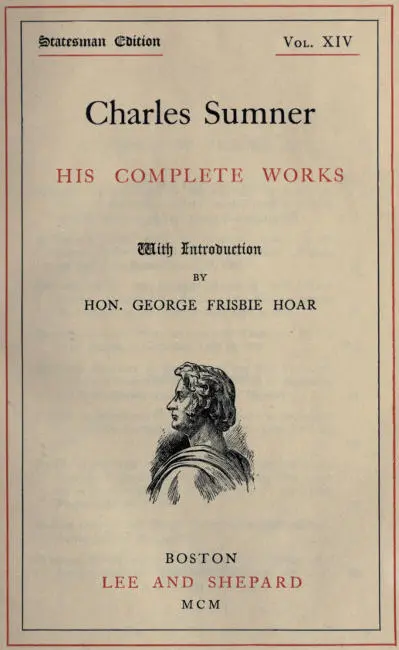
"Charles Sumner: His Complete Works, Volume 14 (of 20)" by Charles Sumner is a historical compilation written in the late 19th century. This volume contains a collection of speeches and writings of Charles Sumner, a prominent American politician and abolitionist, focusing on notable topics concerning justice, civil rights, and legislative practices during his time in the Senate. The topics highlight the pressing political issues and moral questions faced by the United States during the Reconstruction Era following the Civil War. The opening of this volume presents the context of Sumner's speeches in the Senate, beginning with a discussion on the contested election of Hon. John P. Stockton from New Jersey. Sumner argues against the legitimacy of a plurality vote in this election, emphasizing the importance of majority rule and drawing parallels to historical precedents from English parliamentary law. He asserts that the Constitution mandates senators be elected by a majority of votes, thus setting up his subsequent discussions on the principles of democracy and justice. Through a detailed analysis of the debate, Sumner showcases his commitment to lawful representation and the need for consistent application of democratic principles in governance.
Introduction adapted from the source catalogue; source summaries may be automatically generated.
Free to read · English · 96,771 words · No account needed
MAKE TIME FOR A GOOD BOOK
On by default. Untick to stop anonymous reading totals. Each page counts after 10 seconds in view. How this works.
Anonymous counting is on unless you have switched it off.
For instance, we may say met, ar, lit, and gram; and, in describing the denomination, we may say, in the ascending scale, dec, hec, kil, and in the descending scale, dec, cen, and mil,--indicating respectively 10, 100, 1000, and ⅒, ¹⁄₁₀₀ and ¹⁄₁₀₀₀. Compounding these, we should have, for example, kilmet, killit, kilgram, and cenmet, cenlit, cengram. These abbreviations might be substantially the same in all languages. They would preserve the characteristics of the unabridged terms, so that the simple mention of the measure, even in this abridged form, would disclose the proportion it bears to its fellow-measures. Previous measures have been represented by monosyllables, as grain, dram, gross, ounce, pound, stone, ton. Where a word is often repeated, in the hurry of business, it is instinctively abridged. We shall not err, if we profit by this experience, and seek to reduce the new nomenclature to its smallest proportions.
Twelve words only are required by this system. Learning these, you learn all. There are five designating the different units of length, surface, solid capacity, liquid capacity, and weight. Then there are the seven prefixes, being four in the ascending scale, expressing multiples, or augmentations, of the metre or other units, derived from the Greek, and three in the descending scale, expressing subdivisions, or diminutions, of the metre and other units, derived from the Latin. These twelve words contain the whole system.
In closing this chapter on the unquestionable advantages of the metric system, I must not forget that it is already the received system in the majority of countries. At the Statistical Congress assembled at Berlin in 1863, it appeared that it was adopted partly or entirely in Austria, Baden, Bavaria, Belgium, France, Hamburg, Hanover, Hesse, Mecklenburg, the Netherlands, Parma, Portugal, Sardinia, Saxony, Spain, Switzerland, Tuscany, the Two Sicilies, and Würtemberg. Since then, Great Britain, by an Act of Parliament, has added her name to this list. The first step is taken there by making the metric system permissive, as is proposed in the bills before Congress. The example of Great Britain is of especial importance to us, since the commercial relations between the two countries render it essential that these should have a common system of weights and measures. On this point we cannot afford to differ from each other.
Your reading position is saved on this browser. Take it to another device with a library code. Reading pages adapt to text, rather than matching a printed edition.
Charles Sumner

Charles Sumner

Charles Sumner

Charles Sumner
BEHIND THE BOOK
This eBook is for the use of anyone anywhere in the United States and most other parts of the world at no cost and with almost no restrictions whatsoever. You may copy it, give it away or re-use it under the terms of the Project Gutenberg License included with this eBook or online at www.gutenberg.org. If you are not located in the United States, you will have to check the laws of the country where you are located before using this eBook. Read the source licence.
The original source file, including credits and licence, is retained by this library. Request an original-format copy at no charge. Please include the book title and Project Gutenberg identifier #50160.
KEEP YOUR CURIOSITY GOING

David Patterson (Spirit) Hatch

David Patterson (Spirit) Hatch

David Patterson (Spirit) Hatch
Cécile Tormay

Moritz Busch
John L. Ransom