
Charles Sumner: his complete works, volume 20 (of 20)
Charles Sumner
THE CLASSIC COLLECTION · 1874
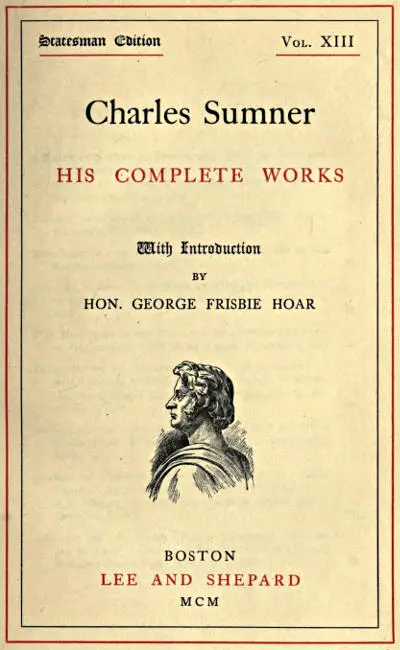
"Charles Sumner: His Complete Works, Volume 13" by Charles Sumner is a historical collection written in the late 19th century. This volume compiles a series of speeches and legislative proposals made by Sumner during a crucial period of American history, particularly focusing on Reconstruction and civil rights for the formerly enslaved population. It sheds light on significant political battles of the time, addressing issues such as suffrage for colored citizens, the reinstatement of a republican form of government, and the implications of the Constitutional amendment abolishing slavery. The opening of this volume sets the stage for a detailed exploration of legislative efforts and political discourses that took place in Congress beginning December 4, 1865. It outlines various bills and resolutions proposed by Sumner, aimed at securing rights and protections for freedmen and ensuring that state governments adhere to republican principles. For instance, Sumner advocates for laws to guarantee equal rights, protect jury trials for colored persons, and reinforce the constitutional amendments that abolish slavery. Additionally, it hints at the contentious political environment during this period, with references to resistance from President Johnson and the perilous conditions faced by both Sumner and African Americans as they strive for justice and equality.
Introduction adapted from the source catalogue; source summaries may be automatically generated.
Free to read · English · 108,941 words · No account needed
MAKE TIME FOR A GOOD BOOK
On by default. Untick to stop anonymous reading totals. Each page counts after 10 seconds in view. How this works.
Anonymous counting is on unless you have switched it off.
I next put aside the examples of history, as absolutely fallacious and inapplicable. In all ages, governments have been called Republics. Tacitus speaks of Rome under the tyranny of the Empire as the Republic; and Marcus Aurelius, while Emperor, pledges himself to the Republic. Indeed, there is hardly a government, from that of the great hunter Nimrod down to insulted and partitioned Poland, which has not been called Republic. In 1773, only a few years before the adoption of the National Constitution, Russia, Austria, and Prussia, after dividing Poland, undertook to establish fundamental laws for this conquered country, where was this declaration:--
“The government of Poland shall be forever free, independent, and of a republican form: the true principle of said government consisting in the strict execution of its laws, and the equilibrium of the three estates, namely, the king, the senate, and the equestrian order.”[65]
But a government thus composed cannot be recognized in this debate as “of a republican form.”
At the adoption of the Constitution, the most competent persons, who disagreed on other things, agreed in discarding these examples. Alexander Hamilton and John Adams met here on common ground. The former, in the Brief of his Argument, exhibits the various forms of government to which the term “Republic” has been applied.
“A Republic, a word used in various senses. Has been applied to aristocracies and monarchies. (1.) To Rome under the Kings. (2.) To Sparta, though a Senate for life. (3.) To Carthage, though the same. (4.) To United Netherlands, though Stadtholder, hereditary nobles. (5.) To Poland, though aristocracy and monarchy. (6.) To Great Britain, though monarchy, &c.”[66]
John Adams, in his Defence of the American Constitutions, written
immediately anterior to the National Constitution, concurs with
Hamilton.
“But, of all the words in all languages, perhaps there has been none so much abused in this way as the words Republic, Commonwealth, and Popular State. In the Rerum-Publicarum Collectio, of which there are fifty and odd volumes, and many of them very incorrect, France, Spain, and Portugal, the four great Empires, the Babylonian, Persian, Greek, and Roman, and even the Ottoman, are all denominated Republics.”[67]
In his old age the patriarch expressed himself in the same sense, and
with equal force.
“The customary meanings of the words Republic and Commonwealth have been infinite. They have been applied to every government under heaven: that of Turkey, and that of Spain, as well as that of Athens and of Rome, of Geneva and San Marino.”[68]
And then again he said:--
Your reading position is saved on this browser. Take it to another device with a library code. Reading pages adapt to text, rather than matching a printed edition.
Charles Sumner

Charles Sumner

Charles Sumner

Charles Sumner
BEHIND THE BOOK
This eBook is for the use of anyone anywhere in the United States and most other parts of the world at no cost and with almost no restrictions whatsoever. You may copy it, give it away or re-use it under the terms of the Project Gutenberg License included with this eBook or online at www.gutenberg.org. If you are not located in the United States, you will have to check the laws of the country where you are located before using this eBook. Read the source licence.
The original source file, including credits and licence, is retained by this library. Request an original-format copy at no charge. Please include the book title and Project Gutenberg identifier #50159.
KEEP YOUR CURIOSITY GOING

David Patterson (Spirit) Hatch

David Patterson (Spirit) Hatch

David Patterson (Spirit) Hatch
Cécile Tormay

Moritz Busch
John L. Ransom