
Charles Sumner: his complete works, volume 20 (of 20)
Charles Sumner
THE CLASSIC COLLECTION · 1874
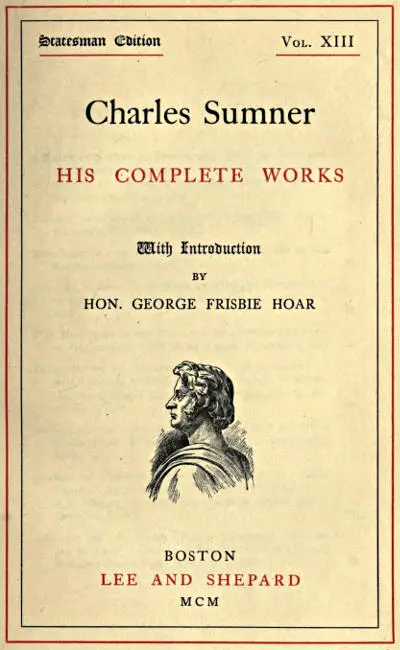
"Charles Sumner: His Complete Works, Volume 13" by Charles Sumner is a historical collection written in the late 19th century. This volume compiles a series of speeches and legislative proposals made by Sumner during a crucial period of American history, particularly focusing on Reconstruction and civil rights for the formerly enslaved population. It sheds light on significant political battles of the time, addressing issues such as suffrage for colored citizens, the reinstatement of a republican form of government, and the implications of the Constitutional amendment abolishing slavery. The opening of this volume sets the stage for a detailed exploration of legislative efforts and political discourses that took place in Congress beginning December 4, 1865. It outlines various bills and resolutions proposed by Sumner, aimed at securing rights and protections for freedmen and ensuring that state governments adhere to republican principles. For instance, Sumner advocates for laws to guarantee equal rights, protect jury trials for colored persons, and reinforce the constitutional amendments that abolish slavery. Additionally, it hints at the contentious political environment during this period, with references to resistance from President Johnson and the perilous conditions faced by both Sumner and African Americans as they strive for justice and equality.
Introduction adapted from the source catalogue; source summaries may be automatically generated.
Free to read · English · 108,941 words · No account needed
MAKE TIME FOR A GOOD BOOK
On by default. Untick to stop anonymous reading totals. Each page counts after 10 seconds in view. How this works.
Anonymous counting is on unless you have switched it off.
Debate ensued for four days, in which Mr. Morrill, Mr. Willey, of West Virginia, Mr. Wilson, of Massachusetts, Mr. Pomeroy, of Kansas, Mr. Anthony, of Rhode Island, Mr. Williams, of Oregon, Mr. Cowan, of Pennsylvania, Mr. Wade, of Ohio, Mr. Yates, of Illinois, Mr. Reverdy Johnson, of Maryland, Mr. Gratz Brown, of Missouri, Mr. Davis, of Kentucky, Mr. Sprague, of Rhode Island, Mr. Buckalew, of Pennsylvania, Mr. Doolittle, of Wisconsin, Mr. Dixon, of Connecticut, Mr. Saulsbury, of Delaware, Mr. Foster, of Connecticut, Mr. Frelinghuysen, of New Jersey, Mr. Hendricks, of Indiana, Mr. Lane, of Indiana, and Mr. Sumner, took part. The remarks of the last will appear in their proper place, according to date.[2] Among the amendments considered was one by Mr. Cowan to strike out the word “male,” so as to open suffrage to women, which was rejected,--Yeas 9, Nays 37. The amendment by Mr. Dixon, making reading and writing a qualification, was also rejected,--Yeas 11, Nays 34.
December 13th, the bill passed the Senate,--Yeas 32, Nays 13. The announcement of its passage was followed by applause in the galleries. On the next day the bill passed the other House,--Yeas 128, Nays 46.
January 7, 1867, the bill passed the Senate over the veto of President Johnson, by a two-thirds vote,--Yeas 29, Nays 10. On the next day it passed the other House by a two-thirds vote,--Yeas 113, Nays 38. And so it became a law, and also a model for similar legislation in the reconstruction of the Rebel States.
A Bill to preserve the right of trial by jury, by securing impartial jurors in the Courts of the United States.
Be it enacted by the Senate and House of Representatives of the United States of America in Congress assembled, That in the courts of the United States in any State, whereof, according to the census Anno Domini eighteen hundred and sixty, one sixth part or more of the population was of African descent, every grand jury shall consist one half of persons of African descent who shall possess the other qualifications now required by law; and when the matter to be tried relates to any injury inflicted by a person of African descent upon a person not of such descent, or vice versa, or to any claim, suit, or demand between a person of such descent and one not of such descent, every petit jury shall consist one half of persons of African descent possessing the other qualifications now required by law. Upon any such trial, prejudice against persons of African descent, or against persons not of such descent, shall be ground of challenge, and, being established by proof, to the satisfaction of the judge, shall exclude the juror. And upon any such trial, inability to read or write shall be ground of challenge, and, the fact being found by the judge, shall exclude the juror.
Your reading position is saved on this browser. Take it to another device with a library code. Reading pages adapt to text, rather than matching a printed edition.
Charles Sumner

Charles Sumner

Charles Sumner

Charles Sumner
BEHIND THE BOOK
This eBook is for the use of anyone anywhere in the United States and most other parts of the world at no cost and with almost no restrictions whatsoever. You may copy it, give it away or re-use it under the terms of the Project Gutenberg License included with this eBook or online at www.gutenberg.org. If you are not located in the United States, you will have to check the laws of the country where you are located before using this eBook. Read the source licence.
The original source file, including credits and licence, is retained by this library. Request an original-format copy at no charge. Please include the book title and Project Gutenberg identifier #50159.
KEEP YOUR CURIOSITY GOING

David Patterson (Spirit) Hatch

David Patterson (Spirit) Hatch

David Patterson (Spirit) Hatch
Cécile Tormay

Moritz Busch
John L. Ransom