
Charles Sumner: his complete works, volume 20 (of 20)
Charles Sumner
THE CLASSIC COLLECTION · 1874
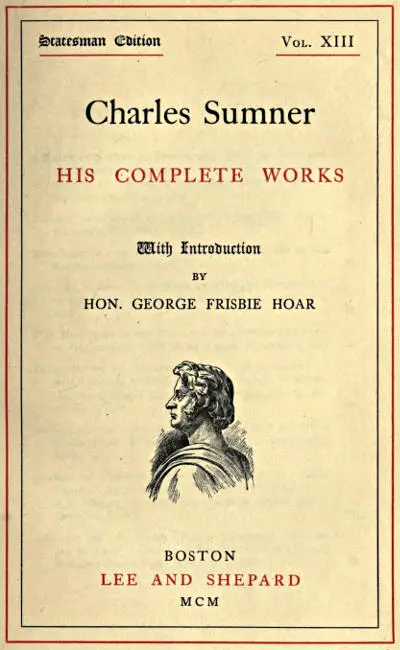
"Charles Sumner: His Complete Works, Volume 13" by Charles Sumner is a historical collection written in the late 19th century. This volume compiles a series of speeches and legislative proposals made by Sumner during a crucial period of American history, particularly focusing on Reconstruction and civil rights for the formerly enslaved population. It sheds light on significant political battles of the time, addressing issues such as suffrage for colored citizens, the reinstatement of a republican form of government, and the implications of the Constitutional amendment abolishing slavery. The opening of this volume sets the stage for a detailed exploration of legislative efforts and political discourses that took place in Congress beginning December 4, 1865. It outlines various bills and resolutions proposed by Sumner, aimed at securing rights and protections for freedmen and ensuring that state governments adhere to republican principles. For instance, Sumner advocates for laws to guarantee equal rights, protect jury trials for colored persons, and reinforce the constitutional amendments that abolish slavery. Additionally, it hints at the contentious political environment during this period, with references to resistance from President Johnson and the perilous conditions faced by both Sumner and African Americans as they strive for justice and equality.
Introduction adapted from the source catalogue; source summaries may be automatically generated.
Free to read · English · 108,941 words · No account needed
MAKE TIME FOR A GOOD BOOK
On by default. Untick to stop anonymous reading totals. Each page counts after 10 seconds in view. How this works.
Anonymous counting is on unless you have switched it off.
[8] This same oath appears in another bill, introduced by Mr. Sumner on the same day, entitled “A Bill prescribing an oath to maintain a republican form of government in the Rebel States”; this oath to be taken by every person in any State lately declared to be in rebellion, before he shall be allowed to vote at any election, State or National, or before he shall enter upon the duties of any office, State or National, or become entitled to the salary or other emoluments thereof. See, ante, p. 12.
[9] Statutes at Large, Vol. XII. pp. 255-258.
[10] The Senate Chamber.
[11] Mr. Butler.
[12] Congressional Globe, 34th Cong. 1st Sess., p. 640, March 12, 1856.
[13] See the engraving of Retzsch.
[14] Ante, Vol. XI. p. 365: Speech of Mr. Sumner on the Recognition of Arkansas, June 13, 1864.
[15] First Inaugural Address, March 4, 1801: Writings, Vol. VIII. p. 4.
[16] Act of July 13, 1861: Statutes at Large, Vol. XII. pp. 255-258.
[17] Congressional Globe, 38th Cong. 2d Sess., February 4, 1865, p. 591.
[18] Horne, Commentary on the Psalms: Ps. xi. 3.
[19] See, ante, p. 42.
[20] Executive Documents, 39th Cong. 1st Sess., Senate, No. 1, pp.
2-105.
[21] Burke, Letter to Henry Dundas, April 9, 1792: Works (Boston,
1865-67), Vol. VI. p. 261.
[22] Ante, Vol. XII. pp. 312-314.
[23] Affranchissement des Serfs: Traduction des Documents Officiels, Résumés Explicatifs et Annotations (St. Petersburg, 1861).
[24] Constitution of Massachusetts, Declaration of Rights, drawn by
John Adams.
[25] Ante, p. 17.
[26] Ante, p. 14.
[27] Post, pp. 136, seqq.
[28] Letters from New Orleans, October, 1865: Nation, October 26, 1865,
Vol. I. pp. 523, 524.
[29] He had already united with President Johnson in his “policy.”
[30] Act to establish and regulate the Domestic Relations of Persons of Color, etc., Sec. XVII. [Approved December 21, 1865.]
[31] Ibid., Sections L., LII., LIII.
[32] Later evidence showed that this hope was without foundation.
[33] Senate Journal, 1865-66, p. 151.
[34] Code of Tennessee, § 3808.
[35] Statutes at Large, Vol. XIV. p. 50.
[36] The Necessity of Universal Suffrage in Reconstruction; Letter to the Editor of the New York Nation, October, 1865: Speeches and Addresses, pp. 585-596.
[37] Speech in the House of Commons, on the Address of Thanks, December 13, 1792: Hansard’s Parliamentary History, Vol. XXX. col. 13.
[38] Ante, p. 14.
[39] Post, p. 123.
[40] Debates in the Federal Convention, August 25, 1787: Madison Papers, Vol. III. pp. 1429, 1430.
[41] Act to protect all Persons in the United States in their Civil Rights, and furnish the Means of their Vindication. It passed the Senate February 2d, and became a law, notwithstanding the veto of President Johnson, April 9th.--Statutes at Large, Vol. XIV. p. 27.
[42] Andrew Fletcher of Saltoun: Characters, prefixed to Political Works, (Glasgow, 1749,) p. viii.
[43] Ante, p. 113.
[44] Ante, Vol. X. p. 167, Our Domestic Relations, Power of Congress over the Rebel States; Vol. XII. p. 305, The National Security and the National Faith. See, also, Vol. IX. p. 1, Rights of Sovereignty and Rights of War.
Your reading position is saved on this browser. Take it to another device with a library code. Reading pages adapt to text, rather than matching a printed edition.
Charles Sumner

Charles Sumner

Charles Sumner

Charles Sumner
BEHIND THE BOOK
This eBook is for the use of anyone anywhere in the United States and most other parts of the world at no cost and with almost no restrictions whatsoever. You may copy it, give it away or re-use it under the terms of the Project Gutenberg License included with this eBook or online at www.gutenberg.org. If you are not located in the United States, you will have to check the laws of the country where you are located before using this eBook. Read the source licence.
The original source file, including credits and licence, is retained by this library. Request an original-format copy at no charge. Please include the book title and Project Gutenberg identifier #50159.
KEEP YOUR CURIOSITY GOING

David Patterson (Spirit) Hatch

David Patterson (Spirit) Hatch

David Patterson (Spirit) Hatch
Cécile Tormay

Moritz Busch
John L. Ransom