
Charles Sumner: his complete works, volume 20 (of 20)
Charles Sumner
THE CLASSIC COLLECTION · 1874
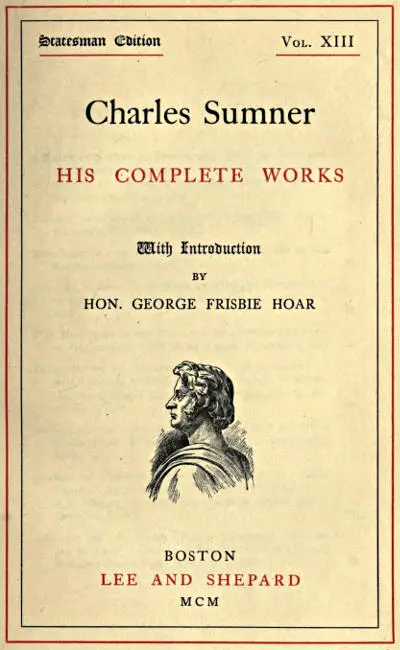
"Charles Sumner: His Complete Works, Volume 13" by Charles Sumner is a historical collection written in the late 19th century. This volume compiles a series of speeches and legislative proposals made by Sumner during a crucial period of American history, particularly focusing on Reconstruction and civil rights for the formerly enslaved population. It sheds light on significant political battles of the time, addressing issues such as suffrage for colored citizens, the reinstatement of a republican form of government, and the implications of the Constitutional amendment abolishing slavery. The opening of this volume sets the stage for a detailed exploration of legislative efforts and political discourses that took place in Congress beginning December 4, 1865. It outlines various bills and resolutions proposed by Sumner, aimed at securing rights and protections for freedmen and ensuring that state governments adhere to republican principles. For instance, Sumner advocates for laws to guarantee equal rights, protect jury trials for colored persons, and reinforce the constitutional amendments that abolish slavery. Additionally, it hints at the contentious political environment during this period, with references to resistance from President Johnson and the perilous conditions faced by both Sumner and African Americans as they strive for justice and equality.
Introduction adapted from the source catalogue; source summaries may be automatically generated.
Free to read · English · 108,941 words · No account needed
MAKE TIME FOR A GOOD BOOK
On by default. Untick to stop anonymous reading totals. Each page counts after 10 seconds in view. How this works.
Anonymous counting is on unless you have switched it off.
Possibly a question may arise as to the effect of such a fundamental condition. I do not think there can be any question. I do not doubt that such a fundamental condition, especially if sanctioned by the popular vote according to the terms of the proviso, will be absolutely obligatory on the State. I believe that you may apply to it the language of Mr. Webster’s great speech in reply to Mr. Hayne, where, describing and vindicating the Ordinance for the government of the Northwest Territory, he used this very striking, and, to my mind, exquisitely beautiful language, as simple as it is expressive:--
“It laid the interdict against personal servitude in original compact, not only deeper than all local law, but deeper also than all local constitutions.”[274]
Now, Sir, I call upon the Senate to do for this far Western Territory the same in kind as was done by our fathers for the whole vast Northwest Territory,--to lay an interdict against all inequality of rights in original compact, not only deeper than all local law, but deeper than all local constitutions. Let that be done, and one of the objections to the admission of Colorado will be removed.
Mr. Stewart, of Nevada, followed Mr. Sumner.
March 13th, the debate was resumed, when Mr. Pomeroy, of Kansas, Mr. Lane, of Kansas, Mr. McDougall, of California, Mr. Trumbull, of Illinois, Mr. Cragin, of New Hampshire, Mr. Ramsey, of Minnesota, and Mr. Williams, of Oregon, spoke for the admission; Mr. Saulsbury, of Delaware, Mr. Grimes, of Iowa, Mr. Hendricks, of Indiana, Mr. Wade, of Ohio, Mr. Doolittle, of Wisconsin, and Mr. Conness, of California, spoke against the admission. The chief topics were the Enabling Act and the want of population. In the course of the debate, Mr. Sumner insisted that the population had diminished, and then said:--
But, unhappily, this is not the only way in which this community has fallen,--fallen in population, as my friend says,--fallen, as I shall proceed to show positively, in another respect, far more important than population.
He then showed[275] that the Legislative Assembly of the Territory, at its first session under the organic act, by an act approved November 6, 1861, had provided “that every male person” with qualification of residence should be deemed a qualified voter; but that was amended by another act, approved March 11, 1864, by inserting the words “not being a negro or mulatto,” which reappeared in the limitation of the constitution before the Senate. He then said:--
Your reading position is saved on this browser. Take it to another device with a library code. Reading pages adapt to text, rather than matching a printed edition.
Charles Sumner

Charles Sumner

Charles Sumner

Charles Sumner
BEHIND THE BOOK
This eBook is for the use of anyone anywhere in the United States and most other parts of the world at no cost and with almost no restrictions whatsoever. You may copy it, give it away or re-use it under the terms of the Project Gutenberg License included with this eBook or online at www.gutenberg.org. If you are not located in the United States, you will have to check the laws of the country where you are located before using this eBook. Read the source licence.
The original source file, including credits and licence, is retained by this library. Request an original-format copy at no charge. Please include the book title and Project Gutenberg identifier #50159.
KEEP YOUR CURIOSITY GOING

David Patterson (Spirit) Hatch

David Patterson (Spirit) Hatch

David Patterson (Spirit) Hatch
Cécile Tormay

Moritz Busch
John L. Ransom