
Charles Sumner: his complete works, volume 20 (of 20)
Charles Sumner
THE CLASSIC COLLECTION · 1874
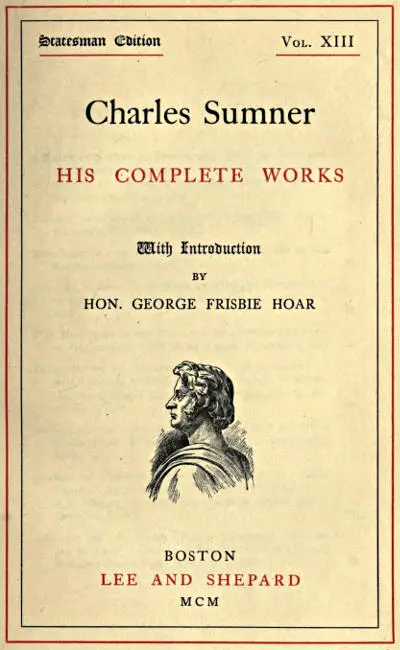
"Charles Sumner: His Complete Works, Volume 13" by Charles Sumner is a historical collection written in the late 19th century. This volume compiles a series of speeches and legislative proposals made by Sumner during a crucial period of American history, particularly focusing on Reconstruction and civil rights for the formerly enslaved population. It sheds light on significant political battles of the time, addressing issues such as suffrage for colored citizens, the reinstatement of a republican form of government, and the implications of the Constitutional amendment abolishing slavery. The opening of this volume sets the stage for a detailed exploration of legislative efforts and political discourses that took place in Congress beginning December 4, 1865. It outlines various bills and resolutions proposed by Sumner, aimed at securing rights and protections for freedmen and ensuring that state governments adhere to republican principles. For instance, Sumner advocates for laws to guarantee equal rights, protect jury trials for colored persons, and reinforce the constitutional amendments that abolish slavery. Additionally, it hints at the contentious political environment during this period, with references to resistance from President Johnson and the perilous conditions faced by both Sumner and African Americans as they strive for justice and equality.
Introduction adapted from the source catalogue; source summaries may be automatically generated.
Free to read · English · 108,941 words · No account needed
MAKE TIME FOR A GOOD BOOK
On by default. Untick to stop anonymous reading totals. Each page counts after 10 seconds in view. How this works.
Anonymous counting is on unless you have switched it off.
This series of propositions attracted the attention of the country. Expressions of sympathy and gratitude were abundant. Colored fellow-citizens at Philadelphia addressed Mr. Sumner in earnest words.
“PHILADELPHIA, PA., December 6, 1865.
“DEAR SIR,--At a large and enthusiastic meeting of the colored citizens of this city, held in the Philadelphia Institute this evening, the undersigned were charged with the duty of conveying to you, in behalf of twenty-five thousand disfranchised Americans here, their most heartfelt gratitude for the noble, fearless, patriotic stand taken by you at the opening of the present Congress. No day of our lives seems brighter than that upon which the foremost champion of Freedom boldly directs the attention of the nation to a series of clear, sound, statesmanlike measures looking to the complete enfranchisement of America.
“We speak but faintly, though truthfully, when we say that four millions of Americans will ever cherish with the warmest gratitude of their hearts, and hand down as a precious legacy to their children, the name of Charles Sumner,--Charles Sumner, who has at all times and under all circumstances, even when friends faltered and foes exulted, stood firm, unflinching, immovable, uncompromising, on the rock of Justice and Liberty.
“God bless the Christian gentleman and scholar, the ablest of American statesmen! God bless the noble, spotless man, Charles Sumner! is the fervent prayer of four millions of disfranchised Americans, not less than of
“Yours, admiringly and sincerely,
Parker Pillsbury, the devoted Abolitionist, wrote at once from the office of the Antislavery Standard, in New York:--
“No need of many words to-day. Your openings yesterday were sublime,--a genuine Apocalypse! God grant it be but the key-note to the grandest oratorio ever performed by less than the morning stars and all the sons of God shouting together!”
Rev. Joshua Leavitt, an editor of the New York Independent, and a constant Abolitionist of great practical sense, wrote from New York:--
“We look to you to forbear when necessary, and to dare when
the time is right.”
William Lloyd Garrison, an honored leader in the long warfare with Slavery, who had just returned from a lecture tour in the West as far as the Mississippi, wrote from Boston:--
“I have found but one opinion, whether the test was made publicly or privately, in regard to that questio vexata, Reconstruction,--and that is, that not one of the revolted States should be admitted into the Union without being put under a longer probation.… Thanks for your prompt action and untiring vigilance in this matter, in the series of resolutions presented by you to the Senate.”
Your reading position is saved on this browser. Take it to another device with a library code. Reading pages adapt to text, rather than matching a printed edition.
Charles Sumner

Charles Sumner

Charles Sumner

Charles Sumner
BEHIND THE BOOK
This eBook is for the use of anyone anywhere in the United States and most other parts of the world at no cost and with almost no restrictions whatsoever. You may copy it, give it away or re-use it under the terms of the Project Gutenberg License included with this eBook or online at www.gutenberg.org. If you are not located in the United States, you will have to check the laws of the country where you are located before using this eBook. Read the source licence.
The original source file, including credits and licence, is retained by this library. Request an original-format copy at no charge. Please include the book title and Project Gutenberg identifier #50159.
KEEP YOUR CURIOSITY GOING

David Patterson (Spirit) Hatch

David Patterson (Spirit) Hatch

David Patterson (Spirit) Hatch
Cécile Tormay

Moritz Busch
John L. Ransom