
Charles Sumner: his complete works, volume 20 (of 20)
Charles Sumner
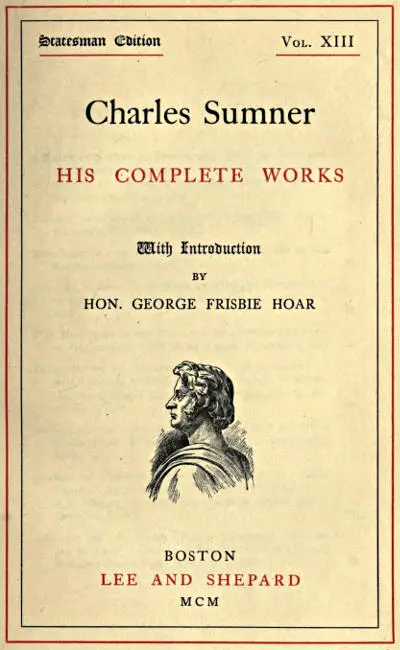
THE CLASSIC COLLECTION · 1874
"Charles Sumner: His Complete Works, Volume 13" by Charles Sumner is a historical collection written in the late 19th century. This volume compiles a series of speeches and legislative proposals made by Sumner during a crucial period of American history, particularly focusing on Reconstruction and civil rights for the formerly enslaved population. It sheds light on significant political battles of the time, addressing issues such as suffrage for colored citizens, the reinstatement of a republican form of government, and the implications of the Constitutional amendment abolishing slavery. The opening of this volume sets the stage for a detailed exploration of legislative efforts and political discourses that took place in Congress beginning December 4, 1865. It outlines various bills and resolutions proposed by Sumner, aimed at securing rights and protections for freedmen and ensuring that state governments adhere to republican principles. For instance, Sumner advocates for laws to guarantee equal rights, protect jury trials for colored persons, and reinforce the constitutional amendments that abolish slavery. Additionally, it hints at the contentious political environment during this period, with references to resistance from President Johnson and the perilous conditions faced by both Sumner and African Americans as they strive for justice and equality.
Introduction adapted from the source catalogue; source summaries may be automatically generated.
Free to read · English · 108,941 words · No account needed
MAKE TIME FOR A GOOD BOOK
On by default. Untick to stop anonymous reading totals. Each page counts after 10 seconds in view. How this works.
Anonymous counting is on unless you have switched it off.
“Your masterly speech will one day be reached by Congress and the people,--I trust, in your day and mine. The best minds believe in it; the best hearts take courage from it.”
Hon. E. L. Pierce, afterwards Secretary of the Board of Charities in Massachusetts, wrote from Boston:--
“I read last evening, at one session, your last speech in the Senate. It is a noble one, and right in all respects. One passage near the close reminds me of the famous passages of Curran and Brougham about Freedom. I agree with you about the proposed Amendment.”
Thomas Sherwin, head master of the Boston High School, father of General Sherwin, and a tutor of Mr. Sumner at Harvard College, wrote from Dedham:--
“Allow me, as an old friend, to congratulate you and to thank you for your noble speech in the Senate on the 5th. I obtained it last evening, and read the whole before I slept. In humanity of sentiment, in true patriotism, in completeness of argument, in fulness of illustration, you have left nothing to be desired.
“This Reconstruction is, indeed, a momentous affair, and I feel a greater doubt of its just determination than I felt for that of arms while the war raged.”
Rev. John T. Sargent, always swift to sympathize with Mr.
Sumner, wrote from Boston:--
“It is emphatically the speech of the time and crisis, absorbing, superseding, and transcending every other. God bless you for these timely words! They ought to be widely circulated, and reprinted in every corner of our land, East, West, North, and South.”
Rev. George C. Beckwith, Congregational clergyman, and Secretary of the American Peace Society, wrote from Boston:--
“Nothing but the constant feeling that you are constantly overtasked has kept me from writing you on several occasions. I will only just say now, that I owe you a thousand thanks for the great and noble services you are rendering. God give you strength and life and full opportunity to complete your work!”
Rev. R. S. Storrs, the eminent Congregational clergyman, wrote
from Braintree:--
“I am sure that I express but the common sentiment of the people all about me, when I say that your own course meets with more than a hearty approval, even admiration and gratitude. May God give you wisdom and firmness equal to the emergency, and crown your arduous labors with the success they deserve!”
E. E. Williamson, one of the earnest men of Massachusetts,
wrote from Boston:--
Your reading position is saved on this browser. Take it to another device with a library code. Reading pages adapt to text, rather than matching a printed edition.
Charles Sumner

Charles Sumner

Charles Sumner

Charles Sumner
BEHIND THE BOOK
This eBook is for the use of anyone anywhere in the United States and most other parts of the world at no cost and with almost no restrictions whatsoever. You may copy it, give it away or re-use it under the terms of the Project Gutenberg License included with this eBook or online at www.gutenberg.org. If you are not located in the United States, you will have to check the laws of the country where you are located before using this eBook. Read the source licence.
The original source file, including credits and licence, is retained by this library. Request an original-format copy at no charge. Please include the book title and Project Gutenberg identifier #50159.
KEEP YOUR CURIOSITY GOING

David Patterson (Spirit) Hatch

David Patterson (Spirit) Hatch

David Patterson (Spirit) Hatch
Cécile Tormay

Moritz Busch
John L. Ransom