
Charles Sumner: his complete works, volume 20 (of 20)
Charles Sumner
THE CLASSIC COLLECTION · 1874
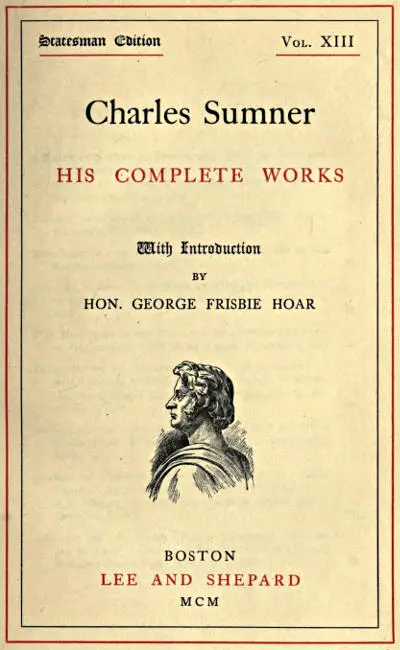
"Charles Sumner: His Complete Works, Volume 13" by Charles Sumner is a historical collection written in the late 19th century. This volume compiles a series of speeches and legislative proposals made by Sumner during a crucial period of American history, particularly focusing on Reconstruction and civil rights for the formerly enslaved population. It sheds light on significant political battles of the time, addressing issues such as suffrage for colored citizens, the reinstatement of a republican form of government, and the implications of the Constitutional amendment abolishing slavery. The opening of this volume sets the stage for a detailed exploration of legislative efforts and political discourses that took place in Congress beginning December 4, 1865. It outlines various bills and resolutions proposed by Sumner, aimed at securing rights and protections for freedmen and ensuring that state governments adhere to republican principles. For instance, Sumner advocates for laws to guarantee equal rights, protect jury trials for colored persons, and reinforce the constitutional amendments that abolish slavery. Additionally, it hints at the contentious political environment during this period, with references to resistance from President Johnson and the perilous conditions faced by both Sumner and African Americans as they strive for justice and equality.
Introduction adapted from the source catalogue; source summaries may be automatically generated.
Free to read · English · 108,941 words · No account needed
MAKE TIME FOR A GOOD BOOK
On by default. Untick to stop anonymous reading totals. Each page counts after 10 seconds in view. How this works.
Anonymous counting is on unless you have switched it off.
March 7th, Mr. Sumner spoke at length in reply to Mr. Fessenden and others who had opposed his substitute. This speech appears in the present volume, according to its date.[199] He was followed by his colleague, Mr. Wilson, who was strenuous for the House Amendment.
“Mr. President, there are indications, not to be mistaken, that this Amendment is doomed to defeat. To me this result will be a subject of sincere and profound regret. My heart, my conscience, and my judgment approve of this Amendment, and I support it without qualification or reservation.”
March 9th, Mr. Fessenden spoke again, criticizing especially
Mr. Yates and Mr. Sumner.
Mr. Sumner followed Mr. Fessenden in a brief reply, which will
be found under its date.[200]
Mr. Wilson declared again his adhesion to the pending Amendment, saying: “I would go to the scaffold joyfully before the sun goes down, if I could put this proposed Amendment into the Constitution of my country; for, if it were there, there would be but one result and one end to it, and that is the enfranchisement of every black man within the bounds of the United States.”
The voting then commenced on the various substitutes for the Amendment adopted by the House of Representatives.
First came the counter proposition of Mr. Sumner, altered, in conformity with the original draught,[201] so as to be applicable only to States that had lapsed, being “lately declared to be in rebellion,” without republican government.
Mr. Henderson moved to strike out all of the counter proposition, and in lieu of it insert a Constitutional Amendment securing the suffrage to colored citizens:--
“ARTICLE 14. No State, in prescribing the qualifications requisite for electors therein, shall discriminate against any person on account of color or race.”
Mr. Henderson felt obliged to move his amendment as a substitute for the counter proposition of Mr. Sumner in order to compel a vote upon it.
Mr. Sumner stated that he was for this proposition, and that he should vote for it, and, on its failure, press his own.
The question, being taken by yeas and nays on Mr. Henderson’s amendment, resulted--Yeas 10, Nays 37--as follows:--
YEAS,--Messrs. Brown, Chandler, Clark, Henderson, Howe, Pomeroy, Sumner, Wade, Wilson, and Yates.
NAYS,--Messrs. Anthony, Buckalew, Conness, Cowan, Cragin, Creswell, Davis, Dixon, Doolittle, Fessenden, Foster, Grimes, Guthrie, Harris, Hendricks, Johnson, Kirkwood, Lane of Indiana, Lane of Kansas, McDougall, Morgan, Morrill, Nesmith, Norton, Nye, Poland, Ramsey, Riddle, Saulsbury, Sherman, Sprague, Stewart, Stockton, Trumbull, Van Winkle, Willey, and Williams.
ABSENT,--Messrs. Foot, Howard, and Wright.
So the amendment to the amendment was rejected.
Your reading position is saved on this browser. Take it to another device with a library code. Reading pages adapt to text, rather than matching a printed edition.
Charles Sumner

Charles Sumner

Charles Sumner

Charles Sumner
BEHIND THE BOOK
This eBook is for the use of anyone anywhere in the United States and most other parts of the world at no cost and with almost no restrictions whatsoever. You may copy it, give it away or re-use it under the terms of the Project Gutenberg License included with this eBook or online at www.gutenberg.org. If you are not located in the United States, you will have to check the laws of the country where you are located before using this eBook. Read the source licence.
The original source file, including credits and licence, is retained by this library. Request an original-format copy at no charge. Please include the book title and Project Gutenberg identifier #50159.
KEEP YOUR CURIOSITY GOING

David Patterson (Spirit) Hatch

David Patterson (Spirit) Hatch

David Patterson (Spirit) Hatch
Cécile Tormay

Moritz Busch
John L. Ransom