
Charles Sumner: his complete works, volume 20 (of 20)
Charles Sumner
THE CLASSIC COLLECTION · 1874
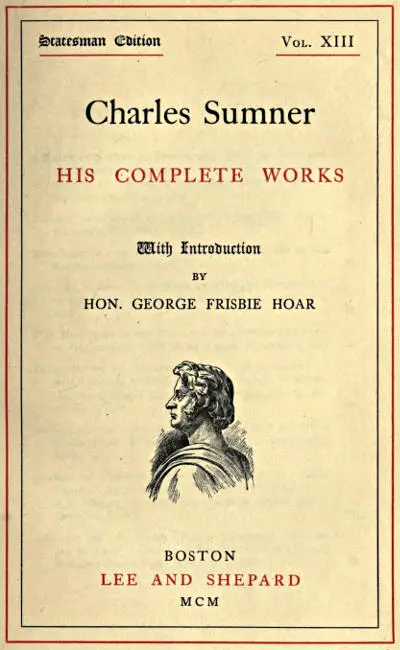
"Charles Sumner: His Complete Works, Volume 13" by Charles Sumner is a historical collection written in the late 19th century. This volume compiles a series of speeches and legislative proposals made by Sumner during a crucial period of American history, particularly focusing on Reconstruction and civil rights for the formerly enslaved population. It sheds light on significant political battles of the time, addressing issues such as suffrage for colored citizens, the reinstatement of a republican form of government, and the implications of the Constitutional amendment abolishing slavery. The opening of this volume sets the stage for a detailed exploration of legislative efforts and political discourses that took place in Congress beginning December 4, 1865. It outlines various bills and resolutions proposed by Sumner, aimed at securing rights and protections for freedmen and ensuring that state governments adhere to republican principles. For instance, Sumner advocates for laws to guarantee equal rights, protect jury trials for colored persons, and reinforce the constitutional amendments that abolish slavery. Additionally, it hints at the contentious political environment during this period, with references to resistance from President Johnson and the perilous conditions faced by both Sumner and African Americans as they strive for justice and equality.
Introduction adapted from the source catalogue; source summaries may be automatically generated.
Free to read · English · 108,941 words · No account needed
MAKE TIME FOR A GOOD BOOK
On by default. Untick to stop anonymous reading totals. Each page counts after 10 seconds in view. How this works.
Anonymous counting is on unless you have switched it off.
A resolution of Congress in April, 1783, seconded by the report of a Grand Committee, of which Mr. Jefferson was Chairman, in April, 1784, recommended an Amendment of the Articles of Confederation, whereby the war expenses should be apportioned among the several States according to “the whole number of white and other free citizens and inhabitants,”--thus positively embracing colored persons. In the Act for the Temporary Government of the Territory “ceded or to be ceded” to the United States, April 23, 1784, and drawn by Jefferson, the voters are declared to be the “free males of full age,” without distinction of color. In the famous Ordinance for the Government of the Northwestern Territory, drawn by Nathan Dane, of Massachusetts, adopted by the Confederation July 13, 1787, and then reënacted by our Congress after the adoption of the Constitution, the voters are declared to be “free male inhabitants of full age,”--again without distinction of color. Then came successive Acts of Congress for the government of Territories, where the rule in the Ordinance for the Northwestern Territory was followed, and there was no distinction of color. If this rule changed, it was only when the partakers in the Revolution and the authors of the Constitution ceased to exercise influence over public affairs. The testimony of the Fathers was constant, and it is only of this that I speak.
Turning from the States collectively, and looking at them individually, we find the same testimony. By the Constitution of New Hampshire, at the adoption of the National Constitution, the suffrage was vested in “every male inhabitant of each town and parish,” with certain qualifications, but without exclusion on account of color. By the Constitution of Massachusetts the suffrage was vested in “every male inhabitant,” with certain specified qualifications, but without distinction of color. Rhode Island, at the adoption of the Constitution, was under her original colonial charter, which provided for elections by “the major part of the freemen of the respective towns or places,” without distinction of color. Connecticut was likewise under her original colonial charter, which also provided for elections by “the major part of the freemen of the respective towns, cities, and places,” without distinction of color. By the Constitution of New York the suffrage was vested in “every male inhabitant of full age,” with certain specified qualifications, but without distinction of color. By the Constitution of New Jersey it was vested in “all inhabitants of this Colony of full age,” with certain specified qualifications, but without distinction of color. By the Constitution of Pennsylvania it was vested in “every freeman of the full age of twenty-one years,” with certain specified qualifications, but without distinction of color. By the Declaration of Rights prefixed to the Constitution of Delaware it was announced that “every freeman, having sufficient evidence of a permanent common interest with and attachment to the community, hath a right of suffrage,” without distinction of color; and in the Constitution the suffrage was vested in “the freemen and inhabitants of the respective counties,” with certain specified exceptions, but without distinction of color. By the Constitution of Maryland the suffrage was vested in “all freemen above twenty-one years of age,” with certain specified qualifications, but without distinction of color. By the Constitution of North Carolina the suffrage was vested in “all freemen of the age of twenty-one years,” with certain specified qualifications, but without distinction of color; and this rule continued down to 1836, when the Constitution was amended, or rather, let me say, perverted. That eminent citizen, Judge Gaston, of North Carolina, in giving judgment at a later day, said: “It is a matter of universal notoriety, that free persons, without regard to color, claimed and exercised the franchise.”[157] To these States I add Tennessee, which was carved out of North Carolina, and followed her benign example. Her Constitution, adopted in 1796, vested the suffrage in “every freeman of the age of twenty-one years,” with certain qualifications, but without distinction of color; and this rule continued down to the perversion of the Constitution in 1834. Mr. Cave Johnson, of Tennessee, once Postmaster General, is reported to have said that he was originally elected to Congress by the votes of colored persons, and I have heard Mr. John Bell make the same confession with regard to himself.
Your reading position is saved on this browser. Take it to another device with a library code. Reading pages adapt to text, rather than matching a printed edition.
Charles Sumner

Charles Sumner

Charles Sumner

Charles Sumner
BEHIND THE BOOK
This eBook is for the use of anyone anywhere in the United States and most other parts of the world at no cost and with almost no restrictions whatsoever. You may copy it, give it away or re-use it under the terms of the Project Gutenberg License included with this eBook or online at www.gutenberg.org. If you are not located in the United States, you will have to check the laws of the country where you are located before using this eBook. Read the source licence.
The original source file, including credits and licence, is retained by this library. Request an original-format copy at no charge. Please include the book title and Project Gutenberg identifier #50159.
KEEP YOUR CURIOSITY GOING

David Patterson (Spirit) Hatch

David Patterson (Spirit) Hatch

David Patterson (Spirit) Hatch
Cécile Tormay

Moritz Busch
John L. Ransom