
Charles Sumner: his complete works, volume 20 (of 20)
Charles Sumner
THE CLASSIC COLLECTION · 1874
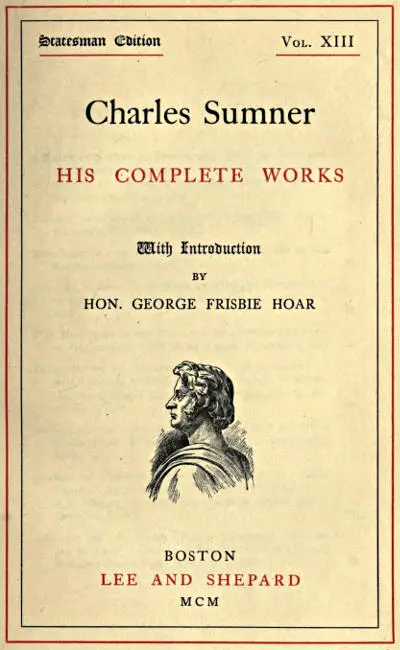
"Charles Sumner: His Complete Works, Volume 13" by Charles Sumner is a historical collection written in the late 19th century. This volume compiles a series of speeches and legislative proposals made by Sumner during a crucial period of American history, particularly focusing on Reconstruction and civil rights for the formerly enslaved population. It sheds light on significant political battles of the time, addressing issues such as suffrage for colored citizens, the reinstatement of a republican form of government, and the implications of the Constitutional amendment abolishing slavery. The opening of this volume sets the stage for a detailed exploration of legislative efforts and political discourses that took place in Congress beginning December 4, 1865. It outlines various bills and resolutions proposed by Sumner, aimed at securing rights and protections for freedmen and ensuring that state governments adhere to republican principles. For instance, Sumner advocates for laws to guarantee equal rights, protect jury trials for colored persons, and reinforce the constitutional amendments that abolish slavery. Additionally, it hints at the contentious political environment during this period, with references to resistance from President Johnson and the perilous conditions faced by both Sumner and African Americans as they strive for justice and equality.
Introduction adapted from the source catalogue; source summaries may be automatically generated.
Free to read · English · 108,941 words · No account needed
MAKE TIME FOR A GOOD BOOK
On by default. Untick to stop anonymous reading totals. Each page counts after 10 seconds in view. How this works.
Anonymous counting is on unless you have switched it off.
The cause of Human Liberty, in this great controversy, found voice in James Otis, a young lawyer of eloquence, learning, and courage, whose early words, like the notes of the morning bugle mingling with the dawn, awakened the whole country. Asked by the merchants of Boston to speak at the bar against Writs of Assistance, issued to enforce ancient Acts of Parliament, he spoke both as lawyer and as patriot, and so doing became a statesman. His speech was the most important, down to that occasion, ever made on this side of the ocean. An earnest contemporary, who was present, says, “No harangue of Demosthenes or Cicero ever had such effects upon this globe as that speech.”[93] It was the harbinger of a new era. For five hours the brilliant orator unfolded the character of these Acts of Parliament; for five hours he held the court-room in rapt and astonished admiration; but his effort ascended into statesmanship, when, after showing that the colonists were without representation in Parliament, he cried out, that, notwithstanding this exclusion, Parliament had undertaken to “impose taxes, and enormous taxes, burdensome taxes, oppressive, ruinous, intolerable taxes”; and then, glowing with generous indignation at this injustice, he launched that thunderbolt of political truth, “Taxation without representation is Tyranny.”[94] From the narrow court-room where he spoke, the thunderbolt passed, smiting and blasting the intolerable pretension. It was the idea of John Locke; but the fervid orator, with tongue of flame, gave to it the intensity of his own genius. He found it in a book of philosophy; but he sent it forth a winged messenger blazing in the sky.
John Adams, then a young man just admitted to the bar, was present at the scene, and he dwells on it often with sympathetic delight. There, in the Old Town-House of Boston, sat the five judges of the Province, with Hutchinson as Chief Justice, in robes of scarlet, cambric bands, and judicial wigs; and there, too, in gowns, bands, and tie-wigs, were the barristers. Conspicuous on the wall were full-length portraits of two British monarchs, Charles the Second and James the Second, while in the corners were the likenesses of Massachusetts Governors. In this presence the great oration was delivered. The patriot lawyer had refused compensation. “In such a cause as this,” said he, “I despise a fee.” He spoke for country and for mankind. Firmly he planted himself on the Rights of Man, which he insisted were, by the everlasting Law of Nature, inherent and inalienable; and these rights, he nobly proclaimed, were common to all, without distinction of color. To suppose them surrendered in any other way than by equal rules and general consent was to suppose men idiot or mad, whose acts are not binding. But he especially flew at two arguments of tyranny: first, that the colonists were “virtually” represented, and, secondly, that there was such a difference between direct and indirect taxation, that, while the former might be questionable, the latter was not. To these two apologies he replied, first, that no such phrase as “virtual representation” was known in Law or Constitution,--that it is altogether subtilty and illusion, wholly unfounded and absurd,--and that we must not be cheated by any such phantom, or other fiction of law or politics, or any monkish trick of deceit and hypocrisy; and then, with the same crushing force, he said, that, in absence of representation, all taxation, whether direct or indirect, whether internal or external, whether on land or trade, was equally obnoxious to the same unhesitating condemnation.[95] The effect was electric. The judges were stunned into silence, and postponed judgment. The people were aroused to a frenzy of patriotism. “American Independence,” says John Adams, in the record of his impressions, “was then and there born; the seeds of patriots and heroes were then and there sown, to defend the vigorous youth. Every man of a crowded audience appeared to me to go away, as I did, ready to take arms against Writs of Assistance. Then and there was the first scene of the first act of opposition to the arbitrary claims of Great Britain. Then and there the child Independence was born.”[96] But this great birth is inseparably associated with the principle, then and there declared, that “Taxation without representation is Tyranny.”
Your reading position is saved on this browser. Take it to another device with a library code. Reading pages adapt to text, rather than matching a printed edition.
Charles Sumner

Charles Sumner

Charles Sumner

Charles Sumner
BEHIND THE BOOK
This eBook is for the use of anyone anywhere in the United States and most other parts of the world at no cost and with almost no restrictions whatsoever. You may copy it, give it away or re-use it under the terms of the Project Gutenberg License included with this eBook or online at www.gutenberg.org. If you are not located in the United States, you will have to check the laws of the country where you are located before using this eBook. Read the source licence.
The original source file, including credits and licence, is retained by this library. Request an original-format copy at no charge. Please include the book title and Project Gutenberg identifier #50159.
KEEP YOUR CURIOSITY GOING

David Patterson (Spirit) Hatch

David Patterson (Spirit) Hatch

David Patterson (Spirit) Hatch
Cécile Tormay

Moritz Busch
John L. Ransom