
Charles Sumner: his complete works, volume 20 (of 20)
Charles Sumner
THE CLASSIC COLLECTION · 1874
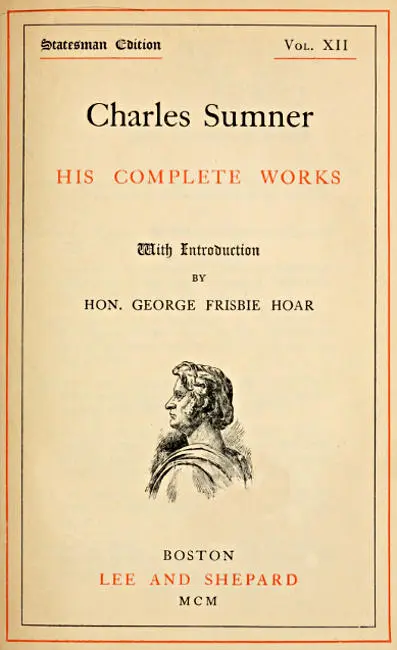
"Charles Sumner: His Complete Works, Volume 12 (of 20)" by Charles Sumner is a collection of political speeches and letters written during the mid-19th century. This volume centers on significant events and themes surrounding the American Civil War, including Reconstruction, emancipation, and the political battles of the time, particularly in relation to slavery and civil rights. Readers can expect to engage with powerful rhetoric and ideas that influenced the shaping of modern American political discourse. The opening of this volume presents multiple pieces, beginning with Sumner's speech delivered at a public meeting celebrating the victory of Abraham Lincoln in the 1864 presidential election. He joyfully proclaims this outcome as a monumental shift towards liberty and the end of slavery, portraying the Democratic party as corrupt and traitorous for its association with the rebellion. Following this, Sumner expresses his admiration for fellow politician James M. Ashley, discusses the case of the Florida war-steamer captured in Brazilian waters, and reflects on the need for justice and civil rights for freedmen. These excerpts establish both the urgency and optimism of the era, highlighting Sumner's strong commitment to liberty, justice, and the struggles faced by marginalized groups in the pursuit of equality.
Introduction adapted from the source catalogue; source summaries may be automatically generated.
Free to read · English · 117,723 words · No account needed
MAKE TIME FOR A GOOD BOOK
On by default. Untick to stop anonymous reading totals. Each page counts after 10 seconds in view. How this works.
Anonymous counting is on unless you have switched it off.
In the Senate, February 6, 1865, Mr. Sumner submitted the following Amendment to the Constitution, which, on his motion, was referred to the Committee on the Judiciary.
Representatives shall be apportioned among the several States which may be included within this Union according to the number of male citizens of age having in each State the qualifications requisite for electors of the most numerous branch of the State Legislature. The actual enumeration of such citizens shall be made by the census of the United States.
This Amendment was a first attempt to meet the new exigency from the abolition of Slavery. One of two alternatives was open: the extension of suffrage to the new-made freedmen by the action of Congress, which Mr. Sumner insisted was the just course; or the apportionment of Representatives according to voters, which would make it for the interest of a State to extend the franchise. Without one of these measures the political power of the former slave-masters would be enlarged by Emancipation.
This subject occupied much attention at the next session of
Congress.
April 25, 1864, Mr. Sumner asked, and by unanimous consent obtained, leave to bring in the following joint resolution, which was read twice, and referred to the Committee on Military Affairs.
“A Joint Resolution to facilitate commercial, postal, and military communication among the several States.
“Whereas the Constitution of the United States confers upon Congress, in express terms, the power to regulate commerce among the several States, to establish post-roads, and to raise and support armies: Therefore,
“Resolved by the Senate and House of Representatives of the United States of America in Congress assembled, That every railroad company in the United States, whose road is operated by steam, its successors and assigns, be, and is hereby, authorized to carry upon and over its road, connections, boats, bridges, and ferries, all freight, property, mails, passengers, troops, and Government supplies, on their way from any State to any other State, and to receive compensation therefor.”
May 12th, Mr. Wilson, of Massachusetts, from the Committee,
reported it without amendment.
Meanwhile the House of Representatives had under consideration a bill to declare certain roads military roads and post-roads, and to regulate commerce, which was much debated, when, on motion of Mr. Wilson, of Iowa, Mr. Sumner’s joint resolution, without the preamble, and with the title, “A Bill to regulate commerce among the several States,” was adopted as a substitute, and the bill thus amended passed the House,--Yeas 63, Nays 58.
Your reading position is saved on this browser. Take it to another device with a library code. Reading pages adapt to text, rather than matching a printed edition.
Charles Sumner

Charles Sumner

Charles Sumner

Charles Sumner
BEHIND THE BOOK
This eBook is for the use of anyone anywhere in the United States and most other parts of the world at no cost and with almost no restrictions whatsoever. You may copy it, give it away or re-use it under the terms of the Project Gutenberg License included with this eBook or online at www.gutenberg.org. If you are not located in the United States, you will have to check the laws of the country where you are located before using this eBook. Read the source licence.
The original source file, including credits and licence, is retained by this library. Request an original-format copy at no charge. Please include the book title and Project Gutenberg identifier #49789.
KEEP YOUR CURIOSITY GOING

David Patterson (Spirit) Hatch

David Patterson (Spirit) Hatch

David Patterson (Spirit) Hatch
Cécile Tormay

Moritz Busch
John L. Ransom