
Charles Sumner: his complete works, volume 20 (of 20)
Charles Sumner
THE CLASSIC COLLECTION · 1874
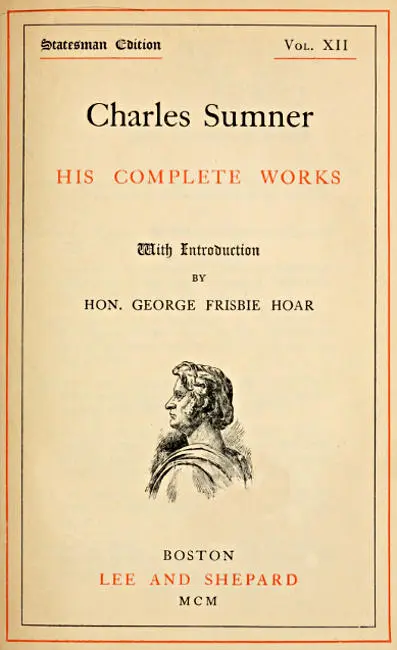
"Charles Sumner: His Complete Works, Volume 12 (of 20)" by Charles Sumner is a collection of political speeches and letters written during the mid-19th century. This volume centers on significant events and themes surrounding the American Civil War, including Reconstruction, emancipation, and the political battles of the time, particularly in relation to slavery and civil rights. Readers can expect to engage with powerful rhetoric and ideas that influenced the shaping of modern American political discourse. The opening of this volume presents multiple pieces, beginning with Sumner's speech delivered at a public meeting celebrating the victory of Abraham Lincoln in the 1864 presidential election. He joyfully proclaims this outcome as a monumental shift towards liberty and the end of slavery, portraying the Democratic party as corrupt and traitorous for its association with the rebellion. Following this, Sumner expresses his admiration for fellow politician James M. Ashley, discusses the case of the Florida war-steamer captured in Brazilian waters, and reflects on the need for justice and civil rights for freedmen. These excerpts establish both the urgency and optimism of the era, highlighting Sumner's strong commitment to liberty, justice, and the struggles faced by marginalized groups in the pursuit of equality.
Introduction adapted from the source catalogue; source summaries may be automatically generated.
Free to read · English · 117,723 words · No account needed
MAKE TIME FOR A GOOD BOOK
On by default. Untick to stop anonymous reading totals. Each page counts after 10 seconds in view. How this works.
Anonymous counting is on unless you have switched it off.
“Of course, the admission of a colored lawyer to the bar of the Supreme Court would make it difficult for any restriction on account of color to be maintained anywhere. Street cars would be open afterwards.[63]
“Ever yours,
The following note, written in pencil, and sent to Mr. Sumner at his seat in the Senate, was the prompt answer:--
“SUPREME COURT ROOM, December 21, 1864.
“DEAR SUMNER,--I will confer with the Judges on Saturday, which is consultation day. It is not likely that any, or any serious, objection will be made.
“Yours faithfully,
Not hearing from the Chief Justice, Mr. Sumner sent the
following reminder:--
“In re John S. Rock, Counsellor at Law, Massachusetts.
“What say you?
“Senate Chamber, Thursday, 15th January, 1865.”
This was returned with the following reply, written in pencil
on the same paper:--
“Nothing at present,--except not forgotten.
Another note, written also in pencil, opened the door.
“January 23, 1865.
“DEAR SUMNER,--You can make your motion for Mr. Rock’s admission at any time which suits your convenience.
“Yours ever,
Mr. Rock, who was waiting in Boston, appeared February 1st, and was at once presented by Mr. Sumner. The few formal words which passed on this occasion are not without interest.
As soon as the judges had taken their seats, Mr. Sumner rose, and, with Mr. Rock standing by his side, said:--
I ask leave to present John S. Rock, Esq., a Counsellor at Law of the Supreme Court of Massachusetts, and now move that he be admitted as a Counsellor of this Court.
The Chief Justice bowed, and said:--
“Let him come forward and take the oath.”
The oath was then administered by Mr. Middleton, Clerk of the Court. At the same time, on motion of Mr. Sumner, Francis V. Balch, Esq., of Boston, his private secretary, was also admitted.
This incident, marking a stage in the battle for Equal Rights, was extensively noticed at home and abroad. It occurred on the day after the final passage in the House of Representatives of the Constitutional Amendment abolishing Slavery, and the correspondent of the Boston Journal remarked the association of the two events.
“The Slave Power, which received its constitutional death-blow yesterday in Congress, writhes this morning on account of the admission of a colored lawyer, John S. Rock, of Boston, as a member of the bar of the Supreme Court of the United States.… The rage depicted in the countenances of some of the old Hunkers present at this invasion of their citadel beggars description.”
Your reading position is saved on this browser. Take it to another device with a library code. Reading pages adapt to text, rather than matching a printed edition.
Charles Sumner

Charles Sumner

Charles Sumner

Charles Sumner
BEHIND THE BOOK
This eBook is for the use of anyone anywhere in the United States and most other parts of the world at no cost and with almost no restrictions whatsoever. You may copy it, give it away or re-use it under the terms of the Project Gutenberg License included with this eBook or online at www.gutenberg.org. If you are not located in the United States, you will have to check the laws of the country where you are located before using this eBook. Read the source licence.
The original source file, including credits and licence, is retained by this library. Request an original-format copy at no charge. Please include the book title and Project Gutenberg identifier #49789.
KEEP YOUR CURIOSITY GOING

David Patterson (Spirit) Hatch

David Patterson (Spirit) Hatch

David Patterson (Spirit) Hatch
Cécile Tormay

Moritz Busch
John L. Ransom