
Charles Sumner: his complete works, volume 20 (of 20)
Charles Sumner
THE CLASSIC COLLECTION · 1874
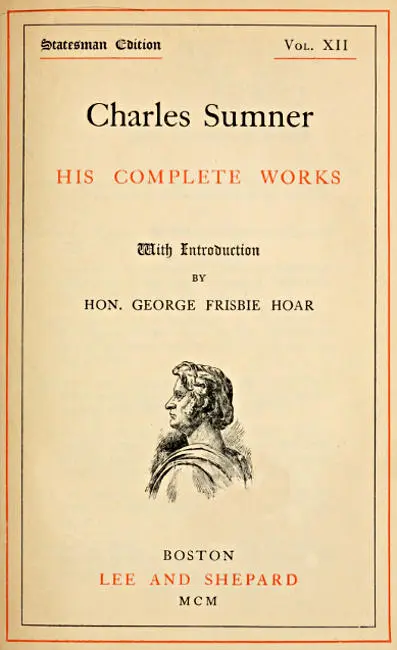
"Charles Sumner: His Complete Works, Volume 12 (of 20)" by Charles Sumner is a collection of political speeches and letters written during the mid-19th century. This volume centers on significant events and themes surrounding the American Civil War, including Reconstruction, emancipation, and the political battles of the time, particularly in relation to slavery and civil rights. Readers can expect to engage with powerful rhetoric and ideas that influenced the shaping of modern American political discourse. The opening of this volume presents multiple pieces, beginning with Sumner's speech delivered at a public meeting celebrating the victory of Abraham Lincoln in the 1864 presidential election. He joyfully proclaims this outcome as a monumental shift towards liberty and the end of slavery, portraying the Democratic party as corrupt and traitorous for its association with the rebellion. Following this, Sumner expresses his admiration for fellow politician James M. Ashley, discusses the case of the Florida war-steamer captured in Brazilian waters, and reflects on the need for justice and civil rights for freedmen. These excerpts establish both the urgency and optimism of the era, highlighting Sumner's strong commitment to liberty, justice, and the struggles faced by marginalized groups in the pursuit of equality.
Introduction adapted from the source catalogue; source summaries may be automatically generated.
Free to read · English · 117,723 words · No account needed
MAKE TIME FOR A GOOD BOOK
On by default. Untick to stop anonymous reading totals. Each page counts after 10 seconds in view. How this works.
Anonymous counting is on unless you have switched it off.
[313] Graesse, in his Trésor de Livres Rares, which ought to be accurate, makes a strange mistake in calling Gualterus “Episcopus Insulanus.” He was never more than canon, and held no post at Lille. Fabricius entitles him simply “Magister Philippus Gualterus de Castellione, Insulanus.” (Bib. Lat. Mediæ et Infimæ Ætatis, Tom. III. p. 328.) See also Wright’s Early Mysteries and other Latin Poems of the Twelfth and Thirteenth Centuries, Preface, p. xviii.
[314] It is pleasant to call this magnificent library National.
[315] Histoire Littéraire, Tom. XV. p. 101.
[316] Édélestand du Méril, Poésies Populaires Latines du Moyen Age, pp. 144-163. Wright, Latin Poems commonly attributed to Walter Mapes.
[317] Historia Poetarum et Poematum Medii Ævi, pp. 367-763.
[318] Histoire Littéraire, Tom. XVI. p. 183.
[319] Poésies Populaires Latines du Moyen Age, pp. 149, 150.
[320] Millin, Magazin Encyclopédique, Tom. II. p. 51.
[321] Michaud, Biographie Universelle, nom. GAULTIER.
[322] Recherches de la France, Liv. III. ch. 29: Œuvres, Tom. I. col.
276.
[323] Warton, History of English Poetry, Vol. I. p. clxix, Dissertation
II.
[324] Ibid., p. cxlvi.
[325] “Veterem Islandicam versionem Alexandreïdos Gualterianæ, incomparabile antiquitatis septentrionalis monumentum.”--FABRICIUS, Bibliotheca Latina, (Venetiis, 1728), Tom. II. p. 256, Lib. IV. c. 2, § 3.
[326] Fabricius, Bib. Lat. Mediæ et Infimæ Ætatis (Hamburgi, 1735), Tom. III. p. 328. Leyser, Historia Poetarum et Poematum Medii Ævi, p. 765.
[327] Histoire Littéraire, Tom. XV. p. 118.
[328] Papillon, Traité Historique et Pratique de la Gravure en Bois, Tom. I. p. 84. Ottley, History of Engraving, Vol. I. pp. 10-21, 255.
[329] Warton, History of English Poetry, Vol. I. p. clxix.
[330] Madox, History of the Exchequer (London, 1769), Vol. I. p. 377.
[331] Book III. 323.
[332] The Monk’s Tale: Alexander.
[333] Observations on English Metre: Works (London, 1843), Vol. V. p.
258, note.
[334] Warton, History of English Poetry, Vol. I. pp. 133, 134.
[335] Poema de Alexandro Magno, Coplas 190, 275, 342, 387; also Prólogo, § 38: Sanchez, Coleccion de Poesias Castellanas anteriores al Siglo XV. (Madrid, 1782), Tom. III.
[336] Lib. I. 249.
[337] Vossius (De Poetis Latinis, Cap. VI.) is mistaken in saying that it had nine books, instead of ten. See also Menagiana, Tom. I. p. 174.
[338] Lib. I. 11-15.
[339] Lib. V. 87.
[340] Lib. III. 237.
[341] Lib. I. 352.
[342] Inferno, Canto XXXIII. 89.
[343] Lib. III. 157. This is the passage translated into blank verse by the early English poet, Nicholas Grimoald. See Ritson, Bibliographia Poetica, p. 228.
[344] Lib. III. 389, 390. There is a contemporary poem in leonine verses on the death of Thomas à Becket, with the same allusion to opposite dangers:--
“Ut post Syrtes mittitur in Charybdim navis,
…
Flatibus et fluctibus transitis tranquille,
Tutum portus impulit in latratus Scyllæ.”
DU MÉRIL, Poésies Pop. Lat. du Moyen Age, p. 82.
[345] Canto X.
[346] Lib. IV. 190, 192.
[347] Lib. IV. 218.
[348] Ibid., 220.
[349] Ibid., 284.
Your reading position is saved on this browser. Take it to another device with a library code. Reading pages adapt to text, rather than matching a printed edition.
Charles Sumner

Charles Sumner

Charles Sumner

Charles Sumner
BEHIND THE BOOK
This eBook is for the use of anyone anywhere in the United States and most other parts of the world at no cost and with almost no restrictions whatsoever. You may copy it, give it away or re-use it under the terms of the Project Gutenberg License included with this eBook or online at www.gutenberg.org. If you are not located in the United States, you will have to check the laws of the country where you are located before using this eBook. Read the source licence.
The original source file, including credits and licence, is retained by this library. Request an original-format copy at no charge. Please include the book title and Project Gutenberg identifier #49789.
KEEP YOUR CURIOSITY GOING

David Patterson (Spirit) Hatch

David Patterson (Spirit) Hatch

David Patterson (Spirit) Hatch
Cécile Tormay

Moritz Busch
John L. Ransom