
Charles Sumner: his complete works, volume 20 (of 20)
Charles Sumner
THE CLASSIC COLLECTION · 1874
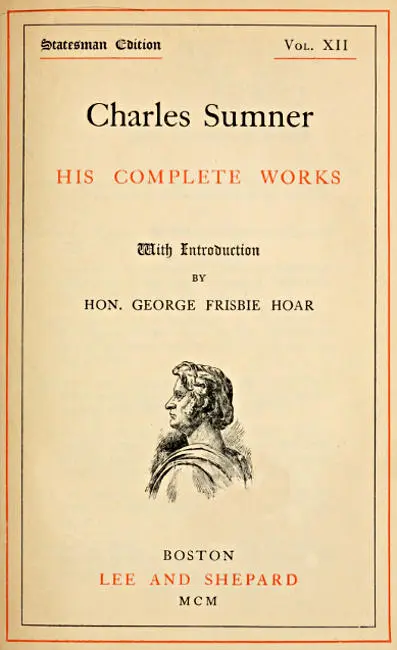
"Charles Sumner: His Complete Works, Volume 12 (of 20)" by Charles Sumner is a collection of political speeches and letters written during the mid-19th century. This volume centers on significant events and themes surrounding the American Civil War, including Reconstruction, emancipation, and the political battles of the time, particularly in relation to slavery and civil rights. Readers can expect to engage with powerful rhetoric and ideas that influenced the shaping of modern American political discourse. The opening of this volume presents multiple pieces, beginning with Sumner's speech delivered at a public meeting celebrating the victory of Abraham Lincoln in the 1864 presidential election. He joyfully proclaims this outcome as a monumental shift towards liberty and the end of slavery, portraying the Democratic party as corrupt and traitorous for its association with the rebellion. Following this, Sumner expresses his admiration for fellow politician James M. Ashley, discusses the case of the Florida war-steamer captured in Brazilian waters, and reflects on the need for justice and civil rights for freedmen. These excerpts establish both the urgency and optimism of the era, highlighting Sumner's strong commitment to liberty, justice, and the struggles faced by marginalized groups in the pursuit of equality.
Introduction adapted from the source catalogue; source summaries may be automatically generated.
Free to read · English · 117,723 words · No account needed
MAKE TIME FOR A GOOD BOOK
On by default. Untick to stop anonymous reading totals. Each page counts after 10 seconds in view. How this works.
Anonymous counting is on unless you have switched it off.
[224] Uhland, The Minstrel’s Return, tr. W. H. Furness: The Dial, p.
412, July, 1860.
[225] Edward the First, called the English Justinian, is also known as
Longshanks.
[226] Tiberius Gracchus.--VELLEIUS PATERCULUS, Historia Romana, Lib.
II. c. 2, § 2.
[227] Congressional Globe, 30th Cong. 1st Sess., Appendix, p. 1042.
[228] Speech in Springfield, July 17, 1858: Political Debates, p. 55.
[229] Letter to General Curtis, January 2, 1863: McPherson’s Political History of the United States during the Rebellion (2d edit.), Appendix, p. 534.
[230] July 18, 1864. McPherson’s Political History of the United States during the Rebellion (2d edit.), p. 301.
[231] Letter to the Union Convention in Illinois, August 26, 1863:
Ibid., p. 335.
[232] Fourth Annual Message, Dec. 6, 1864.
[233] Inaugural Address, March 4, 1865.
[234] Bacon, Of the True Greatness of the Kingdom of Britain: Works, ed. Spedding, (London, 1857-59,) Vol. VII. p. 47.
[235] Suetonius, Vespasianus, Cap. XIV.
[236] Dante died at this age; also Pliny the philosopher, Pope the poet, Gibbon the historian; and at this age Charles the Fifth resigned his empire and withdrew to a monastery.
[237] Letter to Henry Dundas, April 9, 1792: Works (London, 1801-27),
Vol. IX. p. 281.
[238] Isaiah, xiii. 11, 12.
[239] Oliver Wendell Holmes.
[240] Dryden, To the Memory of Mr. Oldham.
[241] At this stage of his speech Mr. Sumner called attention to M. Kapnist, a Russian gentleman belonging to the Chancery of the Emperor, who was on the platform. The allusion was received by the Convention with applause, which M. Kapnist acknowledged by rising and bowing.
[242] Rev. Ichabod Wiswall to Gov. Thomas Hinckley, of Plymouth, November 5, 1691: Hutchinson’s History of Massachusetts, Vol. I. p. 413; Hinckley Papers, Coll. Mass. Hist. Soc., 4th Ser. Vol. V. p. 301.
[243] Moniteur, May 21, 1850, p. 1761.
[244] Acts of July 2, 1862, and January 24, 1865: Statutes at Large, Vol. XII. p. 502; Vol. XIII. p. 424.
[245] Address at the Consecration of the National Cemetery at
Gettysburg, November 19, 1863.
[246] William Lloyd Garrison was in the habit of calling it “a covenant with Death and a league with Hell.”
[247] Lincoln and Johnson, their Plan of Reconstruction and the Resumption of National Authority; First Paper: Hartford Daily Times, March 19, 1872.
[248] Mr. Davis’s brilliant life was closed by an early death, December 30, 1865, which deprived the country of his inestimable services in Reconstruction. See post, Vol. XIII. p. 104.
[249] Ante, Vol. X. p. 167.
[250] Ante, Vol. XI. p. 351.
[251] Ante, p. 179.
[252] Ante, p. 349.
[253] Thirty-seventh Cong. 1st Sess., July 19, 1861: House Journal, p.
117; Cong. Globe, p. 210.
[254] Thirty-eighth Cong. 1st Sess., May 4, 1864: Senate Journal, p. 401; Cong. Globe, p. 2087. See, ante, Vol. IX. pp. 169-175, Speech on the Constitutional Quorum of the Senate.
[255] Vol. I. § 776, note.
[256] Ante, pp. 307, 308.
[257] Æneïs, Lib. III. 420, 421.
[258] Seneca, Hercules Œtæus, 235, 236.
[259] Odyssey, tr. Pope, Book XII. 129-132.
[260] Ibid., 107-114.
[261] Ibid., 52-56.
[262] In Joannis Evangelium Tract. XXXVI. § 9.
[263] Comus, 257-259.
[264] Book II. 659-661.
[265] Book II. 1016-1020.
[266] Merchant of Venice, Act III. Sc. 5.
Your reading position is saved on this browser. Take it to another device with a library code. Reading pages adapt to text, rather than matching a printed edition.
Charles Sumner

Charles Sumner

Charles Sumner

Charles Sumner
BEHIND THE BOOK
This eBook is for the use of anyone anywhere in the United States and most other parts of the world at no cost and with almost no restrictions whatsoever. You may copy it, give it away or re-use it under the terms of the Project Gutenberg License included with this eBook or online at www.gutenberg.org. If you are not located in the United States, you will have to check the laws of the country where you are located before using this eBook. Read the source licence.
The original source file, including credits and licence, is retained by this library. Request an original-format copy at no charge. Please include the book title and Project Gutenberg identifier #49789.
KEEP YOUR CURIOSITY GOING

David Patterson (Spirit) Hatch

David Patterson (Spirit) Hatch

David Patterson (Spirit) Hatch
Cécile Tormay

Moritz Busch
John L. Ransom