
Charles Sumner: his complete works, volume 20 (of 20)
Charles Sumner
THE CLASSIC COLLECTION · 1874
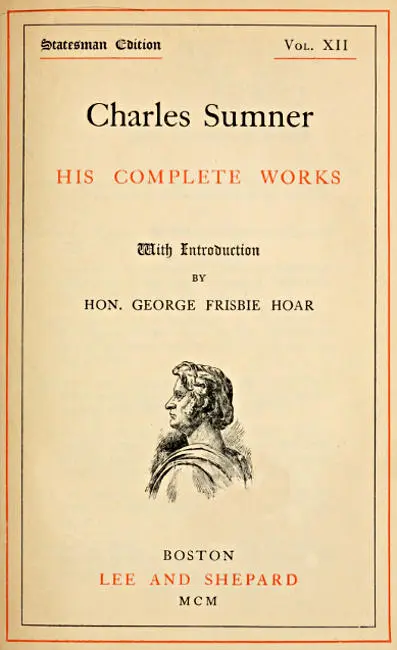
"Charles Sumner: His Complete Works, Volume 12 (of 20)" by Charles Sumner is a collection of political speeches and letters written during the mid-19th century. This volume centers on significant events and themes surrounding the American Civil War, including Reconstruction, emancipation, and the political battles of the time, particularly in relation to slavery and civil rights. Readers can expect to engage with powerful rhetoric and ideas that influenced the shaping of modern American political discourse. The opening of this volume presents multiple pieces, beginning with Sumner's speech delivered at a public meeting celebrating the victory of Abraham Lincoln in the 1864 presidential election. He joyfully proclaims this outcome as a monumental shift towards liberty and the end of slavery, portraying the Democratic party as corrupt and traitorous for its association with the rebellion. Following this, Sumner expresses his admiration for fellow politician James M. Ashley, discusses the case of the Florida war-steamer captured in Brazilian waters, and reflects on the need for justice and civil rights for freedmen. These excerpts establish both the urgency and optimism of the era, highlighting Sumner's strong commitment to liberty, justice, and the struggles faced by marginalized groups in the pursuit of equality.
Introduction adapted from the source catalogue; source summaries may be automatically generated.
Free to read · English · 117,723 words · No account needed
MAKE TIME FOR A GOOD BOOK
On by default. Untick to stop anonymous reading totals. Each page counts after 10 seconds in view. How this works.
Anonymous counting is on unless you have switched it off.
This, Sir, is a cause that would be dishonored and betrayed, if I contented myself with appealing only to the understanding. It is too cold, and its processes are too slow for the occasion. I desire to thank God, that, since He has given me an intellect so fallible, He has impressed upon me an instinct that is sure. On a question of shame and honor reasoning is sometimes useless, and worse. I feel the decision in my pulse: if it throws no light upon the brain, it kindles a fire at the heart.--FISHER AMES, Speech in Congress on the Treaty with Great Britain, April 28, 1796: Works, Vol. II. p. 56.
A spider in his natural size is only a spider, ugly and loathsome, and his flimsy net is only fit for catching flies. But, good God! suppose a spider as large as an ox, and that he spread cables about us; all the wilds of Africa would not produce anything so dreadful.--EDMUND BURKE, Speech on the Petition of the Unitarians, May 11, 1792: Works (London, 1801-27), Vol. X. p. 53.
The Convention was organized with the following officers.
President, Hon. Charles Sumner, Boston.
Vice-Presidents, Hon. F. W. Lincoln, Jr., Boston; Gen. B. F. Butler, Lowell. At large, Caleb Swan, Easton; E. F. Stone, Newburyport; R. L. Pease, Edgartown; W. P. Phillips, Salem; Eliphalet Trask, Springfield; Tully Crosby, Brewster; W. B. Spooner, Boston; Alvah Crocker, Fitchburg; Rev. L. A. Grimes, Boston; G. L. Davis, North Andover; E. L. Pierce, Milton; S. E. Sewall, Melrose; C. O. Rogers, Boston; W. S. Clark, Amherst. District 1, F. Hooper, Fall River; E. L. Barney, New Bedford. 2, F. M. Johnson, Quincy; G. B. Weston, Duxbury. 3, Ginery Twichell, Brookline; A. J. Wright, Boston. 4, Charles Beck, Cambridge; E. C. Fitz, Chelsea. 5, B. H. Smith, Gloucester; William Howland, Lynn. 6, O. R. Clark, Winchester; Milton Bonney, Lawrence. 7, C. R. Train, Framingham; John Nesmith, Lowell. 8, A. M. Bigelow, Grafton; Caleb Thayer, Blackstone. 9, Henry Smith, Templeton; Joseph Hartwell, Ware. 10, Joseph Tucker, Great Barrington; G. M. Fisk, Palmer.
Secretaries, C. W. Slack, Boston; S. N. Stockwell, Boston; Thomas White, Randolph; G. F. Stetson, Hanson; H. S. Gere, Northampton; G. S. Sullivan, Boston; Samuel Chism, Newton; James Pierce, Malden.
Hon. Tappan Wentworth, of Lowell, and Hon. William Brigham, of Boston, were appointed to conduct Mr. Sumner to the chair. Enthusiastic applause greeted his appearance on the platform. He then made the speech which follows.
Your reading position is saved on this browser. Take it to another device with a library code. Reading pages adapt to text, rather than matching a printed edition.
Charles Sumner

Charles Sumner

Charles Sumner

Charles Sumner
BEHIND THE BOOK
This eBook is for the use of anyone anywhere in the United States and most other parts of the world at no cost and with almost no restrictions whatsoever. You may copy it, give it away or re-use it under the terms of the Project Gutenberg License included with this eBook or online at www.gutenberg.org. If you are not located in the United States, you will have to check the laws of the country where you are located before using this eBook. Read the source licence.
The original source file, including credits and licence, is retained by this library. Request an original-format copy at no charge. Please include the book title and Project Gutenberg identifier #49789.
KEEP YOUR CURIOSITY GOING

David Patterson (Spirit) Hatch

David Patterson (Spirit) Hatch

David Patterson (Spirit) Hatch
Cécile Tormay

Moritz Busch
John L. Ransom