
Charles Sumner: his complete works, volume 20 (of 20)
Charles Sumner
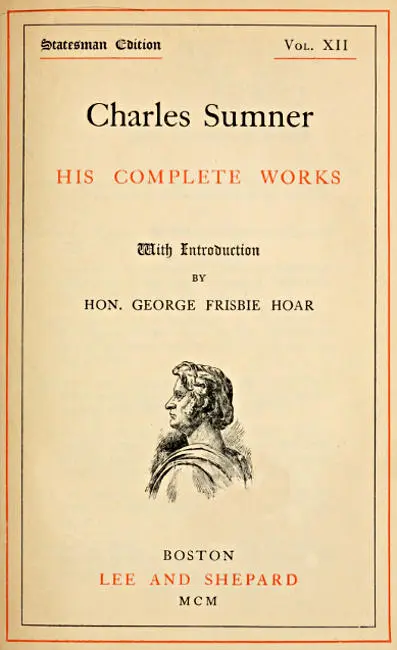
THE CLASSIC COLLECTION · 1874
"Charles Sumner: His Complete Works, Volume 12 (of 20)" by Charles Sumner is a collection of political speeches and letters written during the mid-19th century. This volume centers on significant events and themes surrounding the American Civil War, including Reconstruction, emancipation, and the political battles of the time, particularly in relation to slavery and civil rights. Readers can expect to engage with powerful rhetoric and ideas that influenced the shaping of modern American political discourse. The opening of this volume presents multiple pieces, beginning with Sumner's speech delivered at a public meeting celebrating the victory of Abraham Lincoln in the 1864 presidential election. He joyfully proclaims this outcome as a monumental shift towards liberty and the end of slavery, portraying the Democratic party as corrupt and traitorous for its association with the rebellion. Following this, Sumner expresses his admiration for fellow politician James M. Ashley, discusses the case of the Florida war-steamer captured in Brazilian waters, and reflects on the need for justice and civil rights for freedmen. These excerpts establish both the urgency and optimism of the era, highlighting Sumner's strong commitment to liberty, justice, and the struggles faced by marginalized groups in the pursuit of equality.
Introduction adapted from the source catalogue; source summaries may be automatically generated.
Free to read · English · 117,723 words · No account needed
MAKE TIME FOR A GOOD BOOK
On by default. Untick to stop anonymous reading totals. Each page counts after 10 seconds in view. How this works.
Anonymous counting is on unless you have switched it off.
Hon. Edward L. Pierce wrote from Boston:--
“God bless you a thousand times for your indomitable resistance to the admission of Louisiana with her caste system! This afternoon some forty gentlemen dined at Bird’s room, and all, nemine dissentiente, approved it, and with full praise.”
Joel P. Bishop, the learned law-writer, and author of a much used work on Criminal Law, wrote from Boston:--
“Blessings on you! You have done in this Louisiana matter an excellent work, for which some of your friends thank you less now than they will by-and-by.”
Hon. Charles W. Slack, an Antislavery journalist, wrote from
Boston:--
“Thanks!--hearty, cordial, continued thanks!--for your brave and persistent opposition to Louisiana.
“There is a very much larger share of the community who will sustain you than at first thought may be supposed.
“The idea of negro suffrage in the disloyal States grows daily in favor and advocacy among business men.”
William S. Robinson, the journalist, known as “Warrington,”
wrote:--
“I cannot sit down to my work this morning, albeit pressed for time, without giving you the homage of my sincere admiration and respect for killing Louisiana, at least pro tempore. Thanks! thanks! thanks!”
General William L. Burt, afterwards Postmaster of Boston, who had served in Louisiana during the Rebellion, wrote:--
“I congratulate you upon your defeat of the Louisiana Bill. Your action was not only justifiable, but commendable,--doubly so in view of the fact of your concession upon the Reconstruction Bill.… The complaints made by the Administration, or its friends, of the means you took to prevent the fraud upon you and the people, are a compliment, first, to your sagacity, and, secondly, to your skill and ability. You will be vindicated a hundred times before December.”
Colonel Albert J. Wright, having great influence in the local
politics of Boston, wrote:--
“Something must be done in Boston. Some of your admiring friends here, who at first, in the midst of the muddle of telegraphic despatches, had some misgivings in regard to your action on ‘Reconstruction’ questions before the Senate, have had their eyes opened, and now feel that you have rendered a great service to the country in battling manfully for the rights of humanity,--that you have done right, and saved us from a new disaster. Of course we must have a great meeting at the Music Hall, and give you an ovation: nothing less will satisfy us.”
F. B. Sanborn wrote from Concord, Massachusetts:--
Your reading position is saved on this browser. Take it to another device with a library code. Reading pages adapt to text, rather than matching a printed edition.
Charles Sumner

Charles Sumner

Charles Sumner

Charles Sumner
BEHIND THE BOOK
This eBook is for the use of anyone anywhere in the United States and most other parts of the world at no cost and with almost no restrictions whatsoever. You may copy it, give it away or re-use it under the terms of the Project Gutenberg License included with this eBook or online at www.gutenberg.org. If you are not located in the United States, you will have to check the laws of the country where you are located before using this eBook. Read the source licence.
The original source file, including credits and licence, is retained by this library. Request an original-format copy at no charge. Please include the book title and Project Gutenberg identifier #49789.
KEEP YOUR CURIOSITY GOING

David Patterson (Spirit) Hatch

David Patterson (Spirit) Hatch

David Patterson (Spirit) Hatch
Cécile Tormay

Moritz Busch
John L. Ransom