
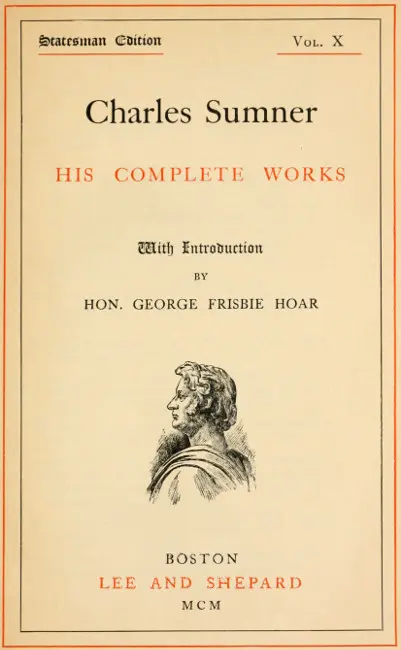
Charles Sumner: his complete works, volume 20 (of 20)
Charles Sumner
THE CLASSIC COLLECTION · 1872
"Charles Sumner: His Complete Works, Volume 10" by Charles Sumner is a historical account written in the late 19th century. This volume is part of a comprehensive collection of Sumner's speeches and writings, focusing on his discourse regarding the American Civil War, emphasizing issues of foreign relations, slavery, and the moral responsibilities of the United States amid conflict. Sumner, a prominent abolitionist and senator from Massachusetts, utilizes this work to advocate for human rights and to denounce the institutions that support slavery. The opening portion introduces Sumner's speech delivered at Cooper Institute in New York on September 10, 1863, wherein he addresses the potential dangers posed by England and France to American sovereignty during the Civil War. He discusses the perilous situation of the Union amid calls for foreign recognition of the Confederacy and the complicity of these nations with slavery. Sumner outlines several key areas of concern, including the nature of foreign intervention and the moral implications of acknowledging a regime built on slavery. He sets forth a detailed critique of the actions and policies of the British and French governments, reinforcing his belief that every inch of support for the Confederacy is a betrayal of the principles of liberty and civil rights.
Introduction adapted from the source catalogue; source summaries may be automatically generated.
Free to read · English · 116,772 words · No account needed
MAKE TIME FOR A GOOD BOOK
On by default. Untick to stop anonymous reading totals. Each page counts after 10 seconds in view. How this works.
Anonymous counting is on unless you have switched it off.
This speech was made at a crisis in our foreign relations when they were watched with more than the wonted anxiety, which began with the hasty concession of belligerent rights, as early as May 13, 1861. Among painful incidents may be mentioned the affair of the Trent, with the attendant menace, the escape of the Florida, and then of the Alabama, the damage to our commerce by these British vessels, the report of other vessels building for the Rebels, the swarm of British blockade-runners with arms and powerful cannon, adverse speeches of British statesmen, offensive articles of the British press, and movements for the recognition of the Rebels as an independent power.
As early as March 4, 1861, Mr. Gregory gave notice in the House of Commons that on an early day he would call the attention of her Majesty’s Government to the expediency of a prompt recognition of the Southern Confederacy of America. April 16, Mr. Gregory renewed his notice, and added a call for papers. This motion was afterward deferred from April 30 to May 13, and on May 16 until June 7, when it was finally postponed sine die. After that frequent debates occurred in both Houses of Parliament, involving the course of England to the United States. As late as June 30, 1863, in the summer before Mr. Sumner’s speech, a long debate was started in the House of Commons by Mr. Roebuck, on presenting a petition praying the House to enter into negotiations with the great powers of Europe with the object of recognizing the independence of the Confederate States. To all these things was now superadded the open construction at Birkenhead of two powerful iron-clad war-vessels, known as the Rebel rams.
The country was alarmed, for the contribution of these powerful vessels to the Rebel navy was felt to be an open participation in the Rebellion. Foreign war seemed to menace. Mr. Sumner, in private correspondence with England during the summer, did not hesitate to say, that, in his judgment, the sailing of these Rebel rams from an English port, after the ample notice given, would be equivalent to a declaration of war by England, not unlike the seizure of the Spanish galleons or the bombardment of Copenhagen. Our diplomatic correspondence shows a similar sentiment in important official quarters. July 11, Mr. Adams, our minister at London, after setting forth “a systematic plan of warfare upon the people of the United States carried on from the port of Liverpool, as well as in less degree from other ports in the kingdom,” called the attention of Earl Russell to “the construction and equipment of a steam vessel of war of the most formidable kind now known,” and intimated that such a proceeding would “be regarded by the Government and people of the United States with the greatest alarm, as virtually tantamount to a participation in the war by the people of Great Britain.”[161] At different times he transmitted additional papers, showing the character of these vessels. Meanwhile one iron-clad ram, being launched, received her engines, and was engaged in receiving her coal, ready to depart, when, September 4, Mr. Adams, transmitting further testimony, begged permission to record, in the name of his Government, “this last solemn protest against the commission of such an act of hostility against a friendly nation.”[162] On the same day he received a communication from Earl Russell, bearing date September 1, where, after setting forth the alleged insufficiency of the testimony against the vessels, he says: “Her Majesty’s Government are advised that they cannot interfere in any way with these vessels.”[163] The next day Mr. Adams replied: “I trust I need not express how profound is my regret at the conclusion to which her Majesty’s Government have arrived.… It would be superfluous in me to point out to your Lordship that this is war. No matter what may be the theory adopted of neutrality in a struggle, when this process is carried on, in the manner indicated, from a territory and with the aid of the subjects of a third party, that third party, to all intents and purposes, ceases to be neutral. Neither is it necessary to show that any government which suffers it to be done fails in enforcing the essential conditions of international amity towards the country against whom the hostility is directed.”[164] On the very day of this reply, Mr. Seward, at Washington, addressed Mr. Adams as follows: “Can the British Government suppose for a moment that such an assault as is thus meditated can be made upon us by British built, armed, and manned vessels, without at once arousing the whole nation and making a retaliatory war inevitable?… For the interest of both countries, and of civilization, I hope they will not let a blow fall from under their hands that will render peace impossible.”[165] Mr. Beaman, in his essay on the Alabama Claims, after examining this correspondence, says, it “shows, that, if these rams had been allowed to escape, peace between Great Britain and the United States would have been no longer possible.”[166]
Your reading position is saved on this browser. Take it to another device with a library code. Reading pages adapt to text, rather than matching a printed edition.
Charles Sumner

Charles Sumner

Charles Sumner

Charles Sumner
BEHIND THE BOOK
This eBook is for the use of anyone anywhere in the United States and most other parts of the world at no cost and with almost no restrictions whatsoever. You may copy it, give it away or re-use it under the terms of the Project Gutenberg License included with this eBook or online at www.gutenberg.org. If you are not located in the United States, you will have to check the laws of the country where you are located before using this eBook. Read the source licence.
The original source file, including credits and licence, is retained by this library. Request an original-format copy at no charge. Please include the book title and Project Gutenberg identifier #48285.
KEEP YOUR CURIOSITY GOING

David Patterson (Spirit) Hatch

David Patterson (Spirit) Hatch

David Patterson (Spirit) Hatch
Cécile Tormay

Moritz Busch
John L. Ransom