
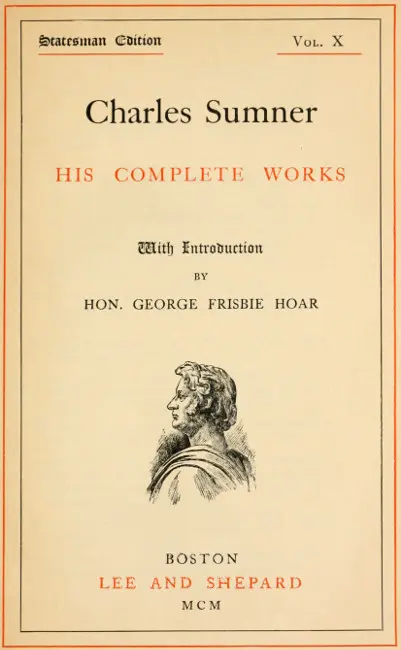
Charles Sumner: his complete works, volume 20 (of 20)
Charles Sumner
THE CLASSIC COLLECTION · 1872
"Charles Sumner: His Complete Works, Volume 10" by Charles Sumner is a historical account written in the late 19th century. This volume is part of a comprehensive collection of Sumner's speeches and writings, focusing on his discourse regarding the American Civil War, emphasizing issues of foreign relations, slavery, and the moral responsibilities of the United States amid conflict. Sumner, a prominent abolitionist and senator from Massachusetts, utilizes this work to advocate for human rights and to denounce the institutions that support slavery. The opening portion introduces Sumner's speech delivered at Cooper Institute in New York on September 10, 1863, wherein he addresses the potential dangers posed by England and France to American sovereignty during the Civil War. He discusses the perilous situation of the Union amid calls for foreign recognition of the Confederacy and the complicity of these nations with slavery. Sumner outlines several key areas of concern, including the nature of foreign intervention and the moral implications of acknowledging a regime built on slavery. He sets forth a detailed critique of the actions and policies of the British and French governments, reinforcing his belief that every inch of support for the Confederacy is a betrayal of the principles of liberty and civil rights.
Introduction adapted from the source catalogue; source summaries may be automatically generated.
Free to read · English · 116,772 words · No account needed
MAKE TIME FOR A GOOD BOOK
On by default. Untick to stop anonymous reading totals. Each page counts after 10 seconds in view. How this works.
Anonymous counting is on unless you have switched it off.
“Vane, young in years, but in sage counsel old, Than whom a better Senator ne’er held The helm of Rome, when gowns, not arms, repelled The fierce Epirot and the African bold.”
The answer of such men is a precedent for us, especially should England, taking up the rejected policy of Mazarin, presumptuously send any ambassador to stay the Republic in its war with Slavery.
The same heart of oak, so strenuous to repel intervention of France between King and Parliament, was not less strenuous the other way, when intervention could serve the rights of England or the principles of religious liberty. Such was England when ruled by the great Protector, called in his own day “chief of men.” No nation so powerful as to be exempt from that irresistible intercession, where, beneath the garb of peace, was a gleam of arms. From France, even under the rule of Mazarin, he claimed respect for the Protestant name, which he insisted upon making great and glorious. From Spain, on whose extended empire the sun did not cease to shine, he required that no Englishman should be subject to the Inquisition. Reading to his Council a despatch from Admiral Blake, announcing justice obtained from the Viceroy of Malaga, Cromwell said, that “he hoped to make the name of Englishman as great as ever that of Roman had been.”[60] In this same exalted mood he turned to propose mediation between Protestant Sweden and Protestant Bremen, “chiefly bewailing, that, being both his friends, they should so despitefully combat one against another,” offering his assistance to “a commodious accommodation on both sides,” and exhorting them “by no means to refuse any honest conditions of reconciliation.”[61] Here was intervention between nation and nation; but it was soon followed by intervention in the internal affairs of a distant country, which of all the acts of Cromwell is the most touching and sublime. The French ambassador, while at Whitehall, urging the signature of a treaty, was unexpectedly interrupted by news from a secluded valley of the Alps, far away among mountain torrents, affluents of the Po, that a company of pious Protestants, for centuries gathered there, keeping the truth pure, “when all our fathers worshipped stocks and stones,” were suffering terrible persecution from their sovereign, Emanuel of Savoy. Despoiled of all possessions and liberties, brutally driven from their homes, given over to licentious and infuriate violence, and then turning in self-defence, they had been “slain by the bloody Piemontese, that rolled mother with infant down the rocks”; and it was reported that French troops took part in the dismal transaction. The Protector heard the story, and his pity flashed into anger. He would not sign the treaty until France united with him in securing justice to these humble sufferers, whom he called the Lord’s people. For their relief he contributed out of his own purse two thousand pounds, and authorized a general collection throughout England, which reached a large sum; but besides money, he set apart a day of humiliation and prayer for them. Nor was this all. “I should be glad,” wrote his Secretary, Thurloe, “to have a most particular account of that business, and to know what is become of those poor people, for whom our very souls here do bleed.”[62] But a pen mightier than that of any plodding secretary was enlisted in this pious intervention. It was John Milton, glowing with that indignation which his sonnet “On the Massacre in Piemont” makes immortal in the heart of man, who wrote the magnificent despatches, where the English nation of that day, after declaring itself “linked together” with its distant brethren, “not only by the same tie of humanity, but by joint communion of the same religion,” naturally and grandly insisted that “both this edict and whatsoever may be decreed to their disturbance upon the account of the Reformed Religion” should be abrogated, “and that an end be put to their oppressions.”[63] Not content with this call upon the Duke of Savoy, the Protector appealed to Louis the Fourteenth and his Cardinal Minister, to the States General of Holland, the Protestant Cantons of Switzerland, the King of Denmark, the King of Sweden, and even to the Protestant Reformed Prince of remote Transylvania,--and always by the pen of Milton,--rallying these princes and powers in joint entreaty and intervention, and, if need were, to “some other course to be speedily taken, that such a numerous multitude of our innocent brethren may not miserably perish for want of succor and assistance.”[64] The Regent of Savoy, daughter of Henry the Fourth, professed to be affected by this English charity, and announced for her Protestant subjects a free pardon, and also “such privileges and graces as could not but give the Lord Protector a sufficient evidence how great a respect they bare both to his person and mediation.”[65] But there was still delay. Meanwhile Cromwell began to inquire where in the Prince’s territories English troops might debark, and Mazarin, anxious to complete the yet unfinished treaty, joined in requiring immediate pacification of the Valleys and the restoration of these persecuted people to their ancient liberties. It was done. Such is the grandest intervention of English history, inspired by Milton, enforced by Cromwell, and sustained by Louis the Fourteenth with his Cardinal Minister by his side, while foreign nations watched the scene.
Your reading position is saved on this browser. Take it to another device with a library code. Reading pages adapt to text, rather than matching a printed edition.
Charles Sumner

Charles Sumner

Charles Sumner

Charles Sumner
BEHIND THE BOOK
This eBook is for the use of anyone anywhere in the United States and most other parts of the world at no cost and with almost no restrictions whatsoever. You may copy it, give it away or re-use it under the terms of the Project Gutenberg License included with this eBook or online at www.gutenberg.org. If you are not located in the United States, you will have to check the laws of the country where you are located before using this eBook. Read the source licence.
The original source file, including credits and licence, is retained by this library. Request an original-format copy at no charge. Please include the book title and Project Gutenberg identifier #48285.
KEEP YOUR CURIOSITY GOING

David Patterson (Spirit) Hatch

David Patterson (Spirit) Hatch

David Patterson (Spirit) Hatch
Cécile Tormay

Moritz Busch
John L. Ransom