
Charles Sumner: his complete works, volume 20 (of 20)
Charles Sumner
THE CLASSIC COLLECTION · 1872
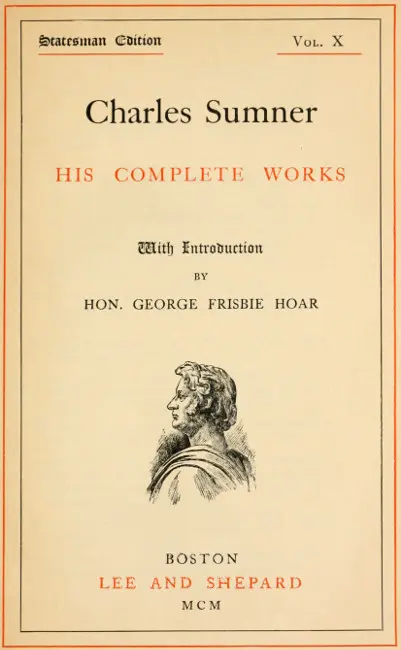
"Charles Sumner: His Complete Works, Volume 10" by Charles Sumner is a historical account written in the late 19th century. This volume is part of a comprehensive collection of Sumner's speeches and writings, focusing on his discourse regarding the American Civil War, emphasizing issues of foreign relations, slavery, and the moral responsibilities of the United States amid conflict. Sumner, a prominent abolitionist and senator from Massachusetts, utilizes this work to advocate for human rights and to denounce the institutions that support slavery. The opening portion introduces Sumner's speech delivered at Cooper Institute in New York on September 10, 1863, wherein he addresses the potential dangers posed by England and France to American sovereignty during the Civil War. He discusses the perilous situation of the Union amid calls for foreign recognition of the Confederacy and the complicity of these nations with slavery. Sumner outlines several key areas of concern, including the nature of foreign intervention and the moral implications of acknowledging a regime built on slavery. He sets forth a detailed critique of the actions and policies of the British and French governments, reinforcing his belief that every inch of support for the Confederacy is a betrayal of the principles of liberty and civil rights.
Introduction adapted from the source catalogue; source summaries may be automatically generated.
Free to read · English · 116,772 words · No account needed
MAKE TIME FOR A GOOD BOOK
On by default. Untick to stop anonymous reading totals. Each page counts after 10 seconds in view. How this works.
Anonymous counting is on unless you have switched it off.
[125] Wicquefort, L’Ambassadeur et ses Fonctions, Liv. I. sec. 3.
[126] Thoughts on French Affairs, 1791: Works (London, 1801), Vol. VII.
pp. 11, 12.
[127] Speech on the Address of Thanks, December 14, 1792: Hansard’s Parliamentary History, Vol. XXX. col. 72.
[128] Works, Vol. VI. p. 86.
[129] Miscellaneous Works (London, 1846), Vol. III. pp. 476, 477.
[130] Note Verbale en Réponse au Memorandum sur les Colonies Espagnoles en Amérique du 24 Novembre, 1822: Congrès de Vérone (2me édit.), Tom. I. p. 93.
[131] Le Droit des Gens, Liv. II. ch. 5, § 70.
[132] Ibid.
[133] Le Droit des Gens, Liv. II. ch. 4, § 56.
[134] Ibid.
[135] Ibid., ch. 12, § 162.
[136] Forbes v. Cochrane et al., 2 Barnwall and Creswell, R., 448,
471.
[137] Wilkie, The Epigoniad, Book I. 403, 404.
[138] Odyssey, tr. Pope, Book IX. 329-332.
[139] Odyssey, tr. Pope, Book X. 133.
Other verses, by Richard Owen Cambridge, the satirist, and contemporary of Dr. Johnson, picture this Slavemonger Government:--
“Polypheme was a cannibal,
And most voracious glutton;
Poor shipwrecked tars he smoused for fish,
And munched marines for mutton.”
[140] Regicide Peace, Second Letter: Works (London, 1801), Vol. VIII.
p. 161.
[141] Deuteronomy, xxviii. 65-67. See, ante, Vol. V. pp. 304, 305, where the fate of the Flying Dutchman is predicted for our Disunionists. The remarkable story of Peter Rugg, always on the road, driving furiously, but unable to find his way to Boston, illustrates the same blasted condition. Chaucer foreshadows a similar doom:--
“And breakers of the law, soth to saine,
… after that they been dede,
Shall whirle about the world, alway in paine,
Till many a world be passed out of drede.”
The Assembly of Foules, 78-81.
[142] Letter to the Sheriffs of Bristol: Works (London, 1801), Vol.
III. p. 144.
[143] Bas v. Tingy, Dallas, R., Vol. IV. pp. 43-45, Chase, J., and
Paterson, J.
[144] Despatch, October 12, 1825,--quoted in Speech of Lord John Russell, on the Blockade of Southern Ports, May 6, 1861: Hansard’s Parliamentary Debates, 3d Ser., Vol. CLXII. col. 1566.
[145] Statutes at Large, ed. Pickering, Vol. III. p. 20.
[146] American State Papers, Foreign Relations, Vol. I. p. 494.
[147] Des Droits et des Devoirs des Nations Neutres, Tom. III. pp. 299,
323, 352.
[148] Le Droit Maritime International, Tom. I. pp. 65, 66.
[149] Wheaton’s Elements of International Law, ed. Lawrence, p. 1024.
Your reading position is saved on this browser. Take it to another device with a library code. Reading pages adapt to text, rather than matching a printed edition.
Charles Sumner

Charles Sumner

Charles Sumner

Charles Sumner
BEHIND THE BOOK
This eBook is for the use of anyone anywhere in the United States and most other parts of the world at no cost and with almost no restrictions whatsoever. You may copy it, give it away or re-use it under the terms of the Project Gutenberg License included with this eBook or online at www.gutenberg.org. If you are not located in the United States, you will have to check the laws of the country where you are located before using this eBook. Read the source licence.
The original source file, including credits and licence, is retained by this library. Request an original-format copy at no charge. Please include the book title and Project Gutenberg identifier #48285.
KEEP YOUR CURIOSITY GOING

David Patterson (Spirit) Hatch

David Patterson (Spirit) Hatch

David Patterson (Spirit) Hatch
Cécile Tormay

Moritz Busch
John L. Ransom