
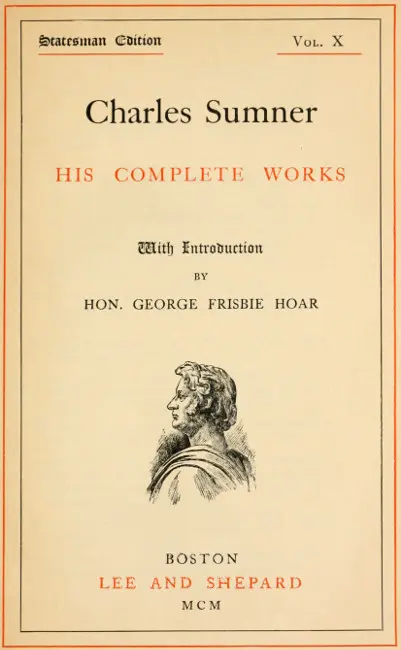
Charles Sumner: his complete works, volume 20 (of 20)
Charles Sumner
THE CLASSIC COLLECTION · 1872
"Charles Sumner: His Complete Works, Volume 10" by Charles Sumner is a historical account written in the late 19th century. This volume is part of a comprehensive collection of Sumner's speeches and writings, focusing on his discourse regarding the American Civil War, emphasizing issues of foreign relations, slavery, and the moral responsibilities of the United States amid conflict. Sumner, a prominent abolitionist and senator from Massachusetts, utilizes this work to advocate for human rights and to denounce the institutions that support slavery. The opening portion introduces Sumner's speech delivered at Cooper Institute in New York on September 10, 1863, wherein he addresses the potential dangers posed by England and France to American sovereignty during the Civil War. He discusses the perilous situation of the Union amid calls for foreign recognition of the Confederacy and the complicity of these nations with slavery. Sumner outlines several key areas of concern, including the nature of foreign intervention and the moral implications of acknowledging a regime built on slavery. He sets forth a detailed critique of the actions and policies of the British and French governments, reinforcing his belief that every inch of support for the Confederacy is a betrayal of the principles of liberty and civil rights.
Introduction adapted from the source catalogue; source summaries may be automatically generated.
Free to read · English · 116,772 words · No account needed
MAKE TIME FOR A GOOD BOOK
On by default. Untick to stop anonymous reading totals. Each page counts after 10 seconds in view. How this works.
Anonymous counting is on unless you have switched it off.
It is sad to know of suffering anywhere, even by a single lowly person. But our feelings are enhanced, when individual sorrows are multiplied, and the blow descends upon a whole race. History, too, takes up the grief. The Jews expelled from Spain by merciless decree, the Huguenots driven from France by the revocation of the Edict of Nantes, our own Puritan fathers compelled to exile for religious Freedom,--all these receive a gushing sympathy, and we detest the tyrants. These were persecutions for religion, in days of religious bigotry and darkness. But an American Congress, in this age of Christian light, not in the fanaticism of religion, but in the fanaticism of Slavery, did a deed that finds companionship only with these enormities of the past. The Fugitive Slave Act carried distress and terror to every person with African blood in the Free States. All were fluttered, as the arbitrary edict commenced its swoop over the land. The very rumor that a slave-hunter was in town so shook the nerves of a sensitive freeman on whom was the ban of color, that he died. To large numbers the Act was a decree of instant expulsion from the Republic, under penalty of Slavery to them and their posterity forever. Driven by despair, as many as six thousand Christian men and women, meritorious persons,--a larger band than that of the escaping Puritans,--precipitately fled from homes they had established, opportunities of usefulness they had found, and the regard of fellow-citizens, until, at last, in an unwelcome Northern climate, beneath the British flag, with glad voices of Freedom on their lips, though with the yearnings of exile in their hearts, they were happy in swelling the chant, “God save the Queen!”
Such an injustice cannot be restricted in influence. Everywhere it is an extension of Slavery, with all the wrong, violence, and brutality which are the natural outgrowth of Slavery. The Free States became little better than a huge outlying plantation quivering under the lash of the overseer; or rather, they were a diversified hunting-ground for the flying bondmen, resounding always with the “halloo” of the huntsman. There seemed no rest. The chase was hardly over at Boston before it was started at Philadelphia, Syracuse, or Buffalo, and then again raged furiously across the prairies of the West. Not an instance occurred which did not shock the conscience of the country and sting it with anger. Records of the time attest the accuracy of this statement. Perhaps there is no example in history where human passion showed itself in grander forms, or eloquence lent all her gifts more completely to the demands of Liberty, than the speech of an eminent character, now dead and buried in a foreign land,[373] denouncing the capture of Thomas Sims at Boston, and invoking the judgment of God and man upon the agents in this wickedness. In the history of Humanity this great effort cannot be forgotten. But every case pleaded with an eloquence of its own, until, at last, occurred one of those tragedies darkening the heavens and crying out with a voice that will be heard. It was the voice of a mother standing over her murdered child. Margaret Garner escaped from Slavery with three children, but was overtaken at Cincinnati. Unwilling to behold her offspring returned to the shambles of the South, this unhappy person, described in the testimony as “a womanly, amiable, affectionate mother,” determined to save them in the only way within her power. With a butcher-knife, coolly and deliberately, she took the life of one of the children, “almost white, and a little girl of rare beauty,” and attempted, without success, to take the life of the other two. To the preacher who interrogated her she exclaimed: “The child was my own, given me of God to do the best a mother could in its behalf. I have done the best I could; I would have done more and better for the rest; I knew it was better for them to go home to God than back to Slavery.” But she was restrained in her purpose. The Fugitive Slave Act triumphed, and, after the determination of sundry questions of jurisdiction, this devoted historic mother, with the two children remaining to her, and the dead body of the little one just emancipated, under a national escort of armed men, was hurried to the doom of Slavery. Her case did not end with this revolting sacrifice. So long as the human heart is moved by human suffering, the story of this mother will be read with alternate anger and grief, while it is studied as a perpetual witness to the slaveholding tyranny which then ruled the Republic with execrable exactions, destined at last to break out in war,--as the sacrifice of Virginia by her father is a perpetual witness to the decemviral tyranny which ruled Rome.
Your reading position is saved on this browser. Take it to another device with a library code. Reading pages adapt to text, rather than matching a printed edition.
Charles Sumner

Charles Sumner

Charles Sumner

Charles Sumner
BEHIND THE BOOK
This eBook is for the use of anyone anywhere in the United States and most other parts of the world at no cost and with almost no restrictions whatsoever. You may copy it, give it away or re-use it under the terms of the Project Gutenberg License included with this eBook or online at www.gutenberg.org. If you are not located in the United States, you will have to check the laws of the country where you are located before using this eBook. Read the source licence.
The original source file, including credits and licence, is retained by this library. Request an original-format copy at no charge. Please include the book title and Project Gutenberg identifier #48285.
KEEP YOUR CURIOSITY GOING

David Patterson (Spirit) Hatch

David Patterson (Spirit) Hatch

David Patterson (Spirit) Hatch
Cécile Tormay

Moritz Busch
John L. Ransom