
Charles Sumner: his complete works, volume 20 (of 20)
Charles Sumner
THE CLASSIC COLLECTION · 1872
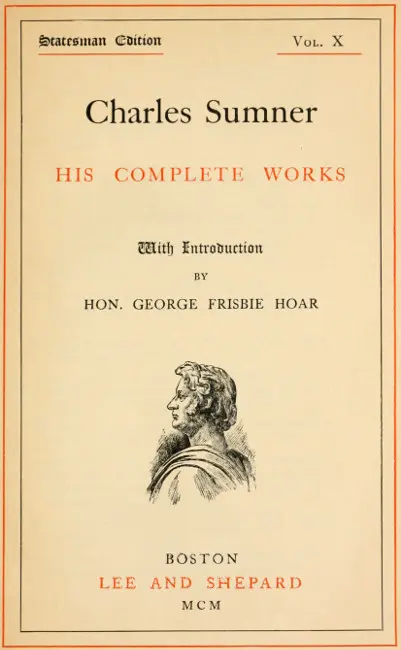
"Charles Sumner: His Complete Works, Volume 10" by Charles Sumner is a historical account written in the late 19th century. This volume is part of a comprehensive collection of Sumner's speeches and writings, focusing on his discourse regarding the American Civil War, emphasizing issues of foreign relations, slavery, and the moral responsibilities of the United States amid conflict. Sumner, a prominent abolitionist and senator from Massachusetts, utilizes this work to advocate for human rights and to denounce the institutions that support slavery. The opening portion introduces Sumner's speech delivered at Cooper Institute in New York on September 10, 1863, wherein he addresses the potential dangers posed by England and France to American sovereignty during the Civil War. He discusses the perilous situation of the Union amid calls for foreign recognition of the Confederacy and the complicity of these nations with slavery. Sumner outlines several key areas of concern, including the nature of foreign intervention and the moral implications of acknowledging a regime built on slavery. He sets forth a detailed critique of the actions and policies of the British and French governments, reinforcing his belief that every inch of support for the Confederacy is a betrayal of the principles of liberty and civil rights.
Introduction adapted from the source catalogue; source summaries may be automatically generated.
Free to read · English · 116,772 words · No account needed
MAKE TIME FOR A GOOD BOOK
On by default. Untick to stop anonymous reading totals. Each page counts after 10 seconds in view. How this works.
Anonymous counting is on unless you have switched it off.
State. Men. Women. Total. New York 6,519 11,187 17,706 Illinois 6,382 8,998 15,380 Massachusetts 4,249 7,392 11,641 Pennsylvania 2,259 6,366 8,625 Ohio 3,676 4,654 8,330 Michigan 1,741 4,441 6,182 Iowa 2,025 4,014 6,039 Maine 1,225 4,362 5,587 Wisconsin 1,639 2,391 4,030 Indiana 1,075 2,591 3,666 New Hampshire 393 2,261 2,654 New Jersey 824 1,709 2,533 Rhode Island 827 1,451 2,278 Vermont 375 1,183 1,558 Connecticut 393 1,162 1,555 Minnesota 396 1,094 1,490 West Virginia 82 100 182 Maryland 115 50 165 Kansas 84 74 158 Delaware 67 70 137 Nebraska 13 20 33 Kentucky 21 .. 21 Louisiana .. 14 14 Citizens of the United States living in New Brunswick 19 17 36 ------ ------ ------ 34,399 65,601 100,000
These several petitions are consolidated into one, being another illustration of the motto on our coin,--E pluribus unum.
This unprecedented petition is signed by one hundred thousand men and women, who unite in this unparalleled number to support its prayer. They are from all parts of the country, and from every condition of life: from the seaboard, fanned by the free airs of the ocean, and from the Mississippi and the prairies of the West, fanned by the free airs which vitalize that extensive region; from the families of the educated and uneducated, rich and poor, of every profession, business, and calling in life, representing every sentiment, thought, hope, passion, activity, intelligence, that inspires, strengthens, and adorns our social system. Here they are, a mighty army, one hundred thousand strong, without arms or banners, the advance-guard of a yet larger army.
Though memorable for numbers, these petitioners are more memorable for the prayer in which they unite. They ask nothing less than Universal Emancipation; and this they ask directly at the hands of Congress. No reason is assigned. The prayer speaks. It is simple, positive. So far as it proceeds from the women of the country, it is naturally a petition and not an argument. But I need not remind the Senate that there is no reason so strong as the reason of the heart. Do not all great thoughts come from the heart?
It is not for me at this moment to offer reasons which the one hundred thousand petitioners have forborne. But I may properly add, that, naturally and obviously, they all feel in their hearts, what reason and knowledge confirm, not only that Slavery as a Unit, one and indivisible, is the guilty origin of the Rebellion, but that its influence everywhere, even outside the Rebel States, is hostile to the Union, always impairing loyalty, and sometimes openly menacing the national cause. It requires no difficult logic to conclude that such a monster, wherever it shows its head, is a National Enemy, to be pursued and destroyed as such, or at least a nuisance to the national cause, to be abated as such.
Your reading position is saved on this browser. Take it to another device with a library code. Reading pages adapt to text, rather than matching a printed edition.
Charles Sumner

Charles Sumner

Charles Sumner

Charles Sumner
BEHIND THE BOOK
This eBook is for the use of anyone anywhere in the United States and most other parts of the world at no cost and with almost no restrictions whatsoever. You may copy it, give it away or re-use it under the terms of the Project Gutenberg License included with this eBook or online at www.gutenberg.org. If you are not located in the United States, you will have to check the laws of the country where you are located before using this eBook. Read the source licence.
The original source file, including credits and licence, is retained by this library. Request an original-format copy at no charge. Please include the book title and Project Gutenberg identifier #48285.
KEEP YOUR CURIOSITY GOING

David Patterson (Spirit) Hatch

David Patterson (Spirit) Hatch

David Patterson (Spirit) Hatch
Cécile Tormay

Moritz Busch
John L. Ransom