
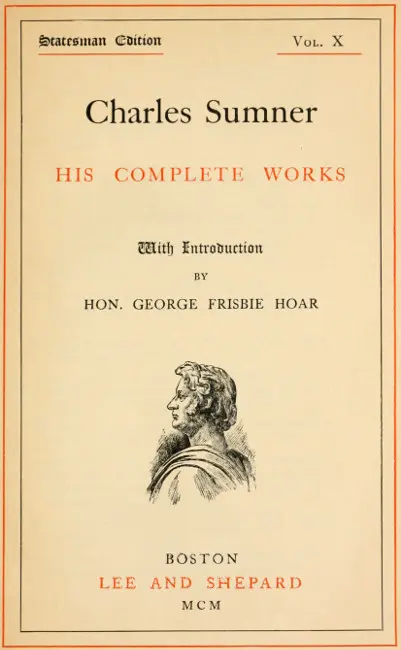
Charles Sumner: his complete works, volume 20 (of 20)
Charles Sumner
THE CLASSIC COLLECTION · 1872
"Charles Sumner: His Complete Works, Volume 10" by Charles Sumner is a historical account written in the late 19th century. This volume is part of a comprehensive collection of Sumner's speeches and writings, focusing on his discourse regarding the American Civil War, emphasizing issues of foreign relations, slavery, and the moral responsibilities of the United States amid conflict. Sumner, a prominent abolitionist and senator from Massachusetts, utilizes this work to advocate for human rights and to denounce the institutions that support slavery. The opening portion introduces Sumner's speech delivered at Cooper Institute in New York on September 10, 1863, wherein he addresses the potential dangers posed by England and France to American sovereignty during the Civil War. He discusses the perilous situation of the Union amid calls for foreign recognition of the Confederacy and the complicity of these nations with slavery. Sumner outlines several key areas of concern, including the nature of foreign intervention and the moral implications of acknowledging a regime built on slavery. He sets forth a detailed critique of the actions and policies of the British and French governments, reinforcing his belief that every inch of support for the Confederacy is a betrayal of the principles of liberty and civil rights.
Introduction adapted from the source catalogue; source summaries may be automatically generated.
Free to read · English · 116,772 words · No account needed
MAKE TIME FOR A GOOD BOOK
On by default. Untick to stop anonymous reading totals. Each page counts after 10 seconds in view. How this works.
Anonymous counting is on unless you have switched it off.
“And here I would make this inquiry of those worthy characters who composed a part of the late Federal Convention. I am sure they were fully impressed with the necessity of forming a great consolidated Government, instead of a Confederation. That this is a consolidated Government is demonstrable clear; and the danger of such a Government is to my mind very striking. I have the highest veneration for those gentlemen; but, Sir, give me leave to demand, What right had they to say, ‘We, the people’?… Who authorized them to speak the language of ‘We, the people,’ instead of ‘We, the States’?”[185]
And again, at another stage of the debate, the same patriotic opponent of the Constitution declared succinctly,--
“The question turns, Sir, on that poor little thing, the expression, ‘We, the people,’ instead of the States, of America.”[186]
In the same Convention, another patriotic opponent of the Constitution, George Mason, following Patrick Henry, said:--
“Whether the Constitution be good or bad, the present clause clearly discovers that it is a National Government, and no longer a Confederation.”[187]
But against all this opposition, and in face of this exposure, the Constitution was adopted, in the name of the people of the United States. Much, indeed, was left to the States; but it was no longer in their name that the government was organized, while the miserable pretension of State “sovereignty” was discarded. Even in the discussions of the National Convention Mr. Madison spoke thus plainly:--
“Some contend that States are sovereign, when, in fact, they are only political societies. The States never possessed the essential rights of sovereignty. These were always vested in Congress.”[188]
Grave words, especially when we consider the position of their author. They were substantially echoed by Elbridge Gerry, of Massachusetts, afterwards Vice-President, who said:--
“It appears to me that the States never were independent. They had only corporate rights.”[189]
On another occasion, Mr. Madison said,--
“I hold it for a fundamental point, that an individual independence of the States is utterly irreconcilable with the idea of an aggregate sovereignty.”[190]
Better words still fell from Mr. Wilson, of Pennsylvania, known afterwards as a learned judge of the Supreme Court, and also for his “Lectures on Law”:--
“Will a regard to State Rights justify the sacrifice of the rights of men? If we proceed on any other foundation than the last, our building will neither be solid nor lasting.”[191]
Your reading position is saved on this browser. Take it to another device with a library code. Reading pages adapt to text, rather than matching a printed edition.
Charles Sumner

Charles Sumner

Charles Sumner

Charles Sumner
BEHIND THE BOOK
This eBook is for the use of anyone anywhere in the United States and most other parts of the world at no cost and with almost no restrictions whatsoever. You may copy it, give it away or re-use it under the terms of the Project Gutenberg License included with this eBook or online at www.gutenberg.org. If you are not located in the United States, you will have to check the laws of the country where you are located before using this eBook. Read the source licence.
The original source file, including credits and licence, is retained by this library. Request an original-format copy at no charge. Please include the book title and Project Gutenberg identifier #48285.
KEEP YOUR CURIOSITY GOING

David Patterson (Spirit) Hatch

David Patterson (Spirit) Hatch

David Patterson (Spirit) Hatch
Cécile Tormay

Moritz Busch
John L. Ransom