
Charles Sumner: his complete works, volume 20 (of 20)
Charles Sumner
THE CLASSIC COLLECTION · 1872
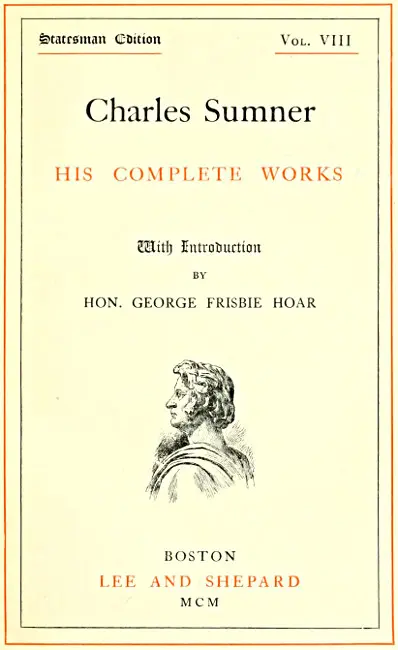
"Charles Sumner: his complete works, volume 08 (of 20)" by Charles Sumner is a historical collection of speeches and writings from the notable American statesman, likely compiled in the late 19th century. This volume emphasizes key issues faced during the Civil War era, including legal reforms, emancipation, and the rights of fugitive slaves. Sumner's articulate arguments reflect his commitment to human rights and the abolition of slavery, offering an insightful perspective on this critical period in American history. The opening of this work introduces various resolutions and speeches presented by Sumner in the Senate around 1861 and 1862. He revisits his long-standing proposals for the revision of national statutes, addresses the injustices faced by colored inventors concerning patent rights, and advocates for the humane treatment of fugitive slaves by the Union army. Additionally, he tackles the political expulsion of those who supported secession, illustrating the intense debates and moral dilemmas that characterized U.S. governance amid the Civil War. This opening segment not only sets the stage for Sumner's powerful oratory but also underscores the socio-political landscape of a nation grappling with its principles of liberty and justice.
Introduction adapted from the source catalogue; source summaries may be automatically generated.
Free to read · English · 114,219 words · No account needed
MAKE TIME FOR A GOOD BOOK
On by default. Untick to stop anonymous reading totals. Each page counts after 10 seconds in view. How this works.
Anonymous counting is on unless you have switched it off.
Paper is of all qualities, and of every degree of durability. Besides rags, there are many other substances out of which it is made, so that even the increasing demand meets a corresponding supply. It is always cheap, and entirely convenient. To reject it for parchment is as if we imitated the early Arabs, and inscribed our statutes on the shoulder-blades of sheep. The skin is less antediluvian than the bone, but both are out of place in our age.
Should the change be deemed advisable, it might be made by substituting the words “linen paper” for “parchment,” in the sixth Joint Rule. This would be simple enough: but the phrases “engrossed” and “enrolled” would still remain in the rules, although the occasion for them had passed. In the British Parliament, the old form of question, “That this bill be engrossed,” which always followed after the Committee of the Whole, is now dispensed with;[328] and it seems to me that we might do something to simplify our proceedings in this respect, also.
I have here a complete collection of bills, as printed, at their different stages in the two Houses of Parliament, as follows.
Bill as delivered to each member of the House of Commons.
House copy of bill originating in the Commons.
Bill as presented by the Commons to the Lords, after passing the
Commons.
Bill as delivered to each peer.
House copy of bill originating in the Lords.
Bill as presented by the Lords to the Commons, after passing the Lords.
Bill on vellum, as passed both Houses, and ready for the royal assent.
All these I shall, if he will allow me, hand over to the Chairman of the Committee on Enrolled Bills, who will do something, I trust, for the improvement of our rules in this respect.
The resolution was adopted, but no report was ever made by the
Committee.
[1] Senate Journal, 32d Cong. 1st Sess., p. 339.
[2] Ibid., 33d Cong. 1st Sess., p. 43.
[3] Ibid., 34th Cong. 1st Sess., p. 100.
[4] Congressional Globe, 37th Cong. 2d Sess., Appendix, p. 2.
[5] Senate Journal, 37th Cong. 2d Sess., pp. 147, 549.
[6] Ibid., 38th Cong. 1st Sess., pp. 28, 47, 667.
[7] Statutes at Large, Vol. XIV. pp. 74, 75.
[8] Act of May 4, 1870: Ibid., Vol. XVI. p. 96.
[9] Opinions of Attorneys-General, Vol. X. p. 382, November 29, 1862.
[10] United States Statutes at Large, Vol. XII. p. 354.
[11] Wheaton’s Elements of International Law, edited, with Notes, by Richard H. Dana, Jr., Note 228, p. 645.
[12] Wheaton’s Elements of International Law, ed. Dana, Note 228, p.
645.
[13] Rebellion Record, Vol. III, Documents, p. 330.
[14] Executive Documents, 37th Cong. 2d Sess., Senate, No. 8, p. 4.
[15] Annual Register, 1861, p. 291.
[16] Annual Register, 1861, p. 254.
[17] Executive Documents, 37th Cong. 2d Sess., Senate, No. 8, p. 3.
[18] Ibid., p. 2.
Your reading position is saved on this browser. Take it to another device with a library code. Reading pages adapt to text, rather than matching a printed edition.
Charles Sumner

Charles Sumner

Charles Sumner

Charles Sumner
BEHIND THE BOOK
This eBook is for the use of anyone anywhere in the United States and most other parts of the world at no cost and with almost no restrictions whatsoever. You may copy it, give it away or re-use it under the terms of the Project Gutenberg License included with this eBook or online at www.gutenberg.org. If you are not located in the United States, you will have to check the laws of the country where you are located before using this eBook. Read the source licence.
The original source file, including credits and licence, is retained by this library. Request an original-format copy at no charge. Please include the book title and Project Gutenberg identifier #48170.
KEEP YOUR CURIOSITY GOING

David Patterson (Spirit) Hatch

David Patterson (Spirit) Hatch

David Patterson (Spirit) Hatch
Cécile Tormay

Moritz Busch
John L. Ransom