
Charles Sumner: his complete works, volume 20 (of 20)
Charles Sumner
THE CLASSIC COLLECTION · 1872
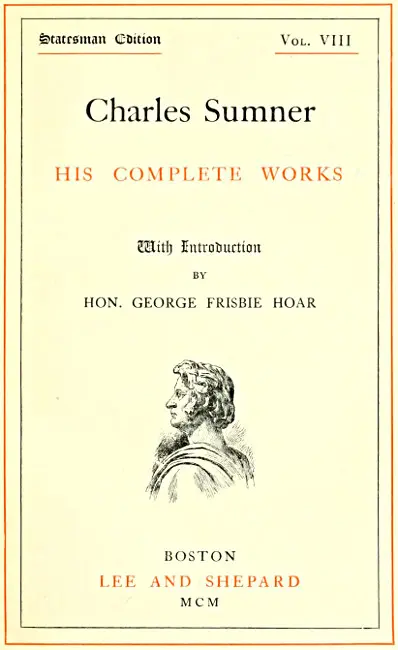
"Charles Sumner: his complete works, volume 08 (of 20)" by Charles Sumner is a historical collection of speeches and writings from the notable American statesman, likely compiled in the late 19th century. This volume emphasizes key issues faced during the Civil War era, including legal reforms, emancipation, and the rights of fugitive slaves. Sumner's articulate arguments reflect his commitment to human rights and the abolition of slavery, offering an insightful perspective on this critical period in American history. The opening of this work introduces various resolutions and speeches presented by Sumner in the Senate around 1861 and 1862. He revisits his long-standing proposals for the revision of national statutes, addresses the injustices faced by colored inventors concerning patent rights, and advocates for the humane treatment of fugitive slaves by the Union army. Additionally, he tackles the political expulsion of those who supported secession, illustrating the intense debates and moral dilemmas that characterized U.S. governance amid the Civil War. This opening segment not only sets the stage for Sumner's powerful oratory but also underscores the socio-political landscape of a nation grappling with its principles of liberty and justice.
Introduction adapted from the source catalogue; source summaries may be automatically generated.
Free to read · English · 114,219 words · No account needed
MAKE TIME FOR A GOOD BOOK
On by default. Untick to stop anonymous reading totals. Each page counts after 10 seconds in view. How this works.
Anonymous counting is on unless you have switched it off.
Hon. Benjamin C. Clark, an eminent merchant, acting as Consul of Hayti at Boston, wrote with the feelings of an American citizen, as well as of a Haytien representative.
“The passage of the bill under your thorough exposition of the subject will be a big white stone in our pathway as a nation, and a gravestone to the vampires and Vandals who have left nothing by the wayside but works of treason leading to bloodshed and desolation.”
The feelings of the Haytien people were communicated by the
following letter.
“CONSULATE OF HAYTI, NEW YORK, 26 April, 1862.
“SIR,--I have the honor to express my high appreciation of the important services you have so untiringly rendered to Hayti, for which you receive the gratitude of all liberal and benevolent persons who desire justice and political equality accorded to all men, and especially, in the present instance, to a people who, under many embarrassments, have nobly maintained their position, and are daily advancing in intellectual culture and in the refinements of civilized life.…
“My despatches announcing the recognition were forwarded yesterday by a vessel sailing directly for the Bay of Port-au-Prince, and duplicates of my despatches will be sent on Monday by a fast vessel for Port-au-Prince.
“I know the character of the Haytiens thoroughly, having lived among them some fifteen years, eight years of the time as Commercial Agent of the United States, and I can imagine their hearts swelling with pleasure and gratitude on the reception of the good news; and your name, Sir, will be held in kind remembrance as long as Hayti exists.
“Be pleased, Sir, to accept assurance of my distinguished
consideration.
“GEORGE F. USHER, Hayti Commercial Agent.
“HON. CHARLES SUMNER, United States Senator, &c., &c.,
&c., Washington.”
The sentiments of Liberia were conveyed in the following.
“WASHINGTON, D. C., 10th June, 1862.
“DEAR SIR,--The children of Africa all over the globe owe you the deepest gratefulness and lasting honor, for you have been most prompt and punctual in vindicating their cause, in advancing their interests, and even in suffering in their behalf. But recently you have participated in an act which touches with benignant power upon the great home of this race, and which, combining with the generous and beneficent policy of other great nations, will, without doubt, serve to stir to unusual activity and to move with a civilizing and saving power millions of human beings throughout the entire continent of Africa.
“To you, Sir, to a very considerable degree, we owe the recognition of the Republic of Liberia by the Government of the United States.
Your reading position is saved on this browser. Take it to another device with a library code. Reading pages adapt to text, rather than matching a printed edition.
Charles Sumner

Charles Sumner

Charles Sumner

Charles Sumner
BEHIND THE BOOK
This eBook is for the use of anyone anywhere in the United States and most other parts of the world at no cost and with almost no restrictions whatsoever. You may copy it, give it away or re-use it under the terms of the Project Gutenberg License included with this eBook or online at www.gutenberg.org. If you are not located in the United States, you will have to check the laws of the country where you are located before using this eBook. Read the source licence.
The original source file, including credits and licence, is retained by this library. Request an original-format copy at no charge. Please include the book title and Project Gutenberg identifier #48170.
KEEP YOUR CURIOSITY GOING

David Patterson (Spirit) Hatch

David Patterson (Spirit) Hatch

David Patterson (Spirit) Hatch
Cécile Tormay

Moritz Busch
John L. Ransom