
Charles Sumner: his complete works, volume 20 (of 20)
Charles Sumner
THE CLASSIC COLLECTION · 1872
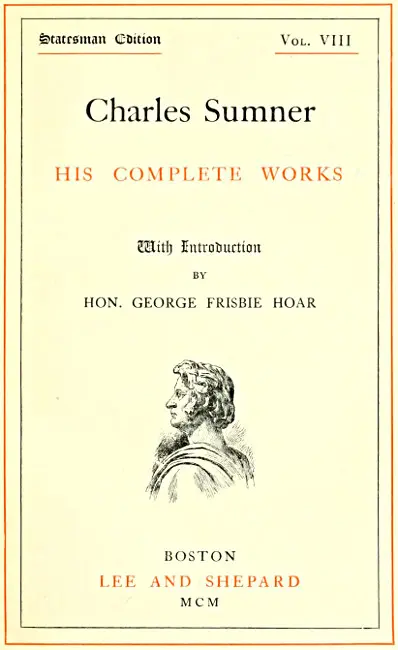
"Charles Sumner: his complete works, volume 08 (of 20)" by Charles Sumner is a historical collection of speeches and writings from the notable American statesman, likely compiled in the late 19th century. This volume emphasizes key issues faced during the Civil War era, including legal reforms, emancipation, and the rights of fugitive slaves. Sumner's articulate arguments reflect his commitment to human rights and the abolition of slavery, offering an insightful perspective on this critical period in American history. The opening of this work introduces various resolutions and speeches presented by Sumner in the Senate around 1861 and 1862. He revisits his long-standing proposals for the revision of national statutes, addresses the injustices faced by colored inventors concerning patent rights, and advocates for the humane treatment of fugitive slaves by the Union army. Additionally, he tackles the political expulsion of those who supported secession, illustrating the intense debates and moral dilemmas that characterized U.S. governance amid the Civil War. This opening segment not only sets the stage for Sumner's powerful oratory but also underscores the socio-political landscape of a nation grappling with its principles of liberty and justice.
Introduction adapted from the source catalogue; source summaries may be automatically generated.
Free to read · English · 114,219 words · No account needed
MAKE TIME FOR A GOOD BOOK
On by default. Untick to stop anonymous reading totals. Each page counts after 10 seconds in view. How this works.
Anonymous counting is on unless you have switched it off.
“Sir, by the eternal principles of natural justice no master in the State has a right to hold his slave in bondage for a single hour.”[215]
And Henry Brougham spoke not only as statesman and lawyer, but as orator also, when, in the British Parliament, he uttered these memorable words:--
“Tell me not of rights, talk not of the property of the planter in his slaves. I deny the right, I acknowledge not the property. The principles, the feelings, of our common nature rise in rebellion against it. Be the appeal made to the understanding or to the heart, the sentence is the same that rejects it. In vain you tell me of laws that sanction such a claim. There is a law above all the enactments of human codes,--the same throughout the world, the same in all times: … it is the law written on the heart of man by the finger of his Maker; and by that law, unchangeable and eternal, while men despise fraud and loathe rapine and abhor blood, they will reject with indignation the wild and guilty fantasy that man can hold property in man.”[216]
It has been sometimes said that the finest sentence of the English language is that famous description of Law with which Hooker closes the first book of his “Ecclesiastical Polity”; but I cannot doubt that this wonderful denunciation of an irrational and inhuman pretension will be remembered hereafter with higher praise; for it gathers into surpassing eloquence the waking and immitigable instincts of Universal Man.
If I enter now into analysis of Slavery, and say familiar things, it is because such exposition is an essential link in the present inquiry. Looking carefully at Slavery as it is, we find that it is not merely a single gross pretension, utterly inadmissible, but an aggregation of gross pretensions, all and each utterly inadmissible. They are five in number: first, the pretension of property in man; secondly, the denial of the marriage relation,--for slaves are “coupled” only, and not married; thirdly, the denial of the paternal relation; fourthly, the denial of instruction; and, fifthly, the appropriation of all the labor of the slave and its fruits by the master. Such are the five essential elements which we find in Slavery; and this fivefold barbarism, so utterly indefensible in every point, is maintained for the single purpose of compelling labor without wages. Of course such a pretension is founded in force, and nothing else. It begins with the kidnapper in Guinea or Congo, traverses the sea with the pirate slave-trader in his crowded hold, and is continued here by virtue of laws representing and embodying the same brutal force that prevailed in the kidnapper and the pirate slave-trader. Slavery, wherever it exists, is the triumph of force, sometimes in the strong arm of an individual, and sometimes in the strong arm of law, but in principle always the same. Depending upon force, he is master who happens to be stronger,--so that, if the slave were stronger, he would be master, and the master would be slave. Beyond all doubt, according to reason and justice, every slave possesses the same right to enslave his master that his master possesses to enslave him. If this simple statement of unquestionable principles needed confirmation, it would be found in the solemn judgments of courts. Here, for instance, are the often quoted words of Mr. Justice McLean, of the Supreme Court of the United States: “Slavery is admitted by almost all who have examined the subject to be founded in wrong, in oppression, in power against right.”[217] And here are the words of the Supreme Court of North Carolina: “Such services [of a slave] can only be expected from one who has no will of his own, who surrenders his will in implicit obedience to that of another. Such obedience is the consequence only of uncontrolled authority over the body. There is nothing else which can operate to produce the effect.”[218] And the Supreme Court of the United States, by the lips of Chief Justice Marshall, has openly declared, in a famous case, read the other day by the Senator from Kentucky [Mr. DAVIS], that “Slavery has its origin in force.”[219] Thus does it appear by most authoritative words, that this monstrous Barbarism is derived not from reason, or nature, or justice, or goodness, but from force, and nothing else.
Your reading position is saved on this browser. Take it to another device with a library code. Reading pages adapt to text, rather than matching a printed edition.
Charles Sumner

Charles Sumner

Charles Sumner

Charles Sumner
BEHIND THE BOOK
This eBook is for the use of anyone anywhere in the United States and most other parts of the world at no cost and with almost no restrictions whatsoever. You may copy it, give it away or re-use it under the terms of the Project Gutenberg License included with this eBook or online at www.gutenberg.org. If you are not located in the United States, you will have to check the laws of the country where you are located before using this eBook. Read the source licence.
The original source file, including credits and licence, is retained by this library. Request an original-format copy at no charge. Please include the book title and Project Gutenberg identifier #48170.
KEEP YOUR CURIOSITY GOING

David Patterson (Spirit) Hatch

David Patterson (Spirit) Hatch

David Patterson (Spirit) Hatch
Cécile Tormay

Moritz Busch
John L. Ransom