
Charles Sumner: his complete works, volume 20 (of 20)
Charles Sumner
THE CLASSIC COLLECTION · 1872
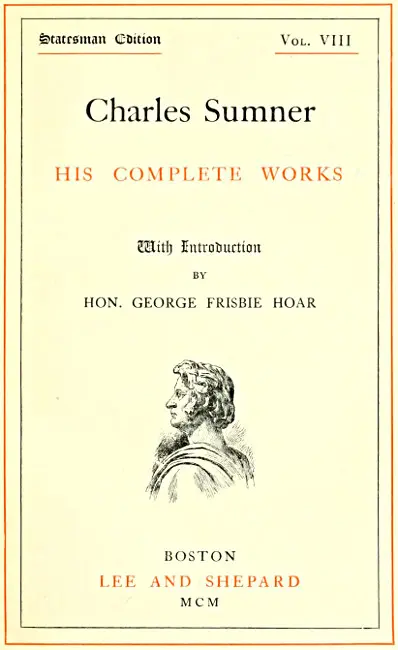
"Charles Sumner: his complete works, volume 08 (of 20)" by Charles Sumner is a historical collection of speeches and writings from the notable American statesman, likely compiled in the late 19th century. This volume emphasizes key issues faced during the Civil War era, including legal reforms, emancipation, and the rights of fugitive slaves. Sumner's articulate arguments reflect his commitment to human rights and the abolition of slavery, offering an insightful perspective on this critical period in American history. The opening of this work introduces various resolutions and speeches presented by Sumner in the Senate around 1861 and 1862. He revisits his long-standing proposals for the revision of national statutes, addresses the injustices faced by colored inventors concerning patent rights, and advocates for the humane treatment of fugitive slaves by the Union army. Additionally, he tackles the political expulsion of those who supported secession, illustrating the intense debates and moral dilemmas that characterized U.S. governance amid the Civil War. This opening segment not only sets the stage for Sumner's powerful oratory but also underscores the socio-political landscape of a nation grappling with its principles of liberty and justice.
Introduction adapted from the source catalogue; source summaries may be automatically generated.
Free to read · English · 114,219 words · No account needed
MAKE TIME FOR A GOOD BOOK
On by default. Untick to stop anonymous reading totals. Each page counts after 10 seconds in view. How this works.
Anonymous counting is on unless you have switched it off.
“MR. COLFAX. Not being a lawyer, and not understanding, therefore, all the rules which govern the proceedings of the courts, I, however, say that I am informed by those who are lawyers that the rules of evidence in force in the States respectively are adopted by the United States courts in such States. And the gentleman from Massachusetts, who is a lawyer, ought to have known the fact, and, knowing it, ought not to have asked me such a question.
“MR. DAWES. The gentleman from Indiana has not quite
answered me.”[210]
Mr. Colfax moved to lay the bill on the table, which was ordered, May 21st: Yeas 82, Nays 45. So the bill was lost.
In the next Congress it was again introduced by Mr. Sumner.
A letter from William C. Nell, of Boston, well known for his volume on “The Colored Patriots of the Revolution,” shows how a single individual suffered under this discrimination of color.
“Please accept my sincere thanks for your efforts to remove the disqualification of color in mail-carrying.
“Mr. Phillips conveyed to me the substance of information imparted by you, to wit, the postponement of the bill in the House. To me the disappointment is heavy, presuming said action to be a finality, at least for this session, and the next one is not likely to be as liberal.
“I never had more desire or more need of chances to earn money than now, and never were my opportunities so small.”
The existing law was general, and Mr. Nell could not be a
letter-carrier in Boston.
SPEECH IN THE SENATE, ON THE BILL FOR THE ABOLITION OF SLAVERY IN THE DISTRICT OF COLUMBIA, MARCH 31, 1862.
And I will very gladly spend and be spent for you.
ST. PAUL, 2 Corinthians, XII. 15.
Ornatus sacramentorum redemtio captivorum est.
ST. AMBROSE, De Officiis Ministrorum, Lib. II. Cap. 28.
Thy ransom paid, which man from death redeems.
MILTON, Paradise Lost, Book XII. 424.
Let me observe, fellow-citizens, that this enterprise of unparalleled magnitude and importance, the extirpation of Slavery from the face of the earth, of which the Abolition of Slavery throughout this Union is the principal branch, and the Abolition of Slavery in the District of Columbia a minute ramification, is an effort to purify and redeem the human race from the sorest evil with which they are afflicted in the mortal stage of their existence.--JOHN QUINCY ADAMS, Speech at Bridgewater, Mass., November 6, 1844.
Your reading position is saved on this browser. Take it to another device with a library code. Reading pages adapt to text, rather than matching a printed edition.
Charles Sumner

Charles Sumner

Charles Sumner

Charles Sumner
BEHIND THE BOOK
This eBook is for the use of anyone anywhere in the United States and most other parts of the world at no cost and with almost no restrictions whatsoever. You may copy it, give it away or re-use it under the terms of the Project Gutenberg License included with this eBook or online at www.gutenberg.org. If you are not located in the United States, you will have to check the laws of the country where you are located before using this eBook. Read the source licence.
The original source file, including credits and licence, is retained by this library. Request an original-format copy at no charge. Please include the book title and Project Gutenberg identifier #48170.
KEEP YOUR CURIOSITY GOING

David Patterson (Spirit) Hatch

David Patterson (Spirit) Hatch

David Patterson (Spirit) Hatch
Cécile Tormay

Moritz Busch
John L. Ransom