
Charles Sumner: his complete works, volume 20 (of 20)
Charles Sumner
THE CLASSIC COLLECTION · 1891
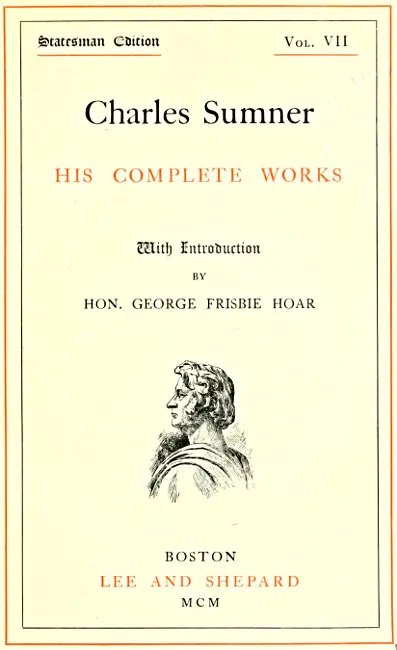
"Charles Sumner: his complete works, volume 07 (of 20)" by Charles Sumner is a historical account composed in the mid-19th century. This volume presents a collection of speeches and writings by Sumner, a prominent abolitionist and U.S. senator, centered around his staunch opposition to slavery and advocacy for civil rights. The work likely spans critical moments leading up to the Civil War, highlighting the political tensions of the time. The opening of this volume introduces letters and speeches made by Sumner in 1860, addressing the moral and constitutional arguments against slavery. He expresses his unwavering condemnation of the Fugitive Slave Act, calls for public opinion to render it ineffective, and desires to reinforce the dignity of human rights through education and moral governance. Through these writings, Sumner emphasizes the responsibilities of citizens and lawmakers to uphold justice, ultimately advocating for a society where freedom prevails over oppression. His eloquent expressions reveal deep convictions and passionate appeals for progress in a nation grappling with the moral dilemmas of slavery.
Introduction adapted from the source catalogue; source summaries may be automatically generated.
Free to read · English · 108,933 words · No account needed
MAKE TIME FOR A GOOD BOOK
On by default. Untick to stop anonymous reading totals. Each page counts after 10 seconds in view. How this works.
Anonymous counting is on unless you have switched it off.
[175] Appleton’s Annual Cyclopædia, 1861, art. SLAVES, p. 643. The Secretary spoke at a “clam-bake.”
[176] Rebellion Record, Vol. III., Documents, p. 36.
[177] On the Frogs, 190.
[178] Plutarch, Decem Oratorum Vitæ: Hyperides. See also Demosthenes, Contra Aristogitonem II. pp. 803, 804; Allgemeine Encyklopädie von Ersch und Gruber, art. HYPERIDES; Smith’s Dictionary of Greek and Roman Biography and Mythology, Vol. I. p. 985, art. DEMOSTHENES.
[179] From a MS. note-book; but the reference is accidentally omitted.
[180] History of Rome, Vol. II. p. 300.
[181] Art. CAIUS MARIUS.
[182] History of Rome, ed. Schmitz, Vol. I. (forming the fourth volume of the entire History) p. 400.
[183] From the French of Amiot, Cambridge, 1676, p. 367.
[184] Life of Tiberius Gracchus, tr. Langhorne.
[185] History of Rome, ed. Schmitz, Vol. I. p. 326.
[186] Suetonius, Julius Cæsar, c. XLII.
[187] Merivale, History of the Romans under the Empire, Vol. I. p. 52.
[188] Life of Caius Marius, tr. Langhorne.
[189] Ibid., from the French of Amiot, Cambridge, 1676, p. 368.
[190] Ibid., tr. Langhorne.
[191] Life of Sertorius, tr. Langhorne.
[192] Ibid.
[193] “Out of which materials he made up a legion.”--Decline of the Roman Republic, Vol. II. Chap. XVIII. p. 239.
[194] Mr. Charles C. Hazewell, in an elaborate article, brought his rare acuteness and reading in reply to the critics. Daily Evening Traveller, October 19, 1861.
[195] The New York Herald, in reproducing the letter, attributed it to Prince Napoleon. In like spirit, Maurice Sand, son of George Sand, who was in the suite of the Prince, in his Six Mille Lieues à toute Vapeur, in the Revue des Deux Mondes, 1862, Jan.-Fév., p. 686.
[196] Lettres sur les États-Unis d’Amérique, par le Lieutenant-Colonel Ferri-Pisani, Aide-de-Camp de S. A. I. Prince Napoléon, pp. 121, 122.
[197] Mr. Sumner insisted that the Union could be saved only through
Freedom.
[198] Strictly true, during the delivery of the speech.
[199] L’Amérique devant l’Europe, pp. 262, 268, 440.
[200] Special Report of the Antislavery Conference in Paris, August 24
and 27, 1867, pp. 30, 31.
[201] Journal des Débats, 11 Oct., 1871.
[202] Cicero, Oratio ad Quirites post Reditum, c. 8,--quoted in Private Letters of Junius to H. S. Woodfall, No. 59, March 5, 1772: Woodfall’s Junius, (London, 1812,) Vol. I. p. 253.
[203] An Historical Research respecting the Opinions of the Founders of the Republic on Negroes as Slaves, as Citizens, and as Soldiers: read before the Massachusetts Historical Society, August 14, 1862. Reprinted from Proceedings of the Massachusetts Historical Society, 1862-63.
[204] This introduction is taken from the pamphlet edition of the
Oration.
[205] Of Reformation in England, Book II.: Prose Works, ed. Symmons,
Vol. I. p. 45.
[206] Rebellion Record, Vol. I. pp. 45, 46.
[207] The Debates in 1776 on the Declaration of Independence, etc., preserved by Thomas Jefferson: Madison Papers, Vol. I. p. 17; Jefferson’s Writings, Vol. I. p. 18.
[208] Bowen, Life of Benjamin Lincoln: Sparks’s American Biography, 2d
Ser. Vol. XIII. p. 286.
[209] Debates in the Federal Convention, August 21, 22, 1787: Madison Papers, Vol. III. pp. 1389-1395.
Your reading position is saved on this browser. Take it to another device with a library code. Reading pages adapt to text, rather than matching a printed edition.
Charles Sumner

Charles Sumner

Charles Sumner

Charles Sumner
BEHIND THE BOOK
This eBook is for the use of anyone anywhere in the United States and most other parts of the world at no cost and with almost no restrictions whatsoever. You may copy it, give it away or re-use it under the terms of the Project Gutenberg License included with this eBook or online at www.gutenberg.org. If you are not located in the United States, you will have to check the laws of the country where you are located before using this eBook. Read the source licence.
The original source file, including credits and licence, is retained by this library. Request an original-format copy at no charge. Please include the book title and Project Gutenberg identifier #48077.
KEEP YOUR CURIOSITY GOING

David Patterson (Spirit) Hatch

David Patterson (Spirit) Hatch

David Patterson (Spirit) Hatch
Cécile Tormay

Moritz Busch
John L. Ransom