
Charles Sumner: his complete works, volume 20 (of 20)
Charles Sumner
THE CLASSIC COLLECTION · 1891
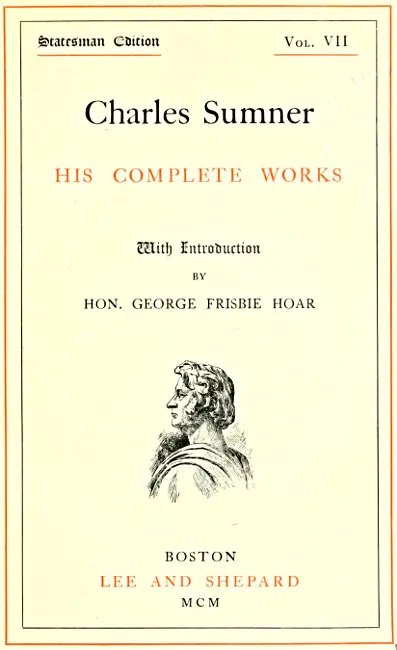
"Charles Sumner: his complete works, volume 07 (of 20)" by Charles Sumner is a historical account composed in the mid-19th century. This volume presents a collection of speeches and writings by Sumner, a prominent abolitionist and U.S. senator, centered around his staunch opposition to slavery and advocacy for civil rights. The work likely spans critical moments leading up to the Civil War, highlighting the political tensions of the time. The opening of this volume introduces letters and speeches made by Sumner in 1860, addressing the moral and constitutional arguments against slavery. He expresses his unwavering condemnation of the Fugitive Slave Act, calls for public opinion to render it ineffective, and desires to reinforce the dignity of human rights through education and moral governance. Through these writings, Sumner emphasizes the responsibilities of citizens and lawmakers to uphold justice, ultimately advocating for a society where freedom prevails over oppression. His eloquent expressions reveal deep convictions and passionate appeals for progress in a nation grappling with the moral dilemmas of slavery.
Introduction adapted from the source catalogue; source summaries may be automatically generated.
Free to read · English · 108,933 words · No account needed
MAKE TIME FOR A GOOD BOOK
On by default. Untick to stop anonymous reading totals. Each page counts after 10 seconds in view. How this works.
Anonymous counting is on unless you have switched it off.
[80] Mémoires, Tom. II. p. 8. Madison, writing to Jefferson, under date of October 17, 1784, says: “The time I have lately passed with the Marquis has given me a pretty thorough insight into his character. With great natural frankness of temper he unites much address and very considerable talents. In his politics, he says his three hobby-horses are the alliance between France and the United States, the union of the latter, and the manumission of the slaves.” (Madison’s Letters and other Writings, Vol. I. p. 106.) Call these hobby-horses! They were three practical policies, having their foundation in everlasting principles. How many of our own statesmen saw as wisely?
[81] Journal of Congress, Vol. X. p. 20: December 13, 1784. Mémoires,
Tom. II. p. 106.
[82] Letter of December 21, 1784: Correspondence of the Revolution, ed. Sparks, Vol. IV. pp. 87, 89; Mémoires, Tom. II. pp. 111, 113.
[83] Letter to Washington, October 26, 1786: Correspondence of the Revolution, ed. Sparks, Vol. IV. p. 144; Mémoires, Tom. II. p. 157.
[84] Mémoires, Tom. II. p. 131.
[85] Correspondence of Charles, First Marquis Cornwallis, ed. Ross,
Vol. I. p. 205.
[86] Letter of 5th April, 1783: Writings, ed. Sparks, Vol. VIII. p. 414; Mémoires, Tom. II. p. 74.
[87] Mémoires, Tom. II. pp. 9, 139; Tom. III. p. 72.
[88] Letter of 10th May, 1786: Writings, ed. Sparks, Vol. IX. p. 163.
[89] Works of John Adams, Vol. VIII. p. 376.
[90] Hamilton’s Works, edited by his Son, Vol. I. pp. 423, 424.
[91] Lady Morgan’s France, Vol. I. p. 71. Ticknor’s Outlines of the Life of Lafayette, p. 19. Mémoires, Tom. II. p. 177.
[92] Mémoires, Tom. II. p. 252.
[93] Mémoires, Tom. II. p. 251.
[94] Speech in the National Assembly, February 20, 1790: Mémoires, Tom.
II. p. 383.
[95] Mémoires, Tom. III. p. 71, note. Clarkson, History of the Abolition of the African Slave-Trade, (Philadelphia, 1808,) Vol. II. pp. 106, 107.
[96] Mémoires, Tom. IV. pp. 221, 230, 231.
[97] Mémoires, Tom. IV. p. 288.
[98] Ibid., pp. 237, 238.
[99] Ibid., p. 242.
[100] Mémoires, Tom. III. p. 412; Tom. IV. p. 229.
[101] Lettre à Madame d’Hénin, Magdebourg, 13 Mars, 1793: Mémoires, Tom. IV. p. 224; Sparks’s Life of Gouverneur Morris, Vol. I. p. 410; Washington’s Writings, ed. Sparks, Vol. IX. p. 163, note.
[102] Mémoires, Tom. III. pp. 72 and 401, note.
[103] Speech of Gen. Fitzpatrick in the House of Commons, December 16, 1796: Hansard’s Parliamentary History, Vol. XXXII. col. 1353.
[104] “M. de la Fayette est de ces hommes que nous devons aimer, et lors de sa captivité je me présentai à l’Empereur pour réclamer sa liberté, que je n’ai pas eu le bonheur d’obtenir.” This is the report, by Joseph Bonaparte, of the conversation of Lord Cornwallis at the dinner-table of the former, in 1802.--Mémoires du Roi Joseph, Tom. I. pp. 86, 87.
Your reading position is saved on this browser. Take it to another device with a library code. Reading pages adapt to text, rather than matching a printed edition.
Charles Sumner

Charles Sumner

Charles Sumner

Charles Sumner
BEHIND THE BOOK
This eBook is for the use of anyone anywhere in the United States and most other parts of the world at no cost and with almost no restrictions whatsoever. You may copy it, give it away or re-use it under the terms of the Project Gutenberg License included with this eBook or online at www.gutenberg.org. If you are not located in the United States, you will have to check the laws of the country where you are located before using this eBook. Read the source licence.
The original source file, including credits and licence, is retained by this library. Request an original-format copy at no charge. Please include the book title and Project Gutenberg identifier #48077.
KEEP YOUR CURIOSITY GOING

David Patterson (Spirit) Hatch

David Patterson (Spirit) Hatch

David Patterson (Spirit) Hatch
Cécile Tormay

Moritz Busch
John L. Ransom