
Charles Sumner: his complete works, volume 20 (of 20)
Charles Sumner
THE CLASSIC COLLECTION · 1891
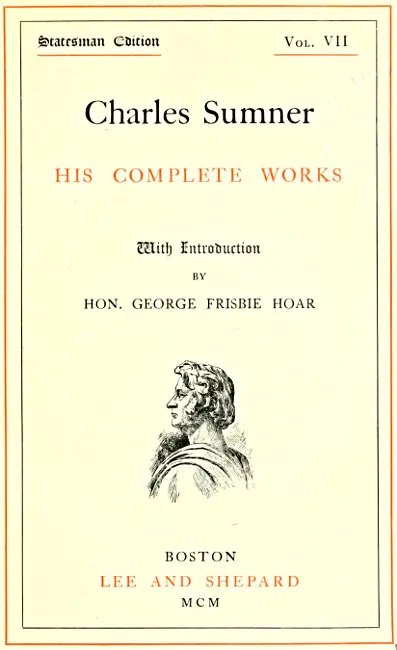
"Charles Sumner: his complete works, volume 07 (of 20)" by Charles Sumner is a historical account composed in the mid-19th century. This volume presents a collection of speeches and writings by Sumner, a prominent abolitionist and U.S. senator, centered around his staunch opposition to slavery and advocacy for civil rights. The work likely spans critical moments leading up to the Civil War, highlighting the political tensions of the time. The opening of this volume introduces letters and speeches made by Sumner in 1860, addressing the moral and constitutional arguments against slavery. He expresses his unwavering condemnation of the Fugitive Slave Act, calls for public opinion to render it ineffective, and desires to reinforce the dignity of human rights through education and moral governance. Through these writings, Sumner emphasizes the responsibilities of citizens and lawmakers to uphold justice, ultimately advocating for a society where freedom prevails over oppression. His eloquent expressions reveal deep convictions and passionate appeals for progress in a nation grappling with the moral dilemmas of slavery.
Introduction adapted from the source catalogue; source summaries may be automatically generated.
Free to read · English · 108,933 words · No account needed
MAKE TIME FOR A GOOD BOOK
On by default. Untick to stop anonymous reading totals. Each page counts after 10 seconds in view. How this works.
Anonymous counting is on unless you have switched it off.
[15] Jackson’s History of Newton, p. 336. See, ante, Vol. II. pp.
289, 290.
[16] Wordsworth, Rob Roy’s Grave.
[17] Tom. II. p. 155.
[18] Collection of Papers on Political, Literary, and Moral Subjects, by Noah Webster, pp. 325, 326.
[19] Letter to Stephen White, February 27, 1820: Life and Letters of Joseph Story, by his Son, Vol. I. p. 362.
[20] See, post, p. 435, Remarks in the Senate, Dec. 10, 1860.
[21] The Impending Crisis, by H. R. Helper, containing a radical arraignment of Slavery, was recommended by Members of Congress.
[22] Leyden, Scenes of Infancy, Part III.: Poetical Remains, pp. 373,
374.
[23] Essays: Of Plantations.
[24] Commentaries, Vol. I. p. 49.
[25] Ibid., p. 160.
[26] Works, (Oxford, 1825,) Vol. VI. p. 234.
[27] Ante, p. 251.
[28] Letter to A. O. P. Nicholson, December 24, 1847.
[29] Oration at Quincy, pp. 13, 14.
[30] Ibid., p. 18.
[31] Oration at Newburyport, p. 24.
[32] Ibid., pp. 26, 27.
[33] Annals of Congress, 7th Cong. 2d Sess., 613, 1353. At a later day the tone of Mr. Randolph was different. See, ante, p. 298.
[34] Congressional Globe, 36th Cong. 1st Sess., p. 2073, May 11, 1860.
[35] Writings of Washington, ed. Sparks, Vol. VII., Appendix, p. 533.
[36] Speech at Chicago, July 10, 1858: Political Debates between
Lincoln and Douglas, p. 20.
[37] See Odyssey, tr. Pope, Book XIII. 180, 181.
[38] Debates in the Federal Convention, August 25, 1787: Madison Papers, Vol. III. pp. 1429, 1430.
[39] In opening his lecture, Mr. Sumner, according to the newspaper reports, alluded to the new hall in which he spoke, called after the founder of Providence, as follows.--“In the honored name assumed for this most beautiful and spacious hall, you pledge yourselves that here Toleration shall prevail, and Liberty be a constant word. It was the gratulation of the Roman historian in the days of the good Emperors, that he could think what he pleased and speak what he thought. Should this privilege ever fail in your new hall, or anywhere within its influence, then must you forget the great example consecrated in the name of Roger Williams. With this privilege securely established, you may proudly point to a higher token of civilization than a column of the Roman Forum or a frieze of the Parthenon.”
[40] “Nullum numen abest, si sit Prudentia.”--JUVENAL, Sat.
X. 365.
[41] Life of Washington, Appendix, pp. 510, 511: Writings, Vol. I.,
Appendix, pp. 552, 553.
[42] Vol. I. p. 652.
[43] Ibid.
[44] Ibid., p. 478.
[45] Sylva, ed. Hunter, (York, 1776,) p. 497.
[46] The Satyr: Works, ed. Gifford, (London, 1816,) Vol. VI. p. 468.
[47] Memoirs, Vol. II. p. 50.
[48] At the date of Mr. Sumner’s letter the extremists of Slavery in our country were known as “fire-eaters.”
[49] Memoirs, Vol. I. pp. 458, 483, 579.
[50] Introduction, p. 4, ed. Milman, London, 1839.
[51] The Republican Party, its Origin, Necessity, and Permanence:
Ante, pp. 191-229.
[52] See, post, p. 420.
[53] Langhorne, The Country Justice, Part I. 161-164. See also Lockhart’s Life of Scott, Vol. I. ch. 5.
Your reading position is saved on this browser. Take it to another device with a library code. Reading pages adapt to text, rather than matching a printed edition.
Charles Sumner

Charles Sumner

Charles Sumner

Charles Sumner
BEHIND THE BOOK
This eBook is for the use of anyone anywhere in the United States and most other parts of the world at no cost and with almost no restrictions whatsoever. You may copy it, give it away or re-use it under the terms of the Project Gutenberg License included with this eBook or online at www.gutenberg.org. If you are not located in the United States, you will have to check the laws of the country where you are located before using this eBook. Read the source licence.
The original source file, including credits and licence, is retained by this library. Request an original-format copy at no charge. Please include the book title and Project Gutenberg identifier #48077.
KEEP YOUR CURIOSITY GOING

David Patterson (Spirit) Hatch

David Patterson (Spirit) Hatch

David Patterson (Spirit) Hatch
Cécile Tormay

Moritz Busch
John L. Ransom