
Charles Sumner: his complete works, volume 20 (of 20)
Charles Sumner
THE CLASSIC COLLECTION · 1891
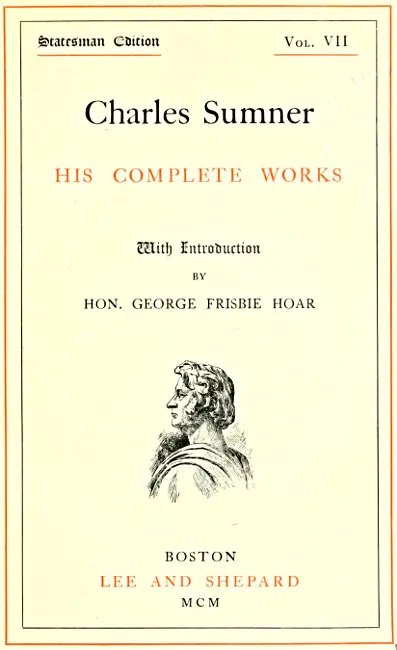
"Charles Sumner: his complete works, volume 07 (of 20)" by Charles Sumner is a historical account composed in the mid-19th century. This volume presents a collection of speeches and writings by Sumner, a prominent abolitionist and U.S. senator, centered around his staunch opposition to slavery and advocacy for civil rights. The work likely spans critical moments leading up to the Civil War, highlighting the political tensions of the time. The opening of this volume introduces letters and speeches made by Sumner in 1860, addressing the moral and constitutional arguments against slavery. He expresses his unwavering condemnation of the Fugitive Slave Act, calls for public opinion to render it ineffective, and desires to reinforce the dignity of human rights through education and moral governance. Through these writings, Sumner emphasizes the responsibilities of citizens and lawmakers to uphold justice, ultimately advocating for a society where freedom prevails over oppression. His eloquent expressions reveal deep convictions and passionate appeals for progress in a nation grappling with the moral dilemmas of slavery.
Introduction adapted from the source catalogue; source summaries may be automatically generated.
Free to read · English · 108,933 words · No account needed
MAKE TIME FOR A GOOD BOOK
On by default. Untick to stop anonymous reading totals. Each page counts after 10 seconds in view. How this works.
Anonymous counting is on unless you have switched it off.
Upon the platform were seated many distinguished citizens, among whom may be named Hon. William Pennington, ex-Governor of New Jersey and ex-Speaker of the House of Representatives, Hon. Schuyler Colfax of Indiana, Hon. Lot M. Morrill of Maine, Charles King, LL. D., President of Columbia College, Professor Francis Lieber, David Dudley Field, Esq., William M. Evarts, Esq., John Jay, Esq., Rev. Stephen H. Tyng, D. D., Rev. William Hague, D. D., Rev. George B. Cheever, D. D., Rev. Theodore L. Cuyler, Rev. Alfred Cookman, John H. Griscom, M. D., Hon. John W. Edmonds, General Prosper M. Wetmore, Lewis Tappan, Esq., Rev. William Goodell, Hon. Charles A. Peabody, Rev. Roswell D. Hitchcock, D. D., Rev. Henry M. Field, Hon. Thomas B. Stillman, Hon. Benjamin F. Manierré, R. M. Blatchford, Esq., William Pitt Palmer, Esq., D. A. Harsha, Esq., George P. Putnam, Esq., Elliot C. Cowdin, Esq., Hon. William B. Taylor, Postmaster of New York, Hon. Rufus F. Andrews, Surveyor of the Port, Hon. H. B. Stanton, Deputy Collector, Hon. Joseph Hoxie, Major A. A. Selover, U. S. Army, Oliver Johnson, Esq.
Charles T. Rodgers, Esq., President of the “Union,” introduced William Curtis Noyes, Esq., as presiding officer of the meeting, and a list of Vice-Presidents and Secretaries was unanimously adopted.
Mr. Noyes, upon taking the chair, delivered the following
address.
“LADIES AND GENTLEMEN:--Thanking you, as I do, gratefully, for the kindness which has called me to preside over this meeting, let me remind you that within the modest chapel which impresses with devotional emotions every visitor to Mount Auburn, that most beautiful of American cemeteries, stands a marble statue of one of the patriot leaders of the American Revolution. Its simple dignity arrests attention and commands admiration and respect. Stern resolve and unflinching courage are depicted in lineament and attitude. We see him voluntarily renouncing a high professional office under the crown to take his place in the forum as a private citizen, to oppose, without reward, the odious violations of the liberties of the people by means of Writs of Assistance. His exordium startles the prejudiced judges:--
“‘Let the consequences be what they will, I am determined to proceed. The only principles of public conduct that are worthy of a gentleman or a man are to sacrifice estate, ease, health, and applause, and even life, to the sacred calls of country. These principles, in private life, make the good citizen,--in public life, the patriot and the hero.’
“Then, rising with the progress of his great theme, he
continues:--
Your reading position is saved on this browser. Take it to another device with a library code. Reading pages adapt to text, rather than matching a printed edition.
Charles Sumner

Charles Sumner

Charles Sumner

Charles Sumner
BEHIND THE BOOK
This eBook is for the use of anyone anywhere in the United States and most other parts of the world at no cost and with almost no restrictions whatsoever. You may copy it, give it away or re-use it under the terms of the Project Gutenberg License included with this eBook or online at www.gutenberg.org. If you are not located in the United States, you will have to check the laws of the country where you are located before using this eBook. Read the source licence.
The original source file, including credits and licence, is retained by this library. Request an original-format copy at no charge. Please include the book title and Project Gutenberg identifier #48077.
KEEP YOUR CURIOSITY GOING

David Patterson (Spirit) Hatch

David Patterson (Spirit) Hatch

David Patterson (Spirit) Hatch
Cécile Tormay

Moritz Busch
John L. Ransom