
Charles Sumner: his complete works, volume 20 (of 20)
Charles Sumner
THE CLASSIC COLLECTION · 1891
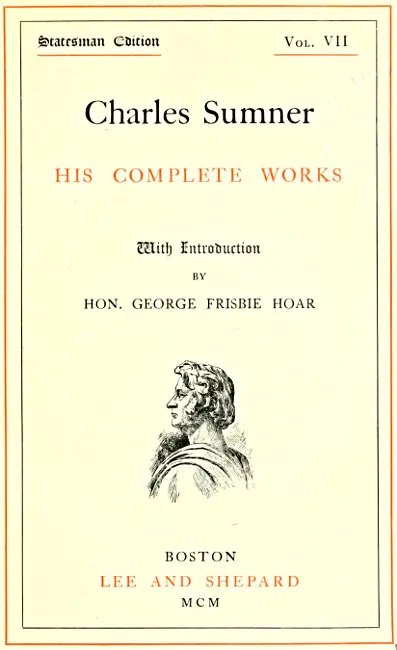
"Charles Sumner: his complete works, volume 07 (of 20)" by Charles Sumner is a historical account composed in the mid-19th century. This volume presents a collection of speeches and writings by Sumner, a prominent abolitionist and U.S. senator, centered around his staunch opposition to slavery and advocacy for civil rights. The work likely spans critical moments leading up to the Civil War, highlighting the political tensions of the time. The opening of this volume introduces letters and speeches made by Sumner in 1860, addressing the moral and constitutional arguments against slavery. He expresses his unwavering condemnation of the Fugitive Slave Act, calls for public opinion to render it ineffective, and desires to reinforce the dignity of human rights through education and moral governance. Through these writings, Sumner emphasizes the responsibilities of citizens and lawmakers to uphold justice, ultimately advocating for a society where freedom prevails over oppression. His eloquent expressions reveal deep convictions and passionate appeals for progress in a nation grappling with the moral dilemmas of slavery.
Introduction adapted from the source catalogue; source summaries may be automatically generated.
Free to read · English · 108,933 words · No account needed
MAKE TIME FOR A GOOD BOOK
On by default. Untick to stop anonymous reading totals. Each page counts after 10 seconds in view. How this works.
Anonymous counting is on unless you have switched it off.
As after the speech on the Barbarism of Slavery, so now, letters came with volunteer testimony. Beyond their interest as tokens of strong and wide-spread sympathy with Mr. Sumner, they have historic value as illustrations of the intense Antislavery sentiment destined so soon to triumph. Sometimes they are directly responsive to the press, especially in the severity of its criticism on the speech. Here, as before, Abolitionists took the lead.
Wendell Phillips thus earnestly placed himself by the side of
his friend:--
“I both thank and congratulate you most heartily on your great speech, for some reasons the boldest even you ever made,--the first statesmanlike word worthy of the hour from any one in a high civil position,--fit response from Statesmanship to War,--showing the people the reasons and purpose of Fremont’s proclamation, and giving it more breadth and a nobler basis.
“All agree it was a most decided success,--taking the Convention wholly off its feet with enthusiasm; and we absent ones may measure the strength of the blow from the rebound,--witness Post, Courier, Journal, and, basest of all, Advertiser, of course.…
“Never fear but that the masses, the hearts, are all with you,--and you’ll see your enemies at your footstool, as you so often have already.”
And in another letter:--
“I could not take the hazard of advising you to make it, though I told you in your circumstances I should; but now you’ve done it, I can say it was wise and well,--your duty to the country, to the hour, yourself, the slave,--to your fame as a statesman, and your duty as leader.”
Lewis Tappan, the Abolitionist, wrote from New York:--
“‘Union and Peace,--how they shall be restored.’ You have shown the way, and the only way. We may have peace on other terms, but no union and peace. The Free States must choose between peace, temporary peace, renewed war, and peace founded upon righteousness, justice, and equity.”
Hon. Amasa Walker, the able writer on Political Economy,
afterwards Representative in Congress, wrote from North
Brookfield:--
“You never made a nobler, braver, or more opportune utterance than at Worcester on the first instant. But all Hunkerdom is down upon you for it, as I expected. No matter,--the people, I trust in God, will sustain you. Your words meet a most hearty response in the hearts of all true men, you may rest assured. If your positions are not sustained by the country, the great contest now going on will end in failure, and ought to end so.”
Your reading position is saved on this browser. Take it to another device with a library code. Reading pages adapt to text, rather than matching a printed edition.
Charles Sumner

Charles Sumner

Charles Sumner

Charles Sumner
BEHIND THE BOOK
This eBook is for the use of anyone anywhere in the United States and most other parts of the world at no cost and with almost no restrictions whatsoever. You may copy it, give it away or re-use it under the terms of the Project Gutenberg License included with this eBook or online at www.gutenberg.org. If you are not located in the United States, you will have to check the laws of the country where you are located before using this eBook. Read the source licence.
The original source file, including credits and licence, is retained by this library. Request an original-format copy at no charge. Please include the book title and Project Gutenberg identifier #48077.
KEEP YOUR CURIOSITY GOING

David Patterson (Spirit) Hatch

David Patterson (Spirit) Hatch

David Patterson (Spirit) Hatch
Cécile Tormay

Moritz Busch
John L. Ransom