
Charles Sumner: his complete works, volume 20 (of 20)
Charles Sumner
THE CLASSIC COLLECTION · 1891
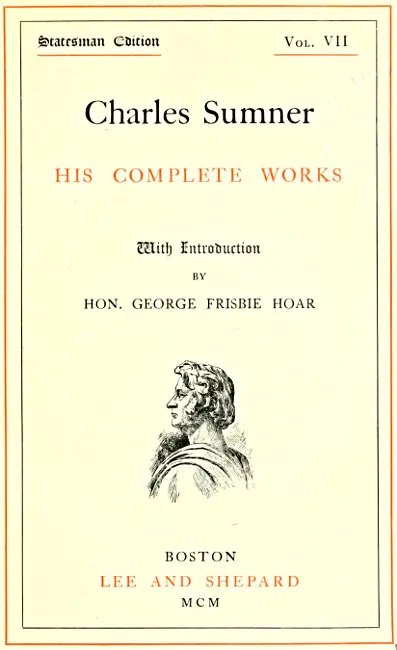
"Charles Sumner: his complete works, volume 07 (of 20)" by Charles Sumner is a historical account composed in the mid-19th century. This volume presents a collection of speeches and writings by Sumner, a prominent abolitionist and U.S. senator, centered around his staunch opposition to slavery and advocacy for civil rights. The work likely spans critical moments leading up to the Civil War, highlighting the political tensions of the time. The opening of this volume introduces letters and speeches made by Sumner in 1860, addressing the moral and constitutional arguments against slavery. He expresses his unwavering condemnation of the Fugitive Slave Act, calls for public opinion to render it ineffective, and desires to reinforce the dignity of human rights through education and moral governance. Through these writings, Sumner emphasizes the responsibilities of citizens and lawmakers to uphold justice, ultimately advocating for a society where freedom prevails over oppression. His eloquent expressions reveal deep convictions and passionate appeals for progress in a nation grappling with the moral dilemmas of slavery.
Introduction adapted from the source catalogue; source summaries may be automatically generated.
Free to read · English · 108,933 words · No account needed
MAKE TIME FOR A GOOD BOOK
On by default. Untick to stop anonymous reading totals. Each page counts after 10 seconds in view. How this works.
Anonymous counting is on unless you have switched it off.
Vice-Presidents,--Richard Libbey of Wellfleet, James H. Mitchell of East Bridgewater, Joseph N. Bacon of Newton, Albert J. Wright of Boston, Nehemiah Boynton of Chelsea, John S. E. Rogers of Gloucester, Gerry W. Cochrane of Methuen, N. C. Munson of Shirley, Giles H. Whitney of Winchendon, J. H. Butler of Northampton, Joel Hayden of Haydensville, by districts; with Robert M. Hooper of Boston, Oliver Ames, Jr., of Easton, Alexander DeWitt of Oxford, Hapgood Swift of Lowell, Freeman Walker of North Brookfield, Marshall P. Wilder of Dorchester, Clement Willis of Boston, Lorenzo Sabine of Roxbury, Thomas Tucker of Worcester, Francis H. Fay of Lancaster, Columbus Tyler of Somerville, George Washington Warren of Charlestown, Linus Beck of Boston, Charles O. Rogers of Boston, H. B. Staples of Milford, Orlando Burt of Sandisfield, Francis Coggswell of Andover, at large.
Secretaries,--S. N. Stockwell of Boston, J. E. Tucker of Worcester, N. A. Horton of Salem, Z. E. Stowe of Lowell, George S. Merrill of Lawrence, Joseph B. Thaxter of Hingham, Samuel B. Noyes of Canton, William S. Robinson of Malden, Charles A. Chase of Boston, L. H. Bradford of Fitchburg, William Martin of North Adams, Gardner M. Fiske of Palmer, William W. Clapp, Jr., of Boston.
The President, on being conducted to the chair, made a speech,
in which he said:--
“Since last assembled here for a kindred purpose, the mighty march of events has borne the popular efforts on to a higher plane than ever before opened to the gaze of man.… Massachusetts cannot, if she would, and, thank God, she would not, if she could, perform an indifferent part in this life struggle of the Republic. She makes no boast over her sister States, but the great Disposer and Adjuster of events has placed her in the forefront rank, in this great battle for the integrity of the nation and the existence of free institutions, and she accepts her place with alacrity.”
Immediately after this speech, John A. Andrew was unanimously and by acclamation renominated as candidate for Governor, being his second nomination for that post. The committees of the Convention having been appointed, there was an adjournment till afternoon.
In the afternoon, the resolutions of the Committee, seven in number, were reported by George S. Hale, of Boston, and at once laid upon the table, on motion of Edward L. Pierce, of Milton, in order to give an opportunity for Mr. Sumner to address the Convention. A report says:--
“Hon. Charles Sumner came on the platform about this time, and his presence was acknowledged with great applause. The President introduced him to the Convention, and he made a speech about an hour long.”
Your reading position is saved on this browser. Take it to another device with a library code. Reading pages adapt to text, rather than matching a printed edition.
Charles Sumner

Charles Sumner

Charles Sumner

Charles Sumner
BEHIND THE BOOK
This eBook is for the use of anyone anywhere in the United States and most other parts of the world at no cost and with almost no restrictions whatsoever. You may copy it, give it away or re-use it under the terms of the Project Gutenberg License included with this eBook or online at www.gutenberg.org. If you are not located in the United States, you will have to check the laws of the country where you are located before using this eBook. Read the source licence.
The original source file, including credits and licence, is retained by this library. Request an original-format copy at no charge. Please include the book title and Project Gutenberg identifier #48077.
KEEP YOUR CURIOSITY GOING

David Patterson (Spirit) Hatch

David Patterson (Spirit) Hatch

David Patterson (Spirit) Hatch
Cécile Tormay

Moritz Busch
John L. Ransom