
Charles Sumner: his complete works, volume 20 (of 20)
Charles Sumner
THE CLASSIC COLLECTION · 1891
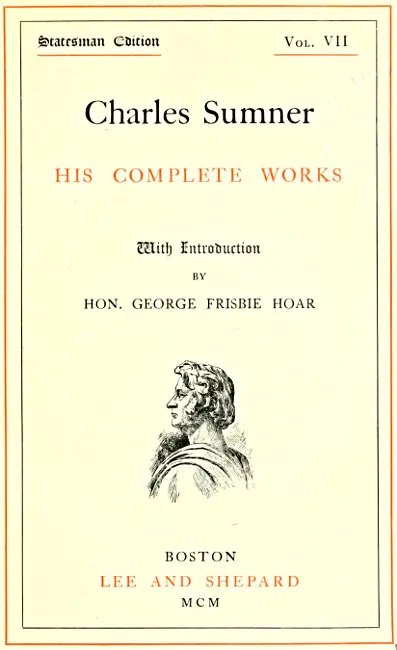
"Charles Sumner: his complete works, volume 07 (of 20)" by Charles Sumner is a historical account composed in the mid-19th century. This volume presents a collection of speeches and writings by Sumner, a prominent abolitionist and U.S. senator, centered around his staunch opposition to slavery and advocacy for civil rights. The work likely spans critical moments leading up to the Civil War, highlighting the political tensions of the time. The opening of this volume introduces letters and speeches made by Sumner in 1860, addressing the moral and constitutional arguments against slavery. He expresses his unwavering condemnation of the Fugitive Slave Act, calls for public opinion to render it ineffective, and desires to reinforce the dignity of human rights through education and moral governance. Through these writings, Sumner emphasizes the responsibilities of citizens and lawmakers to uphold justice, ultimately advocating for a society where freedom prevails over oppression. His eloquent expressions reveal deep convictions and passionate appeals for progress in a nation grappling with the moral dilemmas of slavery.
Introduction adapted from the source catalogue; source summaries may be automatically generated.
Free to read · English · 108,933 words · No account needed
MAKE TIME FOR A GOOD BOOK
On by default. Untick to stop anonymous reading totals. Each page counts after 10 seconds in view. How this works.
Anonymous counting is on unless you have switched it off.
“The petition was placed in the lobby of our post-office, under the charge of a crier, who saluted every one who passed him with, ‘Sign this petition?’--and it was thoughtlessly signed by men and boys, native and foreign.”
Charles W. Slack, of the newspaper press, wrote from Boston:--
“You are entirely right relative to the signers of the Crittenden Petition. Boys, non-voters, foreigners, anybody, were taken, who could write a name. The city police canvassed all the out-of-the-way places, and took the names they could gather.… Glad that you spoke as you did. We look to you to give the key-note. None knows Massachusetts better than you, and none will be more faithful to her, come weal or woe.”
Dr. William J. Dale, afterwards the Surgeon-General of
Massachusetts, wrote from Boston:--
“The other day a neighbor of ours, Mr. Brown, an intelligent citizen, a provision dealer, corner of Derne and Temple Streets, stopped me and said, ‘If you ever write Mr. Sumner, tell him that I, with many others, signed that Crittenden Petition under an entire misapprehension.’ Says he, ‘I would cut off my right hand before it should sign so infamous a proposition.’ That is the feeling among the middling-interest people. The so-called Union men assume the air and manner of slave-overseers. They have overdone the thing here.”
J. Vincent Browne, afterwards Collector of Internal Revenue in the Essex District of Massachusetts, wrote from Salem:--
“At least twenty persons who signed the paper in this city have said to me, ‘Why, Mr. Crittenden’s propositions are merely to restore the Missouri Compromise. I was told so, when I signed.’ When the truth was told them, as usual, they were astonished. And so men trifle with their rights, and are trifled with.”
John Tappan, a venerable citizen, loving peace, but hating
Slavery, and anxious that Massachusetts should be right, wrote
from Boston:--
“I thank you for it, and believe it speaks the sentiments of a vast majority of all parties in this and the other New England States. The only reason assigned by some of the signers is, that it was not expected that it would pass as offered, but lead to some compromise.
“Be assured the heart of the Commonwealth is with you, and that, if ever we were called upon for firmness in maintaining our Constitutional rights, it is now; and although I pray God no blood may be shed in the conflict, yet submission to the demands of Slavery is not to be the alternative.
“I rejoice the conflict has come in my day, although, on the verge of four-score, I may not live to see harmony restored.”[140]
Your reading position is saved on this browser. Take it to another device with a library code. Reading pages adapt to text, rather than matching a printed edition.
Charles Sumner

Charles Sumner

Charles Sumner

Charles Sumner
BEHIND THE BOOK
This eBook is for the use of anyone anywhere in the United States and most other parts of the world at no cost and with almost no restrictions whatsoever. You may copy it, give it away or re-use it under the terms of the Project Gutenberg License included with this eBook or online at www.gutenberg.org. If you are not located in the United States, you will have to check the laws of the country where you are located before using this eBook. Read the source licence.
The original source file, including credits and licence, is retained by this library. Request an original-format copy at no charge. Please include the book title and Project Gutenberg identifier #48077.
KEEP YOUR CURIOSITY GOING

David Patterson (Spirit) Hatch

David Patterson (Spirit) Hatch

David Patterson (Spirit) Hatch
Cécile Tormay

Moritz Busch
John L. Ransom