
Charles Sumner: his complete works, volume 20 (of 20)
Charles Sumner
THE CLASSIC COLLECTION · 1891
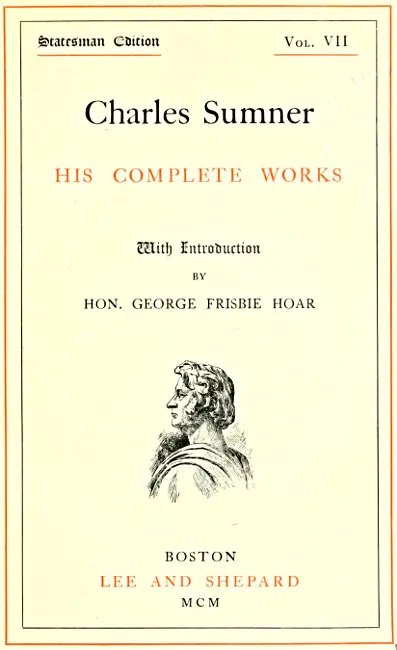
"Charles Sumner: his complete works, volume 07 (of 20)" by Charles Sumner is a historical account composed in the mid-19th century. This volume presents a collection of speeches and writings by Sumner, a prominent abolitionist and U.S. senator, centered around his staunch opposition to slavery and advocacy for civil rights. The work likely spans critical moments leading up to the Civil War, highlighting the political tensions of the time. The opening of this volume introduces letters and speeches made by Sumner in 1860, addressing the moral and constitutional arguments against slavery. He expresses his unwavering condemnation of the Fugitive Slave Act, calls for public opinion to render it ineffective, and desires to reinforce the dignity of human rights through education and moral governance. Through these writings, Sumner emphasizes the responsibilities of citizens and lawmakers to uphold justice, ultimately advocating for a society where freedom prevails over oppression. His eloquent expressions reveal deep convictions and passionate appeals for progress in a nation grappling with the moral dilemmas of slavery.
Introduction adapted from the source catalogue; source summaries may be automatically generated.
Free to read · English · 108,933 words · No account needed
MAKE TIME FOR A GOOD BOOK
On by default. Untick to stop anonymous reading totals. Each page counts after 10 seconds in view. How this works.
Anonymous counting is on unless you have switched it off.
“I think we had better be present by good men in the Conference, if there is to be one, than to be misrepresented by volunteers, or be wholly outside, unheard, and misinformed of the plans and doings inside. Our Committee on Federal Relations will report good resolutions, I think, which will leave us free of complicity with the heresy of the Virginia resolutions, and secure the dignity and fairness of our position.”
Another letter from Massachusetts said, that, if Massachusetts did not send representatives, “the Boston Hunkers would send a delegation, which would not be desirable.”
The Commissioners appointed by the Governor were, John Z. Goodrich, Charles Allen, George S. Boutwell, Francis B. Crowninshield, Theophilus P. Chandler, John M. Forbes, and Richard P. Waters,--all firm against any new concession to Slavery.
Against their influence and votes, the Convention, known as the “Peace Congress,” presented a series of propositions similar in character and surrender to those of Mr. Crittenden, sharing also a similar fate.
During these various efforts, President Buchanan was earnest for the Crittenden Compromise. An interview of Mr. Sumner with him, reported in the Northern papers, shows his desire for this terrible concession.
“WASHINGTON, February 4.
“Much interest is manifested in the interview between President Buchanan and Senator Sumner. Mr. Sumner visited the President, at the request of Governor Andrew, to learn his answer to the Massachusetts offer of military aid; that done, Mr. Sumner said,--
“What else can Massachusetts do for the good of the country?
“Mr. BUCHANAN. A great deal. No State more.
“Mr. SUMNER. I should like to know what.
“Mr. BUCHANAN (after a pause). Adopt the Crittenden
propositions.
“Mr. SUMNER. Is that necessary?
“Mr. BUCHANAN. It is.
“Mr. SUMNER. Massachusetts has not acted directly on these propositions, which seek to give Slavery Constitutional protection in Territories, and disfranchise large numbers of her citizens; but I believe such are the convictions of the Massachusetts people that they would never consent to any such thing.
“Mr. Sumner repeated his assurance in the strongest
language.
“The President said he felt discouraged by the reply.
“Mr. Sumner spoke of the common ground where all who truly loved the country could stand. It was the Constitution as administered by Washington. The verdict of the people last November should be recognized without price or condition.
“The President said he and Mr. Sumner must differ
politically.
“Mr. Sumner assured the President that the people of Massachusetts were attached to the Union; that real disunionists there might all be put in an omnibus; but Massachusetts could not be brought to sacrifice or abandon her principles, and in that he sincerely joined.”
Your reading position is saved on this browser. Take it to another device with a library code. Reading pages adapt to text, rather than matching a printed edition.
Charles Sumner

Charles Sumner

Charles Sumner

Charles Sumner
BEHIND THE BOOK
This eBook is for the use of anyone anywhere in the United States and most other parts of the world at no cost and with almost no restrictions whatsoever. You may copy it, give it away or re-use it under the terms of the Project Gutenberg License included with this eBook or online at www.gutenberg.org. If you are not located in the United States, you will have to check the laws of the country where you are located before using this eBook. Read the source licence.
The original source file, including credits and licence, is retained by this library. Request an original-format copy at no charge. Please include the book title and Project Gutenberg identifier #48077.
KEEP YOUR CURIOSITY GOING

David Patterson (Spirit) Hatch

David Patterson (Spirit) Hatch

David Patterson (Spirit) Hatch
Cécile Tormay

Moritz Busch
John L. Ransom