
Charles Sumner: his complete works, volume 20 (of 20)
Charles Sumner
THE CLASSIC COLLECTION · 1891
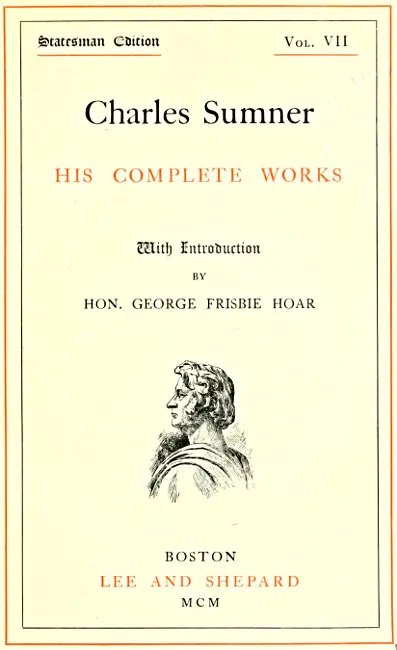
"Charles Sumner: his complete works, volume 07 (of 20)" by Charles Sumner is a historical account composed in the mid-19th century. This volume presents a collection of speeches and writings by Sumner, a prominent abolitionist and U.S. senator, centered around his staunch opposition to slavery and advocacy for civil rights. The work likely spans critical moments leading up to the Civil War, highlighting the political tensions of the time. The opening of this volume introduces letters and speeches made by Sumner in 1860, addressing the moral and constitutional arguments against slavery. He expresses his unwavering condemnation of the Fugitive Slave Act, calls for public opinion to render it ineffective, and desires to reinforce the dignity of human rights through education and moral governance. Through these writings, Sumner emphasizes the responsibilities of citizens and lawmakers to uphold justice, ultimately advocating for a society where freedom prevails over oppression. His eloquent expressions reveal deep convictions and passionate appeals for progress in a nation grappling with the moral dilemmas of slavery.
Introduction adapted from the source catalogue; source summaries may be automatically generated.
Free to read · English · 108,933 words · No account needed
MAKE TIME FOR A GOOD BOOK
On by default. Untick to stop anonymous reading totals. Each page counts after 10 seconds in view. How this works.
Anonymous counting is on unless you have switched it off.
“Resolved, That all attempts to dissolve the present Union, or overthrow or abandon the present Constitution, with the hope or expectation of constructing a new one, are dangerous, illusory, and destructive; that in the opinion of the Senate of the United States no such reconstruction is practicable; and therefore to the maintenance of the existing Union and Constitution should be directed all the energies of all the departments of the Government, and the efforts of all good citizens.”
January 16, the question being taken by yeas and nays, on the motion to substitute, resulted, yeas 25, nays 23, as follows.
Yeas,--Messrs. Anthony, Baker, Bingham, Cameron, Chandler, Clark, Collamer, Dixon, Doolittle, Durkee, Fessenden, Foot, Foster, Grimes, Hall, Harlan, King, Seward, Simmons, Sumner, Ten Eyck, Trumbull, Wade, Wilkinson, Wilson,--25.
Nays,--Messrs. Bayard, Bigler, Bragg, Bright, Clingman, Crittenden, Fitch, Green, Gwin, Hunter, Johnson of Tennessee, Kennedy, Lane, Latham, Mason, Nicholson, Pearce, Polk, Powell, Pugh, Rice, Saulsbury, Sebastian,--23.
So the amendment was agreed to, and the proposition of Mr. Clark was substituted for that of Mr. Crittenden.
This important result, by which the Crittenden Compromise received a heavy blow, was a surprise, brought about by the Senators of the Gulf States,--Iverson of Georgia, Clay and Fitzpatrick of Alabama, Brown and Jefferson Davis of Mississippi, Benjamin and Slidell of Louisiana, Mallory and Yulee of Florida, Hemphill and Wigfall of Texas, and Johnson of Arkansas,--who were in attendance, but withheld their votes. The two Senators of South Carolina, Hammond and Chesnut, also Toombs of Georgia, had not appeared in their seats during the session. Three of these Senators voting against the substitute, it could not have been carried, and the original propositions would have been still before the Senate. The adoption of the substitute was used by them to inflame their constituents. Their conduct on this occasion showed a “foregone conclusion.” Nothing but Disunion would satisfy them,--not even the Crittenden Compromise, so full of surrender.
Then ensued a comedy. Immediately after the adoption of the substitute, a reconsideration of the vote was moved by Mr. Cameron, of Pennsylvania, at the request of Mr. Crittenden, which on a subsequent day was carried. The question was then allowed to sleep on the table, until, unexpectedly, on the last legislative day of the session, just before the expiration of the Congress, and after the withdrawal of the Southern Senators, it was called up by Mr. Mason, of Virginia, when Mr. Clark again offered his substitute, which was lost by a vote of 22 nays against 14 yeas, several Senators expressing a desire to vote directly on the original propositions. On these propositions the final vote stood, yeas 19, nays 20, as follows.
Your reading position is saved on this browser. Take it to another device with a library code. Reading pages adapt to text, rather than matching a printed edition.
Charles Sumner

Charles Sumner

Charles Sumner

Charles Sumner
BEHIND THE BOOK
This eBook is for the use of anyone anywhere in the United States and most other parts of the world at no cost and with almost no restrictions whatsoever. You may copy it, give it away or re-use it under the terms of the Project Gutenberg License included with this eBook or online at www.gutenberg.org. If you are not located in the United States, you will have to check the laws of the country where you are located before using this eBook. Read the source licence.
The original source file, including credits and licence, is retained by this library. Request an original-format copy at no charge. Please include the book title and Project Gutenberg identifier #48077.
KEEP YOUR CURIOSITY GOING

David Patterson (Spirit) Hatch

David Patterson (Spirit) Hatch

David Patterson (Spirit) Hatch
Cécile Tormay

Moritz Busch
John L. Ransom