
Charles Sumner: his complete works, volume 20 (of 20)
Charles Sumner
THE CLASSIC COLLECTION · 1872
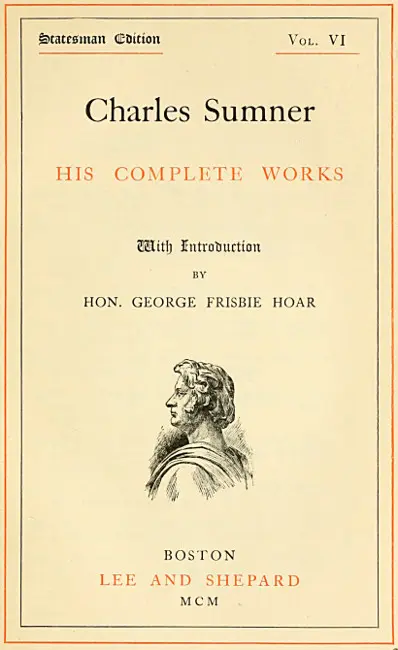
"Charles Sumner: his complete works, volume 06 (of 20)" by Charles Sumner is a historical compilation written in the mid-19th century. This volume comprises a series of letters and speeches from Sumner, a prominent abolitionist and U.S. Senator, during a critical period in American history leading up to the Civil War. The content primarily revolves around political activism for the Republican Party, support for Kansas as a free state, and appeals against the expansion of slavery. At the start of this volume, we see Sumner addressing significant political issues of the time, mainly through letters to various political committees and individuals. He expresses his sympathy and allegiance to fellow Republicans and strongly advocates for anti-slavery measures concerning the violent strife in Kansas. The opening portion highlights his longing to return to public duties despite enduring health challenges, illustrating his commitment to the antislavery cause and rallying the youth of Massachusetts to support the movement. Throughout these initial letters, he not only articulates his political ideologies but also emphasizes the importance of unity among citizens in the fight for liberty.
Introduction adapted from the source catalogue; source summaries may be automatically generated.
Free to read · English · 110,850 words · No account needed
MAKE TIME FOR A GOOD BOOK
On by default. Untick to stop anonymous reading totals. Each page counts after 10 seconds in view. How this works.
Anonymous counting is on unless you have switched it off.
Among educational establishments are public libraries; and here, again, the Free States have their customary eminence, whether we consider libraries strictly called public, or libraries of the common school, Sunday school, college, and church. The disclosures are startling. The number of libraries in the Free States is 14,893, and the sum-total of volumes is 3,883,617; the number of libraries in the Slave States is 713, and the sum-total of volumes is 654,194: showing an excess for Freedom of more than fourteen thousand libraries, and more than three millions of volumes. In the Free States the common-school libraries are 11,881, and contain 1,589,683 volumes; in the Slave States they are 186, and contain 57,721 volumes. In the Free States the Sunday-school libraries are 1,713, and contain 474,241 volumes; in the Slave States they are 275, and contain 68,080 volumes. In the Free States the college libraries are 132, and contain 660,573 volumes; in the Slave States they are 79, and contain 249,248 volumes. In the Free States the church libraries are 109, and contain 52,723 volumes; in the Slave States they are 21, and contain 5,627 volumes. In the Free States the libraries strictly called public, and not included under heads already enumerated, are 1,058, and contain 1,106,397 volumes; those of the Slave States are 152, and contain 273,518 volumes.
Turn these figures over, look at them in any light, and the conclusion is irresistible for Freedom. The college libraries alone of the Free States are greater than all the libraries of Slavery; so, also, are the libraries of Massachusetts alone greater than all the libraries of Slavery; and the common-school libraries alone of New York are more than twice as large as all the libraries of Slavery. Michigan has 107,943 volumes in her libraries; Arkansas has 420; and yet the Acts for the admission of these two States into the Union were passed on the same day.
Among educational establishments, one of the most efficient is the press; and here again all things testify for Freedom. The Free States excel in the number of newspapers and periodicals published, whether daily, semi-weekly, weekly, semi-monthly, monthly, or quarterly,--and whatever their character, whether literary, neutral, political, religious, or scientific. The whole aggregate circulation in the Free States is 334,146,281, in the Slave States 81,038,693; in Free Michigan 3,247,736, in Slave Arkansas 377,000; in Free Ohio 30,473,407, in Slave Kentucky 6,582,838; in Slave South Carolina 7,145,930, in Free Massachusetts 64,820,564,--a larger number than in the twelve Slave States, Delaware, Maryland, Virginia, North Carolina, South Carolina, Georgia, Alabama, Mississippi, Florida, Louisiana, Arkansas, and Texas, combined. This enormous disproportion in the aggregate is also preserved in the details. In the Slave States political newspapers find more favor than all others together; but even of these they publish only 47,243,209 copies, while the Free States publish 163,583,668. Numerous as are political newspapers in the Free States, they form considerably less than one half the aggregate circulation of the Press, while in the Slave States they constitute nearly three fifths. Of neutral newspapers the Slave States publish 8,812,620, the Free States 79,156,733. Of religious newspapers the Slave States publish 4,364,832, the Free States 29,280,652. Of literary journals the Slave States publish 20,245,360, the Free States 57,478,768. And of scientific journals the Slave States publish 372,672, the Free States 4,521,260. Of these last the number of copies published in Massachusetts alone is 2,033,260,--more than five times the number in the whole land of Slavery. Thus, in contributions to science, literature, religion, and even politics, as attested by the activity of the periodical press, do the Slave States miserably fail,--while darkness gathers over them, increasing with time. According to the census of 1810, the disproportion in this respect between the two regions was only as two to one; it is now more than four to one, and is still darkening.
Your reading position is saved on this browser. Take it to another device with a library code. Reading pages adapt to text, rather than matching a printed edition.
Charles Sumner

Charles Sumner

Charles Sumner

Charles Sumner
BEHIND THE BOOK
This eBook is for the use of anyone anywhere in the United States and most other parts of the world at no cost and with almost no restrictions whatsoever. You may copy it, give it away or re-use it under the terms of the Project Gutenberg License included with this eBook or online at www.gutenberg.org. If you are not located in the United States, you will have to check the laws of the country where you are located before using this eBook. Read the source licence.
The original source file, including credits and licence, is retained by this library. Request an original-format copy at no charge. Please include the book title and Project Gutenberg identifier #48045.
KEEP YOUR CURIOSITY GOING

David Patterson (Spirit) Hatch

David Patterson (Spirit) Hatch

David Patterson (Spirit) Hatch
Cécile Tormay

Moritz Busch
John L. Ransom