
Charles Sumner: his complete works, volume 20 (of 20)
Charles Sumner
THE CLASSIC COLLECTION · 1872
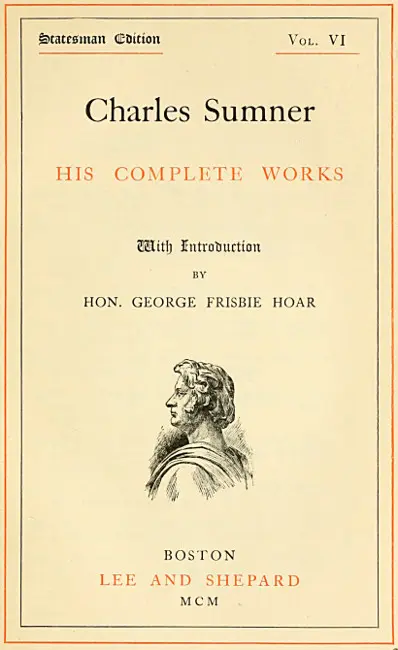
"Charles Sumner: his complete works, volume 06 (of 20)" by Charles Sumner is a historical compilation written in the mid-19th century. This volume comprises a series of letters and speeches from Sumner, a prominent abolitionist and U.S. Senator, during a critical period in American history leading up to the Civil War. The content primarily revolves around political activism for the Republican Party, support for Kansas as a free state, and appeals against the expansion of slavery. At the start of this volume, we see Sumner addressing significant political issues of the time, mainly through letters to various political committees and individuals. He expresses his sympathy and allegiance to fellow Republicans and strongly advocates for anti-slavery measures concerning the violent strife in Kansas. The opening portion highlights his longing to return to public duties despite enduring health challenges, illustrating his commitment to the antislavery cause and rallying the youth of Massachusetts to support the movement. Throughout these initial letters, he not only articulates his political ideologies but also emphasizes the importance of unity among citizens in the fight for liberty.
Introduction adapted from the source catalogue; source summaries may be automatically generated.
Free to read · English · 110,850 words · No account needed
MAKE TIME FOR A GOOD BOOK
On by default. Untick to stop anonymous reading totals. Each page counts after 10 seconds in view. How this works.
Anonymous counting is on unless you have switched it off.
The States where this Barbarism exists excel the Free States in all natural advantages. Their territory is more extensive, stretching over 851,448 square miles, while the Free States, including California, embrace only 612,597 square miles. Here is a difference of more than 238,000 square miles in favor of the Slave States, showing that Freedom starts in this great rivalry with a field more than a quarter less than that of Slavery. In happiness of climate, adapted to productions of special value,--in exhaustless motive power distributed throughout its space,--in natural highways, by more than fifty navigable rivers, never closed by the rigors of winter,--and in a stretch of coast, along Ocean and Gulf, indented by hospitable harbors,--the whole presenting incomparable advantages for that true Civilization, where agriculture, manufactures, and commerce, both domestic and foreign, blend,--in all these respects the Slave States excel the Free States, whose climate is often churlish, whose motive power is less various, whose navigable rivers are fewer and often sealed by ice, and whose coast, while less in extent and with fewer harbors, is often perilous from storm and cold.
But Slavery plays the part of a Harpy, and defiles the choicest banquet. See what it does with this territory, thus spacious and fair.
An important indication of prosperity is in the growth of population. In this respect the two regions started equal. In 1790, at the first census under the Constitution, the population of the present Slave States was 1,961,372, of the present Free States 1,968,455, showing a difference of only 7,083 in favor of the Free States. This difference, at first merely nominal, has been constantly increasing since, showing itself more strongly in each decennial census, until, in 1850, the population of the Slave States, swollen by the annexation of three foreign Territories, Louisiana, Florida, and Texas, was only 9,612,969, while that of the Free States, without such large annexations, reached 13,434,922, showing a difference of 3,821,953 in favor of Freedom. But this difference becomes still more remarkable, if we confine our inquiries to the white population, which at this period was only 6,184,477 in the Slave States, while it was 13,238,670 in the Free States, showing a difference of 7,054,193, in favor of Freedom, and showing also that the white population of the Free States had not only doubled, but, while occupying a smaller territory, commenced to triple, that of the Slave States. The comparative sparseness of the two populations furnishes another illustration. In the Slave States the average number of inhabitants to a square mile was 11.29, while in the Free States it was 21.93, or almost two to one in favor of Freedom.
Your reading position is saved on this browser. Take it to another device with a library code. Reading pages adapt to text, rather than matching a printed edition.
Charles Sumner

Charles Sumner

Charles Sumner

Charles Sumner
BEHIND THE BOOK
This eBook is for the use of anyone anywhere in the United States and most other parts of the world at no cost and with almost no restrictions whatsoever. You may copy it, give it away or re-use it under the terms of the Project Gutenberg License included with this eBook or online at www.gutenberg.org. If you are not located in the United States, you will have to check the laws of the country where you are located before using this eBook. Read the source licence.
The original source file, including credits and licence, is retained by this library. Request an original-format copy at no charge. Please include the book title and Project Gutenberg identifier #48045.
KEEP YOUR CURIOSITY GOING

David Patterson (Spirit) Hatch

David Patterson (Spirit) Hatch

David Patterson (Spirit) Hatch
Cécile Tormay

Moritz Busch
John L. Ransom