
Charles Sumner: his complete works, volume 20 (of 20)
Charles Sumner
THE CLASSIC COLLECTION · 1872
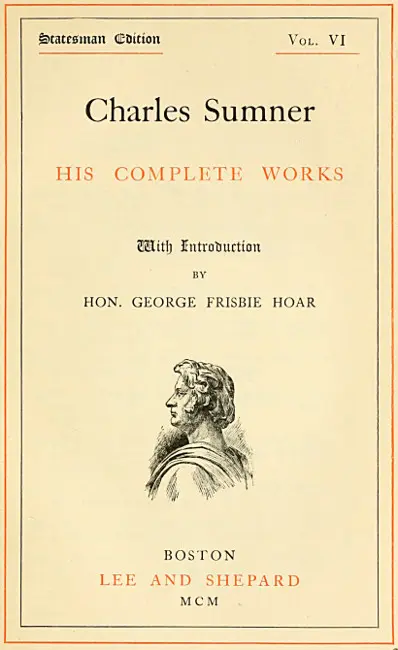
"Charles Sumner: his complete works, volume 06 (of 20)" by Charles Sumner is a historical compilation written in the mid-19th century. This volume comprises a series of letters and speeches from Sumner, a prominent abolitionist and U.S. Senator, during a critical period in American history leading up to the Civil War. The content primarily revolves around political activism for the Republican Party, support for Kansas as a free state, and appeals against the expansion of slavery. At the start of this volume, we see Sumner addressing significant political issues of the time, mainly through letters to various political committees and individuals. He expresses his sympathy and allegiance to fellow Republicans and strongly advocates for anti-slavery measures concerning the violent strife in Kansas. The opening portion highlights his longing to return to public duties despite enduring health challenges, illustrating his commitment to the antislavery cause and rallying the youth of Massachusetts to support the movement. Throughout these initial letters, he not only articulates his political ideologies but also emphasizes the importance of unity among citizens in the fight for liberty.
Introduction adapted from the source catalogue; source summaries may be automatically generated.
Free to read · English · 110,850 words · No account needed
MAKE TIME FOR A GOOD BOOK
On by default. Untick to stop anonymous reading totals. Each page counts after 10 seconds in view. How this works.
Anonymous counting is on unless you have switched it off.
[16] Case of the witness Mrs. Clarke, in the inquiry into the conduct of the Duke of York, February 7, 1809: Hansard, Parliamentary Debates, Vol. XII. col. 436.
[17] Annals of Congress, 6th Cong. 1st Sess., p. 113, March 20, 1800.
[18] As this case was in Executive Session of the Senate, there is no public record of it. From the daily press of the time it appears, that, March 23, 1848, Nugent, a correspondent of the New York Herald, was arrested by order of the Senate, and committed to the Sergeant-at-Arms, for obtaining surreptitiously and publishing the treaty of Guadalupe Hidalgo; that he remained in such custody until April 25th, and perhaps longer; that he refused to answer questions concerning the treaty; that he was twice taken before Judge Cranch, of the United States Court, by Habeas Corpus; that the Sergeant-at-Arms returned for answer to the writ, that he held the prisoner by virtue of a warrant of the Vice-President, in pursuance of certain proceedings of the Senate in Executive Session, which he could not divulge, and that the question gave rise to much debate in Executive Session. See especially Baltimore Sun, March 24, 26, 29, April 18, 1848.
[19] Commentaries, Vol. IV. p. 350.
[20] 9 Adolphus and Ellis, 1.
[21] Lord Mahon, History of England, Chap. XXXI. Vol. IV. p. 20.
[22] Privilege of Parliament, Introduction: Speeches of Henry Lord Brougham upon Questions relating to Public Rights, Duties, and Interests, Vol. IV. p. 353.
[23] Sanborn v. Carleton, 15 Gray, 399.
[24] Rev. Thomas Starr King.
[25] “Eadem de Republica sensisse.”--CIC., Orat. in Pisonem, c. 32.
[26] Mr. Brooks and Senator Butler were both dead.
[27] Speech in the Senate, February 6, 1837: Works, Vol. II. p. 632. See Miscellaneous Writings on Slavery, by William Jay, p. 509.
[28] Message to the Legislature of South Carolina, November, 1835.
[29] Speech in the Senate, March 4, 1858: Congressional Globe, 35th
Cong. 1st Sess., p. 961.
[30] Speech in the Senate, February 29, 1860: Congressional Globe, 36th
Cong. 1st Sess., p. 917.
[31] Speech in the Senate, March 6, 1860: Congressional Globe, 36th
Cong. 1st Sess., p. 1004.
[32] Speech in the Senate, January 31, 1860: Congressional Globe, 36th Cong. 1st Sess., Appendix, pp. 104-109.
[33] Congressional Globe, 36th Cong. 1st Sess., pp. 557, 596: January
23, 26, 1860.
[34] Message to the Legislature of South Carolina, November, 1835.
[35] Statutes at Large of South Carolina, Vol. VII. p. 397, Act No.
670, sec. 1.
[36] Civil Code, Art. 35.
[37] Laws of Maryland, Acts of 1798, Ch. CI. xii. 12.
[38] Stroud, Law relating to Slavery, pp. 22, 23.
[39] Milton, Paradise Lost, Book XII., 68-71.
[40] Exodus, xxi. 16.
[41] Colossians, iv. 1.
[42] Pollok, Course of Time, Book VIII. 632-634.
[43] Clarke, E. D., Travels in Europe, Asia, and Africa, (London,
1816,) Vol. I. pp. 72, 73.
[44] Rokeby, Canto I. st. 21.
Your reading position is saved on this browser. Take it to another device with a library code. Reading pages adapt to text, rather than matching a printed edition.
Charles Sumner

Charles Sumner

Charles Sumner

Charles Sumner
BEHIND THE BOOK
This eBook is for the use of anyone anywhere in the United States and most other parts of the world at no cost and with almost no restrictions whatsoever. You may copy it, give it away or re-use it under the terms of the Project Gutenberg License included with this eBook or online at www.gutenberg.org. If you are not located in the United States, you will have to check the laws of the country where you are located before using this eBook. Read the source licence.
The original source file, including credits and licence, is retained by this library. Request an original-format copy at no charge. Please include the book title and Project Gutenberg identifier #48045.
KEEP YOUR CURIOSITY GOING

David Patterson (Spirit) Hatch

David Patterson (Spirit) Hatch

David Patterson (Spirit) Hatch
Cécile Tormay

Moritz Busch
John L. Ransom