
Charles Sumner: his complete works, volume 20 (of 20)
Charles Sumner
THE CLASSIC COLLECTION · 1872
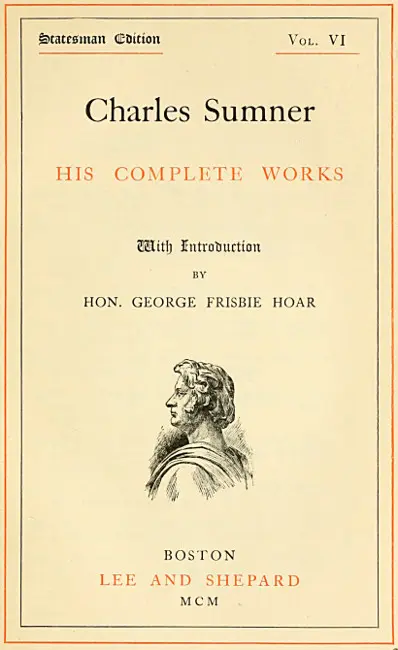
"Charles Sumner: his complete works, volume 06 (of 20)" by Charles Sumner is a historical compilation written in the mid-19th century. This volume comprises a series of letters and speeches from Sumner, a prominent abolitionist and U.S. Senator, during a critical period in American history leading up to the Civil War. The content primarily revolves around political activism for the Republican Party, support for Kansas as a free state, and appeals against the expansion of slavery. At the start of this volume, we see Sumner addressing significant political issues of the time, mainly through letters to various political committees and individuals. He expresses his sympathy and allegiance to fellow Republicans and strongly advocates for anti-slavery measures concerning the violent strife in Kansas. The opening portion highlights his longing to return to public duties despite enduring health challenges, illustrating his commitment to the antislavery cause and rallying the youth of Massachusetts to support the movement. Throughout these initial letters, he not only articulates his political ideologies but also emphasizes the importance of unity among citizens in the fight for liberty.
Introduction adapted from the source catalogue; source summaries may be automatically generated.
Free to read · English · 110,850 words · No account needed
MAKE TIME FOR A GOOD BOOK
On by default. Untick to stop anonymous reading totals. Each page counts after 10 seconds in view. How this works.
Anonymous counting is on unless you have switched it off.
Worse to bear--oh, far worse!--than the evil speaking of others is the conduct of some of her own children. It is hard to see the scholarship which has been drawn from her cisterns, and the riches accumulated under her hospitable shelter, now employed to weaken and discredit that cause which is above riches or scholarship. It is hard, while fellow-citizens in Kansas plead for deliverance from a cruel Usurpation, and while the whole country, including our own soil, is trodden down by a domineering and brutal Despotism, to behold sons of Massachusetts in sympathy, open or disguised, with the vulgar enemy, quickening everywhere the lash of the taskmaster, and helping forward the Satanic carnival, when Slavery shall be fastened not only upon prostrate Kansas, but upon all the Territories of the Republic,--when Cuba shall be torn from a friendly power by dishonest force,--and when the slave-trade itself, with all its crime, its woe, and its shame, shall be opened anew under the American flag. Alas, that any child of Massachusetts, in wickedness of heart, or in weakness of principle, or under the delusion of partisan prejudice, should join in these things! With such I have no word of controversy at this hour. But, leaving them now, in my weakness, I trust not to seem too severe, if I covet for the occasion something of the divine power
“To bend the silver bow with tender skill, While, void of pain, the silent arrows kill.”[6]
Gladly from these do I turn to another character, yet happily spared to Massachusetts, whose heart beats strong with the best blood of the Revolution, and with the best sentiments by which that blood was enriched. The only child of one of the authors of American Liberty, for many years the able and courageous Representative of Boston on the floor of Congress, where his speeches were the masterpieces of the time, distinguished throughout a long career by the grateful trust of his fellow-citizens, happy in all the possessions of a well-spent life, and surrounded by “honor, love, obedience, troops of friends,” with an old age which is second youth, JOSIAH QUINCY, still erect under the burden of eighty-four winters, puts himself at the head of our great battle,--and never before, in the ardor of youth, or the maturity of manhood, did he show himself so grandly conspicuous, and add so much to the heroic wealth of our history. His undaunted soul, lifted already to glimpses of another life, may shame the feebler spirits of a later generation. There is one other personage, at a distant period, who, with precisely the same burden of winters, asserted the same supremacy of powers. It is the celebrated Dandolo, Doge of Venice, at the age of eighty-four, of whom the historian Gibbon has said, in words strictly applicable to our own Quincy: “He shone, in the last period of human life, as one of the most illustrious characters of the times: under the weight of years he retained a sound understanding and a manly courage, the spirit of an hero and the wisdom of a patriot.”[7] This old man carried the Venetian Republic over to the Crusaders, and exposed his person freely to all the perils of war, so that the historian describes him, in words again applicable to our day, saying: “In the midst of the conflict, the Doge, a venerable and conspicuous form, stood aloft, in complete armor, on the prow of his galley,” while “the great standard of St. Mark was displayed before him.”[8] Before the form of our venerable head is displayed the standard of a greater republic than Venice, thrilling with its sight greater multitudes than ever gazed on the standard of St. Mark, while a sublimer cause is ours than the cause of the Crusaders; for our task is not to ransom an empty sepulchre, but to rescue the Saviour himself, in the bodies of his innumerable children,--not to dislodge the Infidel from a distant foreign soil, but to displace him from the very Jerusalem of our Liberties.
Your reading position is saved on this browser. Take it to another device with a library code. Reading pages adapt to text, rather than matching a printed edition.
Charles Sumner

Charles Sumner

Charles Sumner

Charles Sumner
BEHIND THE BOOK
This eBook is for the use of anyone anywhere in the United States and most other parts of the world at no cost and with almost no restrictions whatsoever. You may copy it, give it away or re-use it under the terms of the Project Gutenberg License included with this eBook or online at www.gutenberg.org. If you are not located in the United States, you will have to check the laws of the country where you are located before using this eBook. Read the source licence.
The original source file, including credits and licence, is retained by this library. Request an original-format copy at no charge. Please include the book title and Project Gutenberg identifier #48045.
KEEP YOUR CURIOSITY GOING

David Patterson (Spirit) Hatch

David Patterson (Spirit) Hatch

David Patterson (Spirit) Hatch
Cécile Tormay

Moritz Busch
John L. Ransom