
Charles Sumner: his complete works, volume 20 (of 20)
Charles Sumner
THE CLASSIC COLLECTION · 1900
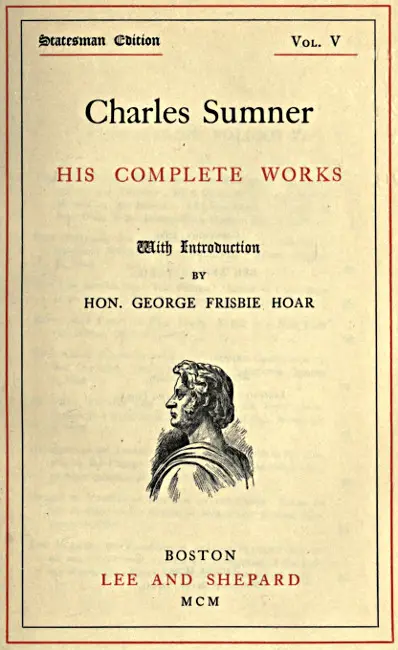
"Charles Sumner: his complete works, volume 05 (of 20)" by Charles Sumner is a historical collection of speeches and writings from the prominent abolitionist and senator, compiled during the mid-19th century. This volume particularly focuses on the moral and political arguments against slavery, documenting Sumner's impassioned calls for justice, liberty, and ethical governance in a nation grappling with the deeply entrenched institution of slavery. As a key figure in the fight for abolition, Sumner’s essays and addresses reveal not only his philosophy but also the broader socio-political climate of the time. The opening of this volume presents an address by Sumner, delivered before a large audience in New York in 1855, consisting of powerful rhetoric discussing the necessity, practicability, and dignity of the antislavery cause. He reflects on the transformation of public sentiment regarding slavery from its past oppression to a burgeoning movement for freedom, emphasizing the moral obligation to end the injustice. Sumner points out the legal and social dynamics of slavery while advocating for a unified front among the North to combat the tyranny of the slave system and its impact on both enslaved individuals and society at large. Through this address, he lays the groundwork for a compelling argument that resonates with the urgency and ethical imperatives of his time.
Introduction adapted from the source catalogue; source summaries may be automatically generated.
Free to read · English · 112,653 words · No account needed
MAKE TIME FOR A GOOD BOOK
On by default. Untick to stop anonymous reading totals. Each page counts after 10 seconds in view. How this works.
Anonymous counting is on unless you have switched it off.
Not content with this poor menace, which we have been twice told was “measured,” the Senator, in the unrestrained chivalry of his nature, has undertaken to apply opprobrious words to those who differ from him on this floor. He calls them “sectional and fanatical”; and resistance to the Usurpation of Kansas he denounces as “an uncalculating fanaticism.” To be sure, these charges lack all grace of originality and all sentiment of truth; but the adventurous Senator does not hesitate. He is the uncompromising, unblushing representative on this floor of a flagrant sectionalism, now domineering over the Republic,--and yet, with a ludicrous ignorance of his own position, unable to see himself as others see him, or with an effrontery which even his white head ought not to protect from rebuke, he applies to those here who resist his sectionalism the very epithet which designates himself. The men who strive to bring back the Government to its original policy, when Freedom and not Slavery was national, while Slavery and not Freedom was sectional, he arraigns as sectional. This will not do. It involves too great a perversion of terms. I tell that Senator that it is to himself, and to the “organization” of which he is the “committed advocate,” that this epithet belongs. I now fasten it upon them. For myself, I care little for names; but, since the question is raised here, I affirm that the Republican party of the Union is in no just sense sectional, but, more than any other party, national,--and that it now goes forth to dislodge from the high places that tyrannical sectionalism of which the Senator from South Carolina is one of the maddest zealots.
To the charge of fanaticism I also reply. Sir, fanaticism is found in an enthusiasm or exaggeration of opinion, particularly on religious subjects; but there may be fanaticism for evil as well as for good. Now I will not deny that there are persons among us loving Liberty too well for personal good in a selfish generation. Such there may be; and, for the sake of their example, would that there were more! In calling them “fanatics,” you cast contumely upon the noble army of martyrs, from the earliest day down to this hour,--upon the great tribunes of human rights, by whom life, liberty, and happiness on earth have been secured,--upon the long line of devoted patriots, who, throughout history, have truly loved their country,--and upon all who, in noble aspiration for the general good, and in forgetfulness of self, have stood out before their age, and gathered into their generous bosoms the shafts of tyranny and wrong, in order to make a pathway for Truth;--you discredit Luther, when alone he nailed his articles to the door of the church at Wittenberg, and then to the imperial demand that he should retract firmly replied, “Here I stand; I cannot do otherwise, so help me God!” you discredit Hampden, when alone he refused to pay the few shillings of ship money, and shook the throne of Charles the First; you discredit Milton, when, amidst the corruptions of a heartless court, he lived on, the lofty friend of Liberty, above question or suspicion; you discredit Russell and Sidney, when, for the sake of country, they calmly turned from family and friends, to tread the steps of the scaffold; you discredit those early founders of American institutions, who preferred the hardships of a wilderness, surrounded by a savage foe, to injustice on beds of ease; you discredit our later fathers, who, few in numbers and weak in resources, yet strong in their cause, did not hesitate to brave the mighty power of England, already encircling the globe with her morning drumbeats. Yes, Sir, of such are the fanatics, according to the Senator. But I tell the Senator that there are characters, badly eminent, of whose fanaticism there can be no question. Such were the ancient Egyptians, who worshipped divinities in brutish forms; the Druids, who darkened the forests of oak, in which they lived, by sacrifices of blood; the Mexicans, who surrendered countless victims to the propitiation of obscene idols; the Spaniards, who, under Alva, sought to force the Inquisition upon Holland, by a tyranny kindred to that now employed to force Slavery upon Kansas; and such were the Algerines, when, in solemn conclave, after listening to a speech not unlike that of the Senator from South Carolina, they resolved to continue the slavery of white Christians, and to extend it over countrymen of Washington,--ay, Sir, extend it! And in this same dreary catalogue faithful History must record all who now, in an enlightened age, and in a land of boasted Freedom, stand up, in perversion of the Constitution, and in denial of immortal truth, to fasten a new shackle upon their fellow-man. If the Senator wishes to see fanatics, let him look round among his own associates,--let him look at himself.
Your reading position is saved on this browser. Take it to another device with a library code. Reading pages adapt to text, rather than matching a printed edition.
Charles Sumner

Charles Sumner

Charles Sumner

Charles Sumner
BEHIND THE BOOK
This eBook is for the use of anyone anywhere in the United States and most other parts of the world at no cost and with almost no restrictions whatsoever. You may copy it, give it away or re-use it under the terms of the Project Gutenberg License included with this eBook or online at www.gutenberg.org. If you are not located in the United States, you will have to check the laws of the country where you are located before using this eBook. Read the source licence.
The original source file, including credits and licence, is retained by this library. Request an original-format copy at no charge. Please include the book title and Project Gutenberg identifier #48035.
KEEP YOUR CURIOSITY GOING

David Patterson (Spirit) Hatch

David Patterson (Spirit) Hatch

David Patterson (Spirit) Hatch
Cécile Tormay

Moritz Busch
John L. Ransom