
Charles Sumner: his complete works, volume 20 (of 20)
Charles Sumner
THE CLASSIC COLLECTION · 1900
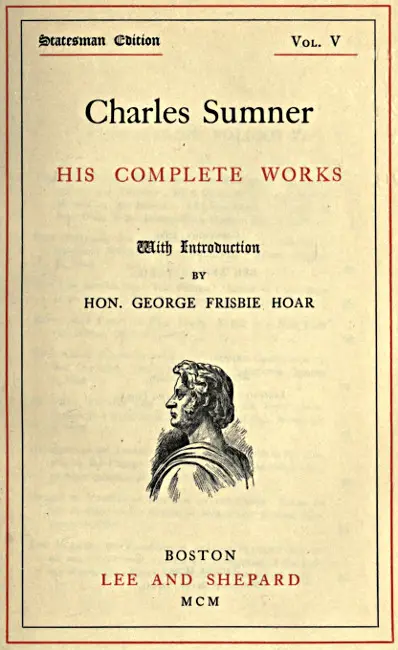
"Charles Sumner: his complete works, volume 05 (of 20)" by Charles Sumner is a historical collection of speeches and writings from the prominent abolitionist and senator, compiled during the mid-19th century. This volume particularly focuses on the moral and political arguments against slavery, documenting Sumner's impassioned calls for justice, liberty, and ethical governance in a nation grappling with the deeply entrenched institution of slavery. As a key figure in the fight for abolition, Sumner’s essays and addresses reveal not only his philosophy but also the broader socio-political climate of the time. The opening of this volume presents an address by Sumner, delivered before a large audience in New York in 1855, consisting of powerful rhetoric discussing the necessity, practicability, and dignity of the antislavery cause. He reflects on the transformation of public sentiment regarding slavery from its past oppression to a burgeoning movement for freedom, emphasizing the moral obligation to end the injustice. Sumner points out the legal and social dynamics of slavery while advocating for a unified front among the North to combat the tyranny of the slave system and its impact on both enslaved individuals and society at large. Through this address, he lays the groundwork for a compelling argument that resonates with the urgency and ethical imperatives of his time.
Introduction adapted from the source catalogue; source summaries may be automatically generated.
Free to read · English · 112,653 words · No account needed
MAKE TIME FOR A GOOD BOOK
On by default. Untick to stop anonymous reading totals. Each page counts after 10 seconds in view. How this works.
Anonymous counting is on unless you have switched it off.
“A slave is one who is in the power of a master to whom he belongs. The master may sell him, dispose of his person, his industry, and his labor. He can do nothing, possess nothing, nor acquire anything but what must belong to his master.”[3]
The law of another polished Slave State gives this definition:--
“Slaves shall be deemed, sold, taken, reputed, and adjudged in law to be chattels personal, in the hands of their owners and possessors, and their executors, administrators, and assigns, to all intents, constructions, and purposes whatsoever.”[4]
And a careful writer, Judge Stroud, in a work of juridical as well as philanthropic merit, thus sums up the law:--
“The cardinal principle of Slavery, that the slave is not to be ranked among sentient beings, but among things, is an article of property, a chattel personal, obtains as undoubted law in all of these [Slave] States.”[5]
Sir, this is enough. As out of its small egg crawls forth the slimy, scaly, reptile crocodile, so out of this simple definition crawls forth the whole slimy, scaly, reptile monstrosity by which a man is changed into a chattel, a person is converted into a thing, a soul is transmuted into merchandise. According to this very definition, the slave is held simply for the good of his master, to whose behest his life, liberty, and happiness are devoted, and by whom he may be bartered, leased, mortgaged, bequeathed, invoiced, shipped as cargo, stored as goods, sold on execution, knocked off at public auction, and even staked at the gaming-table on the hazard of a card or die. The slave may seem to have a wife; but he has not, for his wife belongs to his master. He may seem to have a child; but he has not, for his child is owned by his master. He may be filled with desire of knowledge, opening to him the gates of joy on earth and in heaven; but the master may impiously close all these gates. Thus is he robbed, not merely of privileges, but of himself,--not merely of money and labor, but of wife and children,--not merely of time and opportunity, but of every assurance of happiness,--not merely of earthly hope, but of all those divine aspirations that spring from the Fountain of Light. He is not merely restricted in liberty, but totally deprived of it,--not merely curtailed in rights, but absolutely stripped of them,--not merely loaded with burdens, but changed into a beast of burden,--not merely bent in countenance to the earth, but sunk in law to the level of a quadruped,--not merely exposed to personal cruelty, but deprived of his character as a person,--not merely compelled to involuntary labor, but degraded to a rude thing,--not merely shut out from knowledge, but wrested from his place in the human family. And all this, Sir, is according to the simple Law of Slavery.
Your reading position is saved on this browser. Take it to another device with a library code. Reading pages adapt to text, rather than matching a printed edition.
Charles Sumner

Charles Sumner

Charles Sumner

Charles Sumner
BEHIND THE BOOK
This eBook is for the use of anyone anywhere in the United States and most other parts of the world at no cost and with almost no restrictions whatsoever. You may copy it, give it away or re-use it under the terms of the Project Gutenberg License included with this eBook or online at www.gutenberg.org. If you are not located in the United States, you will have to check the laws of the country where you are located before using this eBook. Read the source licence.
The original source file, including credits and licence, is retained by this library. Request an original-format copy at no charge. Please include the book title and Project Gutenberg identifier #48035.
KEEP YOUR CURIOSITY GOING

David Patterson (Spirit) Hatch

David Patterson (Spirit) Hatch

David Patterson (Spirit) Hatch
Cécile Tormay

Moritz Busch
John L. Ransom