
Charles Sumner: his complete works, volume 20 (of 20)
Charles Sumner
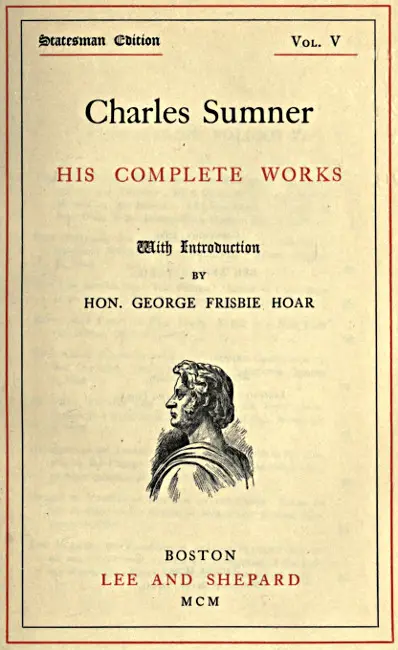
THE CLASSIC COLLECTION · 1900
"Charles Sumner: his complete works, volume 05 (of 20)" by Charles Sumner is a historical collection of speeches and writings from the prominent abolitionist and senator, compiled during the mid-19th century. This volume particularly focuses on the moral and political arguments against slavery, documenting Sumner's impassioned calls for justice, liberty, and ethical governance in a nation grappling with the deeply entrenched institution of slavery. As a key figure in the fight for abolition, Sumner’s essays and addresses reveal not only his philosophy but also the broader socio-political climate of the time. The opening of this volume presents an address by Sumner, delivered before a large audience in New York in 1855, consisting of powerful rhetoric discussing the necessity, practicability, and dignity of the antislavery cause. He reflects on the transformation of public sentiment regarding slavery from its past oppression to a burgeoning movement for freedom, emphasizing the moral obligation to end the injustice. Sumner points out the legal and social dynamics of slavery while advocating for a unified front among the North to combat the tyranny of the slave system and its impact on both enslaved individuals and society at large. Through this address, he lays the groundwork for a compelling argument that resonates with the urgency and ethical imperatives of his time.
Introduction adapted from the source catalogue; source summaries may be automatically generated.
Free to read · English · 112,653 words · No account needed
MAKE TIME FOR A GOOD BOOK
On by default. Untick to stop anonymous reading totals. Each page counts after 10 seconds in view. How this works.
Anonymous counting is on unless you have switched it off.
“At the public meeting where this decision was taken, I was directed, as being Chairman, to acquaint you with the acquiescence of the subscribers to the testimonial in your wishes, and to assure you that all your motives in this act, and throughout the recent signal and portentous events, are by us fully appreciated and honored. I will not add to your fatigues, and to the crowd of communications which must be pouring in upon you, by a long communication. Your name is inseparably and nobly associated with the history of Freedom, in America and in the world, henceforth. We confide in you for the future. We thank you for the past. We supplicate, in your behalf, from the Almighty Source of Good a rapid restoration of your health and strength, and ever-increasing powers of will, of faith, of action, and of speech, in the infinite service of Humanity.
“You will believe, my dear Sir, that my personal feelings go undivided into these assurances of good-will.
“I beg you to account me, now as always,
“Your faithful friend and servant,
The following extract from a letter of Mrs. Lydia Maria Child, the much-loved and always popular author, shows how this act was regarded at the time.
“Your letter declining the testimonial proffered by your native Commonwealth pleased me more than anything you ever did. I had previously said, ‘I hope Massachusetts will express her gratitude toward him with princely magnificence, and I hope he will transfer the gift to Kansas: that would be morally grand on both sides.’ And Mr. Child answered: ‘Depend upon it, he will do it. Nothing could be more characteristic of the man.’ That letter and Mr. Wilson’s answer to the challenge have revived my early faith in human nature. It is impossible to calculate the salutary influence of such examples.”
[1] Resolutions of the Legislature of South Carolina, December 16, 1835. See also Resolutions of the Legislature of North Carolina, December 19, 1835; of Georgia, December 22, 1835; of Alabama, January 7, 1836; and of Virginia, February 16, 1836. Massachusetts Senate Documents, Sess. 1836, No. 56.
[2] “Ahi serva Italia, … bordello!”--Purgatorio, Canto VI. 76-78.
[3] Civil Code of the State of Louisiana, Art. 35.
[4] Statutes at Large of South Carolina, Vol. VII. p. 397, Act No. 670,
sec. 1.
[5] Sketch of the Laws relating to Slavery in the several States, pp.
22, 23.
[6] Genesis, ix. 25-27.
[7] Dryden, Absalom and Achitophel, Part I. 301, 302.
[8] Encyclopædia Metropolitana, First Division, Pure Sciences, Vol. I. p. 32 (ed. 1829, 4to): Preliminary Treatise on Method, Sect. 2, Dark Ages.
Your reading position is saved on this browser. Take it to another device with a library code. Reading pages adapt to text, rather than matching a printed edition.
Charles Sumner

Charles Sumner

Charles Sumner

Charles Sumner
BEHIND THE BOOK
This eBook is for the use of anyone anywhere in the United States and most other parts of the world at no cost and with almost no restrictions whatsoever. You may copy it, give it away or re-use it under the terms of the Project Gutenberg License included with this eBook or online at www.gutenberg.org. If you are not located in the United States, you will have to check the laws of the country where you are located before using this eBook. Read the source licence.
The original source file, including credits and licence, is retained by this library. Request an original-format copy at no charge. Please include the book title and Project Gutenberg identifier #48035.
KEEP YOUR CURIOSITY GOING

David Patterson (Spirit) Hatch

David Patterson (Spirit) Hatch

David Patterson (Spirit) Hatch
Cécile Tormay

Moritz Busch
John L. Ransom