
Charles Sumner: his complete works, volume 20 (of 20)
Charles Sumner
THE CLASSIC COLLECTION · 1900
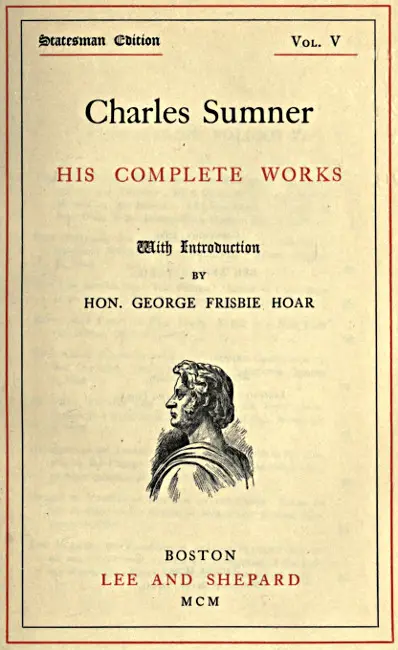
"Charles Sumner: his complete works, volume 05 (of 20)" by Charles Sumner is a historical collection of speeches and writings from the prominent abolitionist and senator, compiled during the mid-19th century. This volume particularly focuses on the moral and political arguments against slavery, documenting Sumner's impassioned calls for justice, liberty, and ethical governance in a nation grappling with the deeply entrenched institution of slavery. As a key figure in the fight for abolition, Sumner’s essays and addresses reveal not only his philosophy but also the broader socio-political climate of the time. The opening of this volume presents an address by Sumner, delivered before a large audience in New York in 1855, consisting of powerful rhetoric discussing the necessity, practicability, and dignity of the antislavery cause. He reflects on the transformation of public sentiment regarding slavery from its past oppression to a burgeoning movement for freedom, emphasizing the moral obligation to end the injustice. Sumner points out the legal and social dynamics of slavery while advocating for a unified front among the North to combat the tyranny of the slave system and its impact on both enslaved individuals and society at large. Through this address, he lays the groundwork for a compelling argument that resonates with the urgency and ethical imperatives of his time.
Introduction adapted from the source catalogue; source summaries may be automatically generated.
Free to read · English · 112,653 words · No account needed
MAKE TIME FOR A GOOD BOOK
On by default. Untick to stop anonymous reading totals. Each page counts after 10 seconds in view. How this works.
Anonymous counting is on unless you have switched it off.
“DEAR SIR,--I have your letter of 30th June, in which you ask my consent with regard to the course you shall take in the conduct of a criminal proceeding now pending in the Circuit Court of the United States for the District of Columbia. I am surprised at this communication. In giving my testimony before the Grand Jury, I stated that I appeared at the summons of the law, and that I wished it distinctly understood that the proceeding was instituted without any suggestion on my part, and that I had nothing to do, directly or indirectly, with its conduct. Nothing has occurred to change my relation to the proceeding. Its whole conduct belongs to the Attorney of the United States.
“I am, dear Sir,
“Your faithful servant,
“P. BARTON KEY, Esq., Attorney of the United States.”
When the trial came on, Mr. Sumner had left for Philadelphia. Mr. Brooks was sentenced to pay a fine of three hundred dollars.
William Y. Leader, of Philadelphia, who testified before the magistrate, drew up the following account of the assault, which is now published for the first time.
“I arrived in Washington City on the morning of the 22d of May, 1856. It was my first visit to Washington. After attending to some business, I visited the Capitol. It was about twelve o’clock, and both Houses of Congress were in session. I went to the Hall of the House of Representatives first. I remained until the House adjourned, which was in a short time, as no business was transacted further than the passage of some resolutions in relation to, and several addresses on, the death of Hon. John G. Miller, of Missouri. I next went to the gallery of the Senate Chamber. Hon. Mr. Geyer, of Missouri, was delivering a eulogy on the death of Mr. Miller, after which a series of resolutions on the same subject were passed, when the Senate adjourned. I then went into the Senate Chamber, for the purpose of delivering a letter to Hon. J. J. Crittenden, but, finding him engaged talking to the Hon. L. S. Foster, of Connecticut, I walked up and down the Chamber, waiting until he would be disengaged. While doing so, a gentleman mentioned the name of Mr. Sumner. I had never seen Mr. Sumner, but, having read several of his speeches, I was anxious to see him, and, looking in the direction from which the voice came, I observed Dr. Madeira, of Philadelphia, introducing to Mr. Sumner one of the then editors of the Chambersburg, Pennsylvania, Transcript. Mr. Sumner then shook the person by the hand and begged him to excuse him, as he was writing on time, that he might get a number of documents, which he was franking, ready for the mail, and told the gentleman he would be pleased to see him at his residence at any time he might call. The gentleman left him, and I walked to the seat of Senator Seward, which was vacant, and which is next but one from Senator Sumner’s, in the same row. Senator Sumner was writing at his seat. On his table was a large pile of documents, and he was writing very rapidly, with his head very close to the desk. While he was thus engaged, I observed a gentleman come in the door and walk to the seat of Mr. Sumner. He came up in a quiet, easy manner, and spoke, saying, ‘Mr. Sumner.’ Mr. Sumner did not rise, but merely turned up his head, as if to see who was speaking to him, when the gentleman continued, saying, ‘I have read your speech twice, and have come to the conclusion that it is an insult to my native State, and my gray-haired relative, Judge Butler,’--and before he had finished the sentence, he struck Mr. Sumner a blow on the top of his head, which was uncovered, which must have stunned him. He struck him two or three times after, when Mr. Sumner raised himself in his chair, not, as has been said, to defend himself, but with his head bent down, as if trying to extricate himself from his chair and desk. While in this position he received several more blows, when he fell against his desk, which upset, and he fell to the floor. While lying here, he was struck until the cane broke into pieces. Mr. Sumner uttered no word, and no one attempted to interfere, though a number of persons gathered around, crying, ‘Don’t interfere!‘ ‘Go it, Brooks!’ ‘Give the damned Abolitionists hell!’ &c. Mr. Crittenden was the first man to seize the perpetrator of the outrage, and take him off his victim. Several of his friends led him off, while Mr. Sumner lay on the floor until Mr. Morgan and Mr. Simonton and one or two others came in and took him into an adjoining room. I was the only person who saw the whole of the transaction, and, being so close to Mr. Sumner, I heard and saw all that was said and done. I afterwards had Mr. Brooks arrested for the offence, and on the trial of the case gave my testimony as I have here related it, and which is substantially correct. I had never known Mr. Sumner, and, as we belonged to different political parties, I had no prejudice in his favor. From beginning to end it was one of the most cold-blooded, high-handed outrages ever committed, and had Mr. Sumner not been a very large and powerfully built man, it must have resulted in his death. No ordinary man could possibly have withstood so many blows upon his bare head.”
Your reading position is saved on this browser. Take it to another device with a library code. Reading pages adapt to text, rather than matching a printed edition.
Charles Sumner

Charles Sumner

Charles Sumner

Charles Sumner
BEHIND THE BOOK
This eBook is for the use of anyone anywhere in the United States and most other parts of the world at no cost and with almost no restrictions whatsoever. You may copy it, give it away or re-use it under the terms of the Project Gutenberg License included with this eBook or online at www.gutenberg.org. If you are not located in the United States, you will have to check the laws of the country where you are located before using this eBook. Read the source licence.
The original source file, including credits and licence, is retained by this library. Request an original-format copy at no charge. Please include the book title and Project Gutenberg identifier #48035.
KEEP YOUR CURIOSITY GOING

David Patterson (Spirit) Hatch

David Patterson (Spirit) Hatch

David Patterson (Spirit) Hatch
Cécile Tormay

Moritz Busch
John L. Ransom