
Charles Sumner: his complete works, volume 20 (of 20)
Charles Sumner
THE CLASSIC COLLECTION · 1900
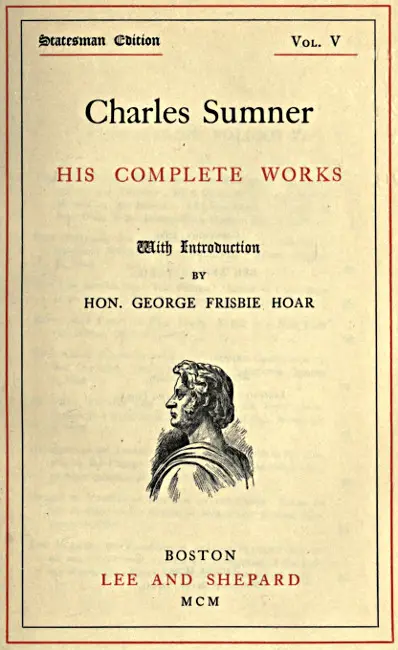
"Charles Sumner: his complete works, volume 05 (of 20)" by Charles Sumner is a historical collection of speeches and writings from the prominent abolitionist and senator, compiled during the mid-19th century. This volume particularly focuses on the moral and political arguments against slavery, documenting Sumner's impassioned calls for justice, liberty, and ethical governance in a nation grappling with the deeply entrenched institution of slavery. As a key figure in the fight for abolition, Sumner’s essays and addresses reveal not only his philosophy but also the broader socio-political climate of the time. The opening of this volume presents an address by Sumner, delivered before a large audience in New York in 1855, consisting of powerful rhetoric discussing the necessity, practicability, and dignity of the antislavery cause. He reflects on the transformation of public sentiment regarding slavery from its past oppression to a burgeoning movement for freedom, emphasizing the moral obligation to end the injustice. Sumner points out the legal and social dynamics of slavery while advocating for a unified front among the North to combat the tyranny of the slave system and its impact on both enslaved individuals and society at large. Through this address, he lays the groundwork for a compelling argument that resonates with the urgency and ethical imperatives of his time.
Introduction adapted from the source catalogue; source summaries may be automatically generated.
Free to read · English · 112,653 words · No account needed
MAKE TIME FOR A GOOD BOOK
On by default. Untick to stop anonymous reading totals. Each page counts after 10 seconds in view. How this works.
Anonymous counting is on unless you have switched it off.
The Committee, after taking evidence, made a report, signed by Mr. Campbell, Mr. Spinner, and Mr. Pennington, which, after setting forth the facts, concludes with the following resolutions.
“Resolved, That Preston S. Brooks be, and he is forthwith, expelled from this House as a Representative from the State of South Carolina.
“Resolved, That this House hereby declare its disapprobation of the said act of Henry A. Edmundson and Lawrence M. Keitt in regard to the said assault.”
A minority report, signed by Mr. Cobb and Mr. Greenwood, concluded with the following resolution.
“Resolved, That this House has no jurisdiction over the assault alleged to have been committed by the Hon. Preston S. Brooks, a member of this House from the State of South Carolina, upon the Hon. Charles Sumner, a Senator from the State of Massachusetts, and therefore deem it improper to express any opinion on the subject.”
In the House, the substitute moved by Mr. Cobb was lost,--yeas 66, nays 145. The resolution of expulsion was lost,--yeas 121, nays 95,--the two thirds required for expulsion not voting in favor thereof. The other resolution, declaring disapprobation of the act of Henry A. Edmundson and Lawrence M. Keitt, was divided, and the censure of Keitt was voted,--yeas 106, nays 96; that of Edmundson was lost,--yeas 60, nays 136. A long preamble, setting forth the facts, was adopted,--yeas 104, nays 83.[143]
Immediately after the vote upon the resolution of expulsion, Mr. Brooks, with some difficulty, obtained leave to address the House. Mr. Giddings objected, but, at the request of friends, withdrew his objection, contrary to his own judgment. In the course of a speech vindicating his conduct, Mr. Brooks took credit to himself for not beginning a revolution.
“Sir, I cannot, on my own account, assume the responsibility, in the face of the American people, of commencing a line of conduct which in my heart of hearts I believe would result in subverting the foundations of this Government and in drenching this Hall in blood. No act of mine, and on my personal account, shall inaugurate revolution; but when you, Mr. Speaker, return to your own home, and hear the people of the great North--and they are a great people--speak of me as a bad man, you will do me the justice to say that a blow struck by me at this time would be followed by revolution,--and this I know. [Applause and hisses in the gallery.]”
Afterwards he seemed to take credit for using the instrument he did.
Your reading position is saved on this browser. Take it to another device with a library code. Reading pages adapt to text, rather than matching a printed edition.
Charles Sumner

Charles Sumner

Charles Sumner

Charles Sumner
BEHIND THE BOOK
This eBook is for the use of anyone anywhere in the United States and most other parts of the world at no cost and with almost no restrictions whatsoever. You may copy it, give it away or re-use it under the terms of the Project Gutenberg License included with this eBook or online at www.gutenberg.org. If you are not located in the United States, you will have to check the laws of the country where you are located before using this eBook. Read the source licence.
The original source file, including credits and licence, is retained by this library. Request an original-format copy at no charge. Please include the book title and Project Gutenberg identifier #48035.
KEEP YOUR CURIOSITY GOING

David Patterson (Spirit) Hatch

David Patterson (Spirit) Hatch

David Patterson (Spirit) Hatch
Cécile Tormay

Moritz Busch
John L. Ransom