
Charles Sumner: his complete works, volume 20 (of 20)
Charles Sumner
THE CLASSIC COLLECTION · 1900
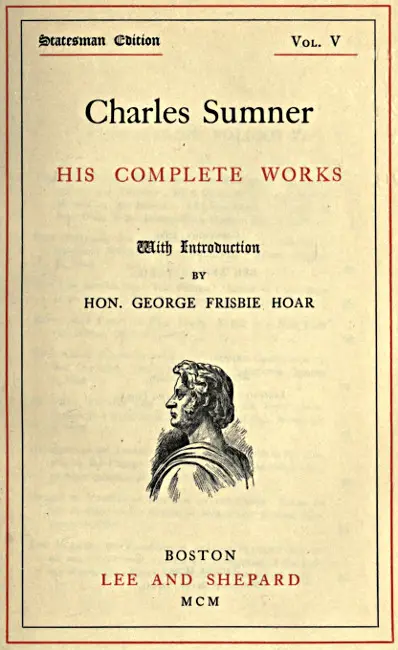
"Charles Sumner: his complete works, volume 05 (of 20)" by Charles Sumner is a historical collection of speeches and writings from the prominent abolitionist and senator, compiled during the mid-19th century. This volume particularly focuses on the moral and political arguments against slavery, documenting Sumner's impassioned calls for justice, liberty, and ethical governance in a nation grappling with the deeply entrenched institution of slavery. As a key figure in the fight for abolition, Sumner’s essays and addresses reveal not only his philosophy but also the broader socio-political climate of the time. The opening of this volume presents an address by Sumner, delivered before a large audience in New York in 1855, consisting of powerful rhetoric discussing the necessity, practicability, and dignity of the antislavery cause. He reflects on the transformation of public sentiment regarding slavery from its past oppression to a burgeoning movement for freedom, emphasizing the moral obligation to end the injustice. Sumner points out the legal and social dynamics of slavery while advocating for a unified front among the North to combat the tyranny of the slave system and its impact on both enslaved individuals and society at large. Through this address, he lays the groundwork for a compelling argument that resonates with the urgency and ethical imperatives of his time.
Introduction adapted from the source catalogue; source summaries may be automatically generated.
Free to read · English · 112,653 words · No account needed
MAKE TIME FOR A GOOD BOOK
On by default. Untick to stop anonymous reading totals. Each page counts after 10 seconds in view. How this works.
Anonymous counting is on unless you have switched it off.
With regret I come again upon the Senator from South Carolina [Mr. BUTLER], who, omnipresent in this debate,[126] overflows with rage at the simple suggestion that Kansas has applied for admission as a State, and, with incoherent phrase, discharges the loose expectoration of his speech, now upon her representative, and then upon her people. There was no extravagance of the ancient Parliamentary debate which he did not repeat; nor was there any possible deviation from truth which he did not make,--with so much of passion, I gladly add, as to save him from the suspicion of intentional aberration. But the Senator touches nothing which he does not disfigure--with error, sometimes of principle, sometimes of fact. He shows an incapacity of accuracy, whether in stating the Constitution or in stating the law, whether in details of statistics or diversions of scholarship. He cannot ope his mouth, but out there flies a blunder. Surely he ought to be familiar with the life of Franklin; and yet he referred to this household character, while acting as agent of our fathers in England, as above suspicion: and this was done that he might give point to a false contrast with the agent of Kansas,[127]--not knowing, that, however the two may differ in genius and fame, they are absolutely alike in this experience: that Franklin, when intrusted with the petition of Massachusetts Bay, was assaulted by a foul-mouthed speaker where he could not be heard in defence, and denounced as “thief,” even as the agent of Kansas is assaulted on this floor, and denounced as “forger.” And let not the vanity of the Senator be inspired by parallel with the British statesmen of that day; for it is only in hostility to Freedom that any parallel can be found.
But it is against the people of Kansas that the sensibilities of the Senator are particularly aroused. Coming, as he announces, “from a State,”--ay, Sir, from South Carolina,--he turns with lordly disgust from this newly formed community, which he will not recognize even as “a member of the body politic.”[128] Pray, Sir, by what title does he indulge in this egotism? Has he read the history of the “State” which he represents? He cannot, surely, forget its shameful imbecility from Slavery, confessed throughout the Revolution, followed by its more shameful assumptions for Slavery since. He cannot forget its wretched persistence in the slave-trade, as the very apple of its eye, and the condition of its participation in the Union. He cannot forget its Constitution, which is republican only in name, confirming power in the hands of the few, and founding the qualifications of its legislators on “a settled freehold estate of five hundred acres of land and ten negroes.”[129] And yet the Senator to whom this “State” has in part committed the guardianship of its good name, instead of moving with backward-treading steps to cover its nakedness, rushes forward, in the very ecstasy of madness, to expose it, by provoking comparison with Kansas. South Carolina is old; Kansas is young. South Carolina counts by centuries, where Kansas counts by years. But a beneficent example may be born in a day; and I venture to declare, that against the two centuries of the older “State” may be set already the two years of trial, evolving corresponding virtue, in the younger community. In the one is the long wail of Slavery; in the other, the hymn of Freedom. And if we glance at special achievement, it will be difficult to find anything in the history of South Carolina which presents so much of heroic spirit in an heroic cause as shines in that repulse of the Missouri invaders by the beleaguered town of Lawrence, where even the women gave their effective efforts to Freedom. The matrons of Rome who poured their jewels into the treasury for the public defence, the wives of Prussia who with delicate fingers clothed their defenders against French invasion, the mothers of our own Revolution who sent forth their sons covered over with prayers and blessings to combat for Human Rights, did nothing of self-sacrifice truer than did these women on this occasion. Were the whole history of South Carolina blotted out of existence, from its very beginning down to the day of the last election of the Senator to his present seat on this floor, civilization might lose--I do not say how little, but surely less than it has already gained by the example of Kansas, in that valiant struggle against oppression, and in the development of a new science of emigration. Already in Lawrence alone are newspapers and schools, including a High School,--and throughout this infant Territory there is more of educated talent, in proportion to its inhabitants, than in his vaunted “State.” Ah, Sir, I tell the Senator, that Kansas, welcomed as a Free State, “a ministering angel shall be” to the Republic, when South Carolina, in the cloak of darkness which she hugs, “lies howling.”[130]
Your reading position is saved on this browser. Take it to another device with a library code. Reading pages adapt to text, rather than matching a printed edition.
Charles Sumner

Charles Sumner

Charles Sumner

Charles Sumner
BEHIND THE BOOK
This eBook is for the use of anyone anywhere in the United States and most other parts of the world at no cost and with almost no restrictions whatsoever. You may copy it, give it away or re-use it under the terms of the Project Gutenberg License included with this eBook or online at www.gutenberg.org. If you are not located in the United States, you will have to check the laws of the country where you are located before using this eBook. Read the source licence.
The original source file, including credits and licence, is retained by this library. Request an original-format copy at no charge. Please include the book title and Project Gutenberg identifier #48035.
KEEP YOUR CURIOSITY GOING

David Patterson (Spirit) Hatch

David Patterson (Spirit) Hatch

David Patterson (Spirit) Hatch
Cécile Tormay

Moritz Busch
John L. Ransom