
Charles Sumner: his complete works, volume 20 (of 20)
Charles Sumner
THE CLASSIC COLLECTION · 1900
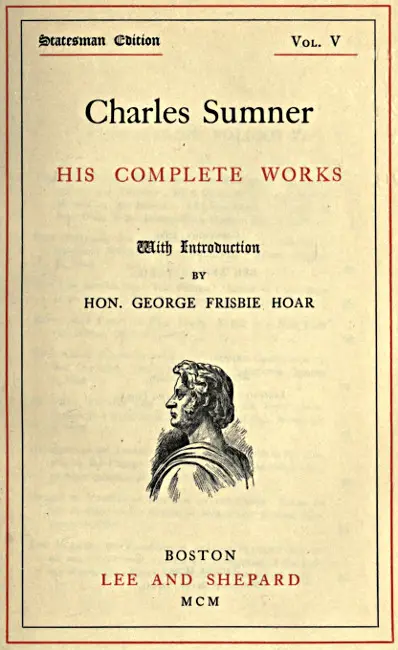
"Charles Sumner: his complete works, volume 05 (of 20)" by Charles Sumner is a historical collection of speeches and writings from the prominent abolitionist and senator, compiled during the mid-19th century. This volume particularly focuses on the moral and political arguments against slavery, documenting Sumner's impassioned calls for justice, liberty, and ethical governance in a nation grappling with the deeply entrenched institution of slavery. As a key figure in the fight for abolition, Sumner’s essays and addresses reveal not only his philosophy but also the broader socio-political climate of the time. The opening of this volume presents an address by Sumner, delivered before a large audience in New York in 1855, consisting of powerful rhetoric discussing the necessity, practicability, and dignity of the antislavery cause. He reflects on the transformation of public sentiment regarding slavery from its past oppression to a burgeoning movement for freedom, emphasizing the moral obligation to end the injustice. Sumner points out the legal and social dynamics of slavery while advocating for a unified front among the North to combat the tyranny of the slave system and its impact on both enslaved individuals and society at large. Through this address, he lays the groundwork for a compelling argument that resonates with the urgency and ethical imperatives of his time.
Introduction adapted from the source catalogue; source summaries may be automatically generated.
Free to read · English · 112,653 words · No account needed
MAKE TIME FOR A GOOD BOOK
On by default. Untick to stop anonymous reading totals. Each page counts after 10 seconds in view. How this works.
Anonymous counting is on unless you have switched it off.
In support of Slavery, it is the habit to pervert texts and to invent authority. Even St. Paul is vouched for a wrong which his Christian life rebukes. Much stress is now laid on his example, as it appears in the Epistle to Philemon, written at Rome, and sent by Onesimus, a servant. From the single chapter constituting the entire epistle I take the following ten verses, most strangely invoked for Slavery.
“I beseech thee for my son Onesimus, whom I have begotten in my bonds; which in time past was to thee unprofitable, but now profitable to thee and to me; whom I have sent again. Thou, therefore, receive him, that is, mine own bowels: whom I would have retained with me, that in thy stead he might have ministered unto me in the bonds of the gospel; but without thy mind would I do nothing; that thy benefit should not be as it were of necessity, but willingly. For perhaps he therefore departed for a season that thou shouldest receive him forever; not now as a servant, but above a servant, a brother beloved, specially to me, but how much more unto thee, both in the flesh and in the Lord! If thou count me, therefore, a partner, receive him as myself. If he hath wronged thee, or oweth thee aught, put that on mine account: I Paul have written it with mine own hand, I will repay it: albeit I do not say to thee how thou owest unto me even thine own self besides.”[10]
Out of this affectionate epistle, where St. Paul calls the converted servant, Onesimus, his son, precisely as in another epistle he calls Timothy his son, Slavery is elaborately vindicated, and the great Apostle to the Gentiles made the very tutelary saint of the Slave-Hunter. Now, without invoking his real judgment of Slavery from his condemnation on another occasion of “men-stealers,” or what I prefer to call slave-hunters, in company with “murderers of fathers and murderers of mothers,” and without undertaking to show that the present epistle, when truly interpreted, is a protest against Slavery and a voice for Freedom,--all of which might be done,--I content myself with calling attention to two things, apparent on its face, and in themselves an all-sufficient response. First, while it appears that Onesimus had been in some way the servant of Philemon, it does not appear that he was ever held as chattel; and how gross and monstrous is the effort to derive such a wrong out of words, whether in the Constitution of our country or in the Bible, which do not explicitly, unequivocally, and exclusively define this wrong! Secondly, in charging Onesimus with this epistle to Philemon, the Apostle recommends him as “not now a servant, but above a servant, a brother beloved,” and he enjoins upon his correspondent the hospitality due to a freeman, saying expressly, “If thou count me, therefore, a partner, receive him as myself”: ay, Sir, not as slave, not even as servant, but as brother beloved, even as the Apostle himself. Thus, with apostolic pen, wrote Paul to his disciple, Philemon. In these words of gentleness, benediction, and equal rights, dropping with celestial, soul-awakening power, there can be no justification for a conspiracy, which, beginning with the treachery of Iscariot and the temptation of pieces of silver, seeks, by fraud, brutality, and violence, through officers of the law armed to the teeth, like pirates, and amidst soldiers who degrade their uniform, to hurl a fellow-man back into the lash-resounding den of American Slavery; and when any one thus perverts this beneficent example, allow me to say that he gives too much occasion to doubt his intelligence or his sincerity.
Your reading position is saved on this browser. Take it to another device with a library code. Reading pages adapt to text, rather than matching a printed edition.
Charles Sumner

Charles Sumner

Charles Sumner

Charles Sumner
BEHIND THE BOOK
This eBook is for the use of anyone anywhere in the United States and most other parts of the world at no cost and with almost no restrictions whatsoever. You may copy it, give it away or re-use it under the terms of the Project Gutenberg License included with this eBook or online at www.gutenberg.org. If you are not located in the United States, you will have to check the laws of the country where you are located before using this eBook. Read the source licence.
The original source file, including credits and licence, is retained by this library. Request an original-format copy at no charge. Please include the book title and Project Gutenberg identifier #48035.
KEEP YOUR CURIOSITY GOING

David Patterson (Spirit) Hatch

David Patterson (Spirit) Hatch

David Patterson (Spirit) Hatch
Cécile Tormay

Moritz Busch
John L. Ransom