
Charles Sumner: his complete works, volume 20 (of 20)
Charles Sumner
THE CLASSIC COLLECTION · 1900
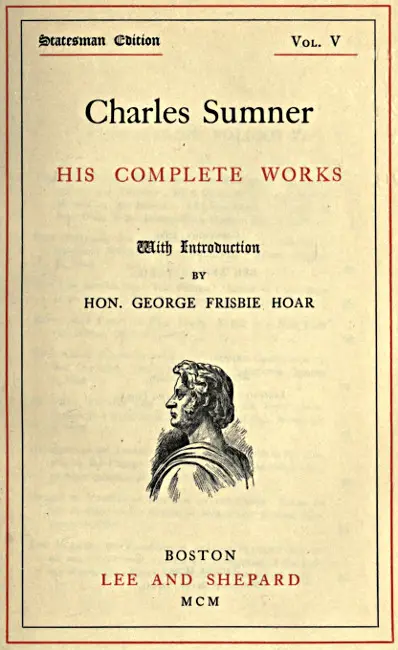
"Charles Sumner: his complete works, volume 05 (of 20)" by Charles Sumner is a historical collection of speeches and writings from the prominent abolitionist and senator, compiled during the mid-19th century. This volume particularly focuses on the moral and political arguments against slavery, documenting Sumner's impassioned calls for justice, liberty, and ethical governance in a nation grappling with the deeply entrenched institution of slavery. As a key figure in the fight for abolition, Sumner’s essays and addresses reveal not only his philosophy but also the broader socio-political climate of the time. The opening of this volume presents an address by Sumner, delivered before a large audience in New York in 1855, consisting of powerful rhetoric discussing the necessity, practicability, and dignity of the antislavery cause. He reflects on the transformation of public sentiment regarding slavery from its past oppression to a burgeoning movement for freedom, emphasizing the moral obligation to end the injustice. Sumner points out the legal and social dynamics of slavery while advocating for a unified front among the North to combat the tyranny of the slave system and its impact on both enslaved individuals and society at large. Through this address, he lays the groundwork for a compelling argument that resonates with the urgency and ethical imperatives of his time.
Introduction adapted from the source catalogue; source summaries may be automatically generated.
Free to read · English · 112,653 words · No account needed
MAKE TIME FOR A GOOD BOOK
On by default. Untick to stop anonymous reading totals. Each page counts after 10 seconds in view. How this works.
Anonymous counting is on unless you have switched it off.
For a long time, emigration to the West, from the Northern and Middle States, but particularly from New England, has been of marked significance. In quest of better homes, annually it presses to the unsettled lands, in numbers counted by tens of thousands; but this has been done heretofore with little knowledge, and without guide or counsel. Finally, when, by the establishment of a government in Kansas, the tempting fields of that central region were opened to the competition of peaceful colonization, and especially when it was declared that the question of Freedom or Slavery there was to be determined by the votes of actual settlers, then at once was organization enlisted as an effective agency in quickening and conducting the emigration impelled thither, and, more than all, in providing homes on its arrival.
The Company was first constituted under an Act of the Legislature of Massachusetts, April 26, 1854, some weeks prior to the passage of the Nebraska Bill. The original act of incorporation was subsequently abandoned, and a new charter received in February, 1855, in which the objects of the Society are thus declared:--
“For the purposes of directing emigration westward, and aiding in providing accommodations for the emigrants after arriving at their places of destination.”[86]
At any other moment an association for these purposes would take its place, by general consent, among philanthropic experiments; but Crime is always suspicious, and shakes, like a sick man, merely at the pointing of a finger. The conspirators against Freedom in Kansas became alarmed at the movement. Their wicked plot was about to fail. To help themselves, they denounced the Emigrant Aid Company; and their denunciations, after finding an echo in the President, are repeated, with much particularity, on this floor, in the formal report of your Committee.
The falsehood of the whole accusation will appear in illustrative
instances.
A charter is set out, section by section, which, though originally granted, was subsequently abandoned, and is not in reality the charter of the Company, but is materially unlike it.
The Company is represented as “a powerful corporation, with a capital of five millions,” when, by its actual charter, it is not allowed to hold property above one million, and, in point of fact, its capital has not exceeded one hundred thousand dollars.
Then, again, it is suggested, if not alleged, that this enormous capital, which I have already said does not exist, is invested in “cannon and rifles, in powder and lead,” and “implements of war,” all of which, whether alleged or suggested, is absolutely false. The officers of the Company authorize me to give this whole assumption a point-blank denial.
Your reading position is saved on this browser. Take it to another device with a library code. Reading pages adapt to text, rather than matching a printed edition.
Charles Sumner

Charles Sumner

Charles Sumner

Charles Sumner
BEHIND THE BOOK
This eBook is for the use of anyone anywhere in the United States and most other parts of the world at no cost and with almost no restrictions whatsoever. You may copy it, give it away or re-use it under the terms of the Project Gutenberg License included with this eBook or online at www.gutenberg.org. If you are not located in the United States, you will have to check the laws of the country where you are located before using this eBook. Read the source licence.
The original source file, including credits and licence, is retained by this library. Request an original-format copy at no charge. Please include the book title and Project Gutenberg identifier #48035.
KEEP YOUR CURIOSITY GOING

David Patterson (Spirit) Hatch

David Patterson (Spirit) Hatch

David Patterson (Spirit) Hatch
Cécile Tormay

Moritz Busch
John L. Ransom