
Charles Sumner: his complete works, volume 20 (of 20)
Charles Sumner
THE CLASSIC COLLECTION · 1900
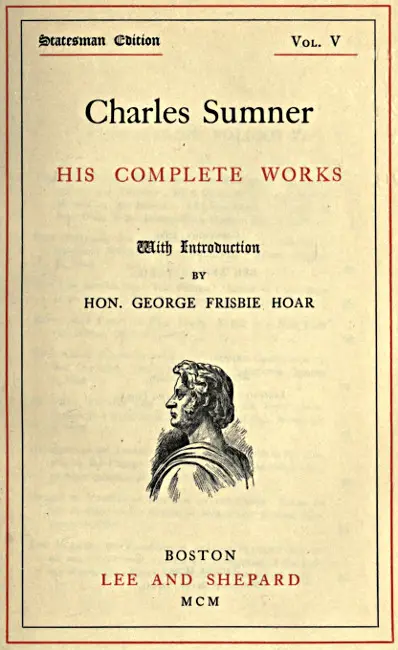
"Charles Sumner: his complete works, volume 05 (of 20)" by Charles Sumner is a historical collection of speeches and writings from the prominent abolitionist and senator, compiled during the mid-19th century. This volume particularly focuses on the moral and political arguments against slavery, documenting Sumner's impassioned calls for justice, liberty, and ethical governance in a nation grappling with the deeply entrenched institution of slavery. As a key figure in the fight for abolition, Sumner’s essays and addresses reveal not only his philosophy but also the broader socio-political climate of the time. The opening of this volume presents an address by Sumner, delivered before a large audience in New York in 1855, consisting of powerful rhetoric discussing the necessity, practicability, and dignity of the antislavery cause. He reflects on the transformation of public sentiment regarding slavery from its past oppression to a burgeoning movement for freedom, emphasizing the moral obligation to end the injustice. Sumner points out the legal and social dynamics of slavery while advocating for a unified front among the North to combat the tyranny of the slave system and its impact on both enslaved individuals and society at large. Through this address, he lays the groundwork for a compelling argument that resonates with the urgency and ethical imperatives of his time.
Introduction adapted from the source catalogue; source summaries may be automatically generated.
Free to read · English · 112,653 words · No account needed
MAKE TIME FOR A GOOD BOOK
On by default. Untick to stop anonymous reading totals. Each page counts after 10 seconds in view. How this works.
Anonymous counting is on unless you have switched it off.
“In consequence of an attack upon the Court House last night, for the purpose of rescuing a fugitive slave under arrest, and in which one of my own guards was killed, I have availed myself of the resources of the United States, placed under my control by letter from the War and Navy Departments in 1851, and now have two companies of troops from Fort Independence stationed in the Court House. Everything is now quiet. The attack was repulsed by my own guard.
“United States Marshal, Boston, Mass.”
“WASHINGTON, May 27, 1854.
“To WATSON FREEMAN, United States Marshal, Boston, Mass.
“Your conduct is approved. The law must be executed.
“WASHINGTON, May 30, 1854.
“To HON. B. F. HALLETT, Boston, Mass.
“What is the state of the case of Burns?
“Private Secretary of the President.”
“WASHINGTON, May 31, 1854.
“To B. F. HALLETT, United States Attorney, Boston, Mass.
“Incur any expense deemed necessary by the Marshal and yourself
for City Military, or otherwise, to insure the execution of the
law.
The President was not content with the forces then on hand in the neighborhood. Other posts also were put under requisition. Two companies of national troops, stationed at New York, were kept under arms, ready at any moment to proceed to Boston; and the Adjutant-General of the Army was directed to repair to the scene, there to superintend the execution of the statute. All this was done for the sake of Slavery. But during long months of menace suspended over the Free Soil of Kansas, breaking forth in successive invasions, the President folds his hands in complete listlessness, or, if he moves at all, it is only to encourage the robber propagandists.
And now the intelligence of the country is insulted by the Apology, that the President had no power to interfere. Why, Sir, to make this confession is to confess our Government a practical failure, which I will never do,--except, indeed, as it is administered now. No, Sir, the imbecility of the Chief Magistrate shall not be charged upon American Institutions. Where there is a will, there is a way; and in his case, had the will existed, there would have been a way, easy and triumphant, to guard against the Crime we deplore. His powers are in every respect ample; and this I prove by the statute-book. By the Act of Congress of 28th February, 1795, it is enacted, “that, whenever the laws of the United States shall be opposed, or the execution thereof obstructed, in any State, by combinations too powerful to be suppressed by the ordinary course of judicial proceedings, or by the powers vested in the marshals by this Act, it shall be lawful for the President of the United States to call forth the militia.”[81] By the supplementary Act of 3d March, 1807, in all cases where he is authorized to call forth the militia “for the purpose of causing the laws to be duly executed,” the President is further empowered, in any State or Territory, “to employ for the same purposes such part of the land or naval force of the United States as shall be judged necessary.”[82] There is the letter of the law; and you will please to mark the power conferred. In no case, where the laws of the United States are opposed, or their execution obstructed, is the President constrained to wait for the requisition of a Governor, or even the petition of a citizen. Just so soon as he learns the fact, no matter by what channel, he is invested by law with full power to counteract it. True it is, that, when the laws of a State are obstructed, he can interfere only on the application of the Legislature of such State, or of the Executive, when the Legislature cannot be convened; but when the National laws are obstructed, no such preliminary application is necessary. It is his high duty, under his oath of office, to see that they are executed, and, if need be, by the National forces.
Your reading position is saved on this browser. Take it to another device with a library code. Reading pages adapt to text, rather than matching a printed edition.
Charles Sumner

Charles Sumner

Charles Sumner

Charles Sumner
BEHIND THE BOOK
This eBook is for the use of anyone anywhere in the United States and most other parts of the world at no cost and with almost no restrictions whatsoever. You may copy it, give it away or re-use it under the terms of the Project Gutenberg License included with this eBook or online at www.gutenberg.org. If you are not located in the United States, you will have to check the laws of the country where you are located before using this eBook. Read the source licence.
The original source file, including credits and licence, is retained by this library. Request an original-format copy at no charge. Please include the book title and Project Gutenberg identifier #48035.
KEEP YOUR CURIOSITY GOING

David Patterson (Spirit) Hatch

David Patterson (Spirit) Hatch

David Patterson (Spirit) Hatch
Cécile Tormay

Moritz Busch
John L. Ransom