
Charles Sumner: his complete works, volume 20 (of 20)
Charles Sumner
THE CLASSIC COLLECTION · 1900
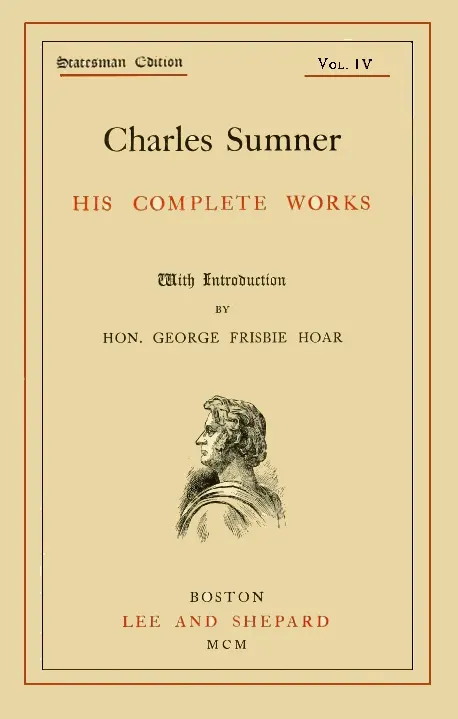
"Charles Sumner: his complete works, Volume 04 (of 20)" by Charles Sumner is a historical collection written in the late 19th century. This volume encompasses speeches and writings of Charles Sumner, a prominent abolitionist and senator, focusing on his views and advocacy regarding key political issues of his time, notably slavery and civil rights. At the start of this volume, the contents are outlined, revealing a series of speeches delivered by Sumner on various topics such as the legacy of Andrew J. Downing, the necessity of freedom, and the political landscape surrounding the issue of slavery. The opening portion includes a speech where Sumner argues for compensation to Downing's widow, establishing a precedent for valuing contributions of individuals to society. It also teases a later speech made at a Free-Soil Party convention, highlighting Sumner's commitment to freedom and his criticism of existing political parties that supported slavery, setting a tone of moral urgency and political activism that characterizes his work throughout this collection.
Introduction adapted from the source catalogue; source summaries may be automatically generated.
Free to read · English · 101,030 words · No account needed
MAKE TIME FOR A GOOD BOOK
On by default. Untick to stop anonymous reading totals. Each page counts after 10 seconds in view. How this works.
Anonymous counting is on unless you have switched it off.
Here, Sir, let it be remembered that the friends of Freedom are not open to any charge of aggression. They are now standing on the defensive, guarding the early intrenchments thrown up by our fathers. No proposition to abolish Slavery anywhere is now before you, but, on the contrary, a proposition to abolish Freedom. The term Abolitionist, so often applied in reproach, justly belongs, on this occasion, to him who would overthrow this well-established landmark. He is, indeed, no Abolitionist of Slavery; let him be called, Sir, Abolitionist of Freedom. For myself, whether with many or few, my place is taken. Even if alone, my feeble arm should not be wanting as a bar against this outrage.
On two distinct grounds, "strong both against the deed," I arraign it: First, in the name of Public Faith, as an infraction of solemn obligations, assumed beyond recall by the South, on the admission of Missouri into the Union as a Slave State. Secondly, I arraign it in the name of Freedom, as an unjustifiable departure from the original Antislavery policy of our fathers. These two heads I shall consider in their order, glancing, under the latter, at the objections to the Prohibition of Slavery in the Territories.
Before I approach the argument, indulge me with a few preliminary words on the character of this proposition. Slavery is the forcible subjection of one human being, in person, labor, and property, to the will of another. In this simple statement is involved its whole injustice. There is no offence against religion, against morals, against humanity, which, in the license of this enormity, may not stalk "unwhipped of justice." For the husband and wife there is no marriage; for the mother there is no assurance that her infant child will not be ravished from her breast; for all who bear the name of Slave there is nothing that they can call their own. Without a father, without a mother, almost without a God, the slave has nothing but a master. It would be contrary to that Rule of Right which is ordained by God, if such a system, though mitigated often by patriarchal kindness, and by plausible physical comfort, could be otherwise than pernicious. It is confessed that the master suffers not less than the slave. And this is not all. The whole social fabric is disorganized; labor loses its dignity; industry sickens; education finds no schools; and all the land of Slavery is impoverished. And now, Sir, when the conscience of mankind is at last aroused to these things, when, throughout the civilized world, a slave-dealer is a by-word and a reproach, we, as a nation, are about to open a new market to the traffickers in flesh that haunt the shambles of the South. Such an act, at this time, is removed from all reach of that palliation often vouchsafed to Slavery. This wrong, we are speciously told by those who seek to defend it, is not our original sin. It was entailed upon us, so we are instructed, by our ancestors; and the responsibility is often thrown, with exultation, upon the mother country. Now, without stopping to inquire into the value of this apology, which is never adduced in behalf of other abuses, and which availed nothing against that kingly power imposed by the mother country, but overthrown by our fathers, it is sufficient for the present purpose to know that it is now proposed to make Slavery our own original act. Here is a fresh case of actual transgression, which we cannot cast upon the shoulders of any progenitors, nor upon any mother country, distant in time or place. The Congress of the United States, the people of the United States, at this day, in this vaunted period of light, will be responsible for it, so that it shall be said hereafter, so long as the dismal history of Slavery is read, that in the year of Christ 1854 a new and deliberate act was passed by which a vast territory was opened to its incursions.
Your reading position is saved on this browser. Take it to another device with a library code. Reading pages adapt to text, rather than matching a printed edition.
Charles Sumner

Charles Sumner

Charles Sumner

Charles Sumner
BEHIND THE BOOK
This eBook is for the use of anyone anywhere in the United States and most other parts of the world at no cost and with almost no restrictions whatsoever. You may copy it, give it away or re-use it under the terms of the Project Gutenberg License included with this eBook or online at www.gutenberg.org. If you are not located in the United States, you will have to check the laws of the country where you are located before using this eBook. Read the source licence.
The original source file, including credits and licence, is retained by this library. Request an original-format copy at no charge. Please include the book title and Project Gutenberg identifier #45954.
KEEP YOUR CURIOSITY GOING

David Patterson (Spirit) Hatch

David Patterson (Spirit) Hatch

David Patterson (Spirit) Hatch
Cécile Tormay

Moritz Busch
John L. Ransom